


Between textbooks, whiteboards and videos in class, most of the information that’s presented to kids at school is visual. So what does that mean for a child who can’t see clearly?
In countries where eye health care is difficult to access, a simple eye condition like myopia (nearsightedness) can cause a student to fall behind and even drop out of school, which in turn could affect the child’s income for the rest of his or her life.
Ensuring that Quality Education is available to all children is one of the 17 Sustainable Development Goals set by the United Nations’ 2030 Agenda. We’re working towards this goal by ensuring that more children get the eye health care they need to thrive at school and take charge of their education.
According to a survey by the World Bank, children with visual impairments in sub-Saharan Africa are five percentage points less likely to ever be enrolled in school or to complete primary school. They are six percentage points less likely to be literate.1
The links between academic performance and visual impairment can be harder to draw given the complexity of the issue, but one survey from francophone countries in Africa found that primary school students – who self-reported difficulties with their vision – performed worse on standardized tests in math and reading in all but one of the 10 participating countries.2 Similarly, a Stanford study of 20,000 fourth and fifth graders in rural China found that eyeglasses boosted the standardized test scores by 18 per cent over six months.3

Even studies from higher income countries, where children have better access to eye health care, show that students with poor vision tend to read more slowly than their peers and are more likely to report that they don’t like reading.4 Visual fatigue is a likely culprit for both, and the resulting headaches and tiredness that these kids experience are also thought to play a role in behavioral issues at school.
Roughly 22.16 million children ages 14 and under have Moderate to Severe Vision Impairment (MSVI) and 44.6 million have mild vision impairment, according to a panel of global health professionals called the Vision Loss Expert Group.5
Only 20-50 per cent of the children who need prescription eyeglasses worldwide actually own a pair.6 Often, this is due to a lack of access to eye health care. In rural, remote or underserved communities, especially in low- and middle-income countries, many kids don’t get regular eye exams or have access to prescription eyeglasses and other treatment. This could be due to financial constraints, lack of education about the importance of eye health, or simply because there aren’t any optometry clinics nearby.
Across lower-income communities, schools may also lack electricity or lighting, making it even more difficult for a student with vision impairment to read information written on a blackboard. Lack of adequate lighting at home can also cause difficulties in completing homework. For a secondary student who is already falling behind in class, not being able to finish homework in a timely manner could end their school career, and cause them to drop out early.

Isaac Baffoe, who manages our school eye health programs in Ghana, says one student’s story really stuck with him. The girl reported that her eyesight started to fade when she was about 12 years old, and by age 15 she had severe vision impairment. For years, she relied on a classmate to read the blackboard out loud to her during class. Isaac often wonders what would have happened to her if her friend hadn’t been so helpful, or even more importantly, if our school eye health program hadn’t reached her school and she hadn’t gotten prescription eyeglasses.
Our field staff hear a lot about the difficulties that students face before they get eyeglasses. One student in Ethiopia reported that she and her friend were frequently scolded when the friend read the blackboard notes aloud to her. Others reported that their grades dropped sharply, or that they lost interest in their studies. Many children say that they asked their parents to take them to the eye doctor, but due to tight finances or difficulty in reaching a clinic, they weren’t able to get the eye care they needed.
The good news is that, with your ongoing support, we are changing all of this – one school and one child at a time.

Part of our goal at Operation Eyesight is to reach every single member of a community with eye health care, ensuring that nobody gets left behind. Increasingly, we’re screening school-aged children for eye issues right in the classroom.
In 2023 alone, our school eye health programs helped us screen more than 240,000 students in Bangladesh, Ethiopia, Ghana, India, Kenya, Nepal and Zambia.
In Kenya, we’ve partnered with the United States Agency for International Development’s (USAID’s) Child Blindness Program and Peek Vision to deliver an innovative program where teachers are trained to do the initial eye health screenings using a simple smartphone app. This allows us to screen more students overall, while still providing referrals to those children identified with eye problems to get a complete eye exam with a healthcare professional.

In Ghana, we train community health nurses to help deliver our school eye health programs, also in partnership with USAID and with funding from the Church of Jesus Christ of Latter-day Saints and Latter-day Saints Charities. In addition to conducting school eye health screenings, the nurses provide the students with eye health education sessions, where they learn how to prevent eye injuries and infections and learn about various conditions, like refractive errors (the need for eyeglasses). By making sure children have basic eye health information and know where to go for subsidized eye care, whole families are made aware of the services that are available to them.
Isaac, who has been on hand during several of these school screening events, says the children are always very eager to get involved. “The children show lots of interest. They want to participate,” he explains. “During all the screenings we’ve attended to audit, the children are very cooperative, they really want to know what is going on.”
He adds that it’s not just the students who are happy with getting a pair of eyeglasses.
“It’s not only a relief to the children, but also to the teachers,” he says, “because it also made their work difficult to spend extra time with these children who were struggling with their studies prior to receiving eyeglasses.”
In November 2020, the borehole in the Zambian village of Kangwa broke down. The COVID-19 pandemic was in full swing, and the need for clean water was more urgent than ever. For Natasha, a teenager who was in high school at the time, the breakdown had devastating consequences. As the family member tasked with fetching water, Natasha now had to walk several kilometres each day to complete the chore, meaning she could no longer attend school. She wasn’t alone – other teenage girls in her community were in the same situation.

When our team in Zambia found out about the broken borehole, they sprang into action and quickly got it fixed. They were well equipped to do so, because we have been working with communities to repair and drill boreholes for many years to curb the spread of trachoma.
Trachoma is a bacterial eye infection that’s common in areas with water shortages and crowded living conditions. The bacteria spreads easily through contact with eye discharge from infected people on hands and clothing, and also through direct transmission by flies. If left untreated, it can cause severe pain, vision loss and even blindness. In fact, it is the leading infectious cause of blindness worldwide.
When we work with communities in areas of Zambia, Ethiopia and Kenya where trachoma is endemic, we ensure that water and sanitation issues are part of our intervention. In communities like Kangwa, this means training local volunteer teams to help maintain and repair broken boreholes, and training community WASH (Water, Sanitation and Hygiene) teams to educate their neighbours about preventing trachoma transmission in the home.

In order to ensure that girls have equal access to quality education, clean water and sanitation facilities must be part of the solution. (Watch this video to learn more about the ripple effects of clean water.)
Myopia (nearsightedness) rates are on the rise all over the world. In 2020, the global prevalence was 30 per cent. It’s estimated to rise to 50 per cent by 2050.7
In China, where the rise in myopia in children is being described as an epidemic, the government has rolled out a nation-wide strategy to curb the growth, which includes school-based eye screenings, public health education campaigns, a reduction in homework and an increase in time spent outdoors.8
As suggested by China’s strategies, many of the factors contributing to the rise of myopia are likely due to modern lifestyles: more time spent indoors, doing near-work like homework, and more time spent parked in front of digital devices.
But there may be more at play in the phenomenon, including environmental risks like increasing urbanization and changing diets. As low- to middle-income countries become more urbanized and educational pressures mount, children everywhere are at increased risk of developing the refractive error. In parts of Africa and Asia where families already face difficulties accessing eye health care, the gap between eye health services and those in need of treatment will continue to grow.
As part of our 2024-2028 Global Strategy, we are committed to providing eye health care and clean water to more children so that they can take full advantage of any educational opportunities they are presented with. This means integrating WASH projects with school eye health projects and rolling out more school eye health programs across our countries of work.
We have already seen much success with our school eye health programs in countries like Kenya and Ghana, where we’re working with the local ministries of health and education. Now, it’s time to scale our efforts to more schools, more districts and more countries. With your ongoing support, we can expand our reach and improve the quality of life for more kids around the world.
Donate today and help us restore sight and prevent blindness for more children. The Gift of Sight is the gift of education and the gift of opportunity. Thank you for your support!
A group of women and men cluster around a table, peering at an illustration on a digital drawing tablet held up by artist Anil Kumar. The illustration depicts a young girl showing her mother a school certificate. One of the women looks closely at the illustration before making a comment. “The girl should be holding a trophy,” she says. The others agree – a trophy is a better symbol for school achievement than a certificate alone. The artist begins sketching a trophy into the girl’s other hand. The group nods their approval of the change.
The scene above was one of many such moments observed by the Operation Eyesight team during a recent community workshop in the city of Udhampur in northern India. The goal of the workshop was to get input on some new educational materials from members of the communities where they will be used.
The illustration described above is from a series of flash cards that tell the story of a mother with vision problems who doesn’t understand why her daughter has received an award at school because she can’t read the writing on the certificate. The story is meant to jumpstart conversations about why women in the region are often hesitant to seek out eye health care.

Over two days, eight community members from several villages in our project area worked with an Operation Eyesight team that included an artist, a writer, a gender equality specialist and several of our program managers.
“It’s important to note that the community was the driver for these materials,” says Dr. Troy Cunningham, our Country Director for India. “Our experts took the backseat. The images were decided by the community members, the stories were decided by them. Even before the artist and writer sat down with the community, we took them around the villages to meet people with eye problems.”

The new educational materials are just one small part of a larger eye health project we are undertaking in the region. Called “Empowering Women in Rural India by Debunking Feminine Eye Health Myths,” the project was launched in 2022 in partnership with the nearby Rotary Eye and ENT Hospital in Udhampur, and Edmonton’s NorQuest College. The project is being funded by the Inter-Council Network’s FIT program, which stands for “The Fund for Innovation and Transformation”. The program is designed to support Canadian organizations so they can test innovative solutions for advancing gender equality in the Global South, and is funded by Global Affairs Canada.
The Udhampur Block stretches over miles of hilly Himalayan terrain in India’s Union Territory of Jammu and Kashmir. Roads connecting the region’s villages are prone to flooding and landslides. For many, it’s difficult to leave the village to seek any kind of health care, so vision problems often go ignored, especially for women and girls.
What’s more is that there are a number of gender-related eye health myths that also create barriers to seeking medical care. As a result, our team designed a custom project for the region, which includes sending a four-wheel drive mobile vision clinic staffed with an all-female healthcare team into the area. We have also trained local women as community health workers. These health workers use the new educational materials in their daily work.
Here is a snapshot of some of the new materials that our team and the community members have developed.

Jhanoo is the oldest rhinoceros in her clan. She can’t see well because of her cataracts, but she thinks that she is too old to have them treated. The youngest member of the clan, Banoo, convinces her that she should see the local community health worker. After the visit with the health worker, Jhanoo agrees to get cataract surgery, and after the operation she enjoys a more independent lifestyle. She also gets back to a key role she plays in her community – teaching math to the local children.
This story is designed to ease fears of surgery and show the community how important eye health is to even its oldest members. It is presented to the community participants as a series of flash cards that they put in order to tell the story.
Cunningham says that, initially, his team was concerned that the community members would be offended by the artist’s use of animals to depict people, but they decided to wait and see what feedback they would receive at the workshop in Udhampur. To the team’s surprise, the community members loved the rhinos and told the artist to stick with the theme.

Rani is an embroidery artist. She has a pair of eyeglasses, but she doesn’t wear them because her parents worry they will affect her chances of finding a good life partner. As a result, she makes a lot of errors in her work and her supervisor is unhappy with her. She speaks to a friend who convinces her to wear her glasses more often. Her work improves and she gets a promotion.
This story, shared through a poster, is aimed at getting more young women to seek treatment for vision problems and to wear their eyeglasses. It’s meant to combat the stereotypes that prevent many women from addressing their vision problems.
For the past few months, community health workers in the Udhampur region have been piloting these new materials as they conduct surveys and workshops throughout the project area. Along the way, the team has been continuing to tweak and update the materials to make sure they best serve the communities.

Project Manager Tapobrat Bhuyan says the materials are important tools for understanding the issues in each village.
“They can explore the main concepts and myths through the stories told in the materials,” he says. “All the materials come with a session guide, and there are some excellent questions in the guide that help them to understand the problems in the community.”
The project is just one more way we are working towards the United Nations’ Sustainable Development Goals (SDGs), particularly SDG number five, Gender Equality.

Salome grew up picking fruit and berries with her friends in the bushes near their village in Uasin Gishu County, Kenya.
As they picked berries they would laugh and sing songs, and on their way home they would compare their handfuls of the fruit as they snacked on their bounty. But when they entered their preteen years, Salome found herself comparing her cuts and bruises to her friends', rather than berries.
“I would leave the bushes with scratches on my arms and legs,” she says. “I was bumping into branches with thorns that I couldn’t see.”
Salome was just 12 years old when her mother passed away. She moved in with her older brother who works as a casual labourer.
“My brother is very good to me, he keeps me safe and healthy, but he couldn’t find time to take me to a hospital for my eyes,” she says.
Salome had previously received eye drops but they didn’t remedy her condition. “The eye drops would help for a minute or two, but then I would go back to squinting to see things.”

At school, Salome’s performance steadily declined. “Salome was very withdrawn. She was always in the bottom five of the class. I even caught her copying her friends’ work,” says Mr. Kimeli, the school's deputy headteacher. “I thought it was because of the loss she had suffered, but that turned out to only be half true.”
Last year, the teacher learned how to screen students for eye conditions through Operation Eyesight’s School Eye Health Program, supported by the United States Agency for International Development’s (USAID’s) Child Blindness Program. “There had been no vision screenings for the students prior to this program,” he says. “Children like Salome had struggled for a long time.”
After getting an eye screening at school, Salome and two other students were referred to Huruma Eye Unit for further assessment. Operation Eyesight provided transportation for the three students, and Salome received prescription eyeglasses within one week of her eye exam.
“Now I’m comfortable sitting in the middle of the classroom, surrounded by my friends. If I wanted to, I could sit at the back of the class and still be able to see the blackboard!”
Salome and Mr. Kimeli are confident that her school performance will continue to improve as she grows.
“These glasses are changing everything in my life for the better,” she says. “I am focusing on improving my grades so that I can become a doctor and help other kids like me!”
With files from Caroline Ikumu, Program Manager, Kenya
Vision impairment disproportionately affects women and girls, and girls are less likely to be prioritized for eye health care. That’s why our school eye health programs are so important for reaching all children, regardless of gender or family income. Learn more about our commitment to the United Nations’ Sustainable Development Goal 4: Gender Equality.
Amandah is a girl with big dreams.
“I hope to be a designer when I grow up,” explains the fourth grader in Uasin Gishu County, located in Kenya’s Rift Valley region.
Sitting in class, Amandah throws her hand into the air as her teacher asks the class a math question – but it wasn’t always this way.
“Before I got my glasses, I couldn’t see very well from afar, no matter how close I was to the blackboard,” says Amandah.
Last year, she received free prescription eyeglasses through our school eye health program. Launched in 2021, the program has to date screened more than 86,000 children and 2,200 teachers for eye conditions across 220 schools in the county.
It’s part of our focus on achieving the UN’s Sustainable Development Goals, including improving access to quality education and achieving gender equality. Thanks to partnership with Kenya’s national government, Peek Vision and the United States Agency for International Development’s (USAID’s) Child Blindness Program, more than 8,000 students have been identified as having eye conditions and were referred for treatment.
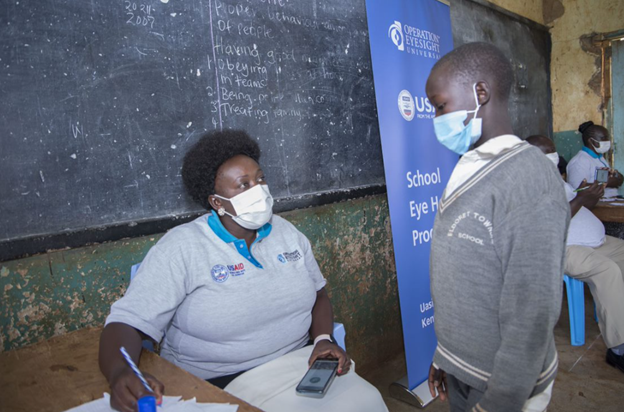
“People often do not seek eye health care – or are simply unable to access it – for a variety of reasons,” says Alice Mwangi, our Country Director for Kenya. “We also know that women and girls are more likely to suffer vision impairment and face barriers to care.”
Today, we’re partnering with communities, focused on expanding school eye health programs in Africa and South Asia. “I would like to thank the people who gave me the glasses,” says Amandah. “Now that I can read and see well, I hope I will be able to achieve my dream.”
Learn more about our school eye health programs and how you can help.
This story and media content is made possible by the generous support of the American people through the United States Agency for International Development (USAID). The contents are the responsibility of Operation Eyesight Universal and do not necessarily reflect the views of USAID or the United States Government.
Today, nine-year-old Aaliya from the village of Vallabhnagar in Rajasthan can go to school and play with her friends – but it wasn’t always this way.
Failing vision from the age of three meant the gradual loss of sight in her right eye. Aaliya’s family took her to several hospitals seeking treatment, but these efforts were in vain; Aaliya could get neither diagnosis nor treatment.
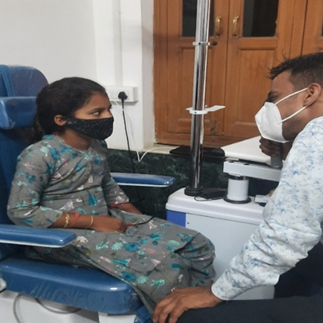
It wasn’t until an Operation Eyesight community health worker met the family during a door-to-door screening that Aaliya was directed to one of our local vision centres, where she was diagnosed with a squint. Also called a strabismus, this condition causes the eyes to point in different directions. If not treated early enough in life, squints can cause vision to be blurry or doubled and can impact how eyesight develops during childhood.
Aaliya was referred to our partner hospital, Alakh Nayan Mandir, for further treatment. She received prescription eyeglasses and over a number of months, received patching on alternate eyes to treat her eye condition. Doctors told her family that without proper and timely treatment, Aaliyah would have lost her vision.
"We never expected such an improvement in her vision,” says Aaliya’s father, Yusuf. “We are delighted.”
By partnering with hospitals and establishing a local presence in communities, we are strengthening India’s health system and making eye health care a standard part of primary health care. This approach allows us to bring quality eye care to patients like Aaliya, who were previously unable to access these services, as well as connect them with their local health system.

In the last six years, we have established more than 140 vision centres across India that provide eye exams, dispense prescription eyeglasses and refer patients to hospital for specialized treatment if needed. These self-funding facilities are established in accessible locations and staffed by trained eye health personnel.
Blindness and visual impairment are major public health issues in India, which is home to more than 20 per cent of those who are blind or visually impaired worldwide. The good news is 90 per cent of blindness and visual impairment is treatable or preventable.
Through the support of our donors and partners, in 2021 we referred nearly 150,000 patients for sight-saving surgery in India and provided nearly 160,000 pairs of prescription eyeglasses to patients who would not otherwise be able to afford them.
“A key part of our success is investment in infrastructure and training,” explains Troy Cunningham, our Country Director for India. “By training staff to deliver primary eye care and equipping facilities with the tools they need, we are ensuring the sustainability of our impact, long-term. We believe this approach can be replicated in states across India and are working with state governments to achieve this.
We also recruit and train hundreds of female community health workers, who who provide door-to-door eye health screening in target communities. These local eye health champions identify patients requiring care or referral to hospital. They also provide health counselling and education regarding various health issues, including maternal and child health.
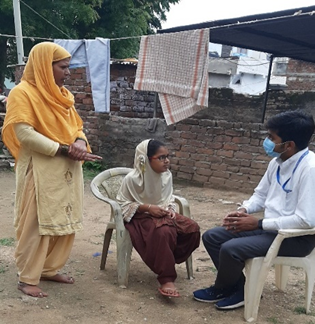
Remaining present in the community this way allows us to deliver eye health care that is truly integrated, because it's eye care that is preventive, provides treatment and follow-up care for all eye conditions. This integrated approach to eye care allows us to focus on the individual needs of patients and families.
By focusing on gender equality, promoting health and access to health services and bringing clean water and sanitation, we are also helping end poverty and the root causes of blindness. Together, we are helping achieve the UN Sustainable Development Goals (SDG).
The Government of India’s “Ayush Bharat” program aims to provide free access to healthcare to 500 million people nation-wide. While eye care is included in this program, many gaps still exist which prevent many Indians from accessing quality eye care.
By supporting policy development on eye health, establishing referral pathways, training staff and establishing facilities, Operation Eyesight is playing a key role in shaping India’s health system. Thanks to our partnership with state governments in Arunachal Pradesh and Madhya Pradesh, our primary eye care program is making eye care a key part of local primary health care in these regions.
“We are focused on strengthening existing health systems as well as equipping communities to look after their own eye health long-term,” explains our Global Director of International Programmes Vikas Gora.
“Eye care is primary care – thanks to our donors and partners who make our work possible, we are making this a reality in India.”
Visit operationeyesight.com/india/ to learn more about our work in India.
Marina is a 12-year-old girl who lives in a village in Assam state in India. She had always been a vibrant and happy girl who was eager to learn, but a few years ago, something had changed. Her teacher was the first to notice the deterioration in her vision. The teacher reported to her parents that her writing was suffering, and she couldn’t see the blackboard.
Her parents had noticed other issues at home. Marina seemed unhappy and irritated. It happened very slowly over time, but when they heard that Marina’s issue was affecting her performance in school, they were worried about her future.
Many children who live in remote villages continue to suffer when they develop treatable eye issues such as cataracts. Their parents may not be able to afford surgery, or even transportation to a hospital for an eye exam.
Fortunately, Marina lived close to a vision centre. Her parents were able to take her there for an exam, where she was referred for cataract surgery. Thanks to the generosity of our donors and our partners, Marina can see again and is excited to read and learn. She is once again the happy girl her parents knew!
“We are so grateful to the doctors for giving sight back to our daughter,” they said. “She is healthier and living a very happy life.”
For girls like Marina, access to eye health care provides the gift of education.
You can transform the life of a girl like Marina. Your generosity can give a child the healthy eyesight they need to craft a bright future. Please give the Gift of Sight today.