

Kajiado County, Kenya, August 30, 2023 – Patients living in Kenya’s Kajiado County and surrounding areas will have access to comprehensive eye health care, thanks to a new eye unit now open in the community.
The Kajiado County Referral Hospital Eye Unit was established in partnership by Operation Eyesight Universal with the County Department of Health and constructed in partnership with CBM Christian Blind Mission. Equipped with state-of-the-art diagnostic and surgical equipment, the new facility can provide a range of eye health services, including comprehensive eye exams and prescription eyeglasses fittings to diagnoses and sight-restoring eye surgery.
“Healthy eyes open up a future full of possibility and opportunity for individuals and entire communities,” says Alice Mwangi, Operation Eyesight’s Country Director for Kenya. “We are bringing quality eye health care to people’s front doors, and this new eye unit will serve as a hub for the entire community, connecting people with not only eye health care but also their local health system.”

The new eye unit was constructed as part of the Vision Impact Project, a four-year project started in October 2021 that aims to bring eye health care to unreached communities in Kajiado County, where blinding trachoma is endemic and other leading causes of vision loss include uncorrected refractive error and cataract. The project will train a local team of 23 local eye care workers and 175 eye screeners to use Peek Vision’s mobile app for screening and referrals. They will screen nearly 720,000 residents through door-to-door outreach. The project will also train 140 healthcare providers in primary eye care.
“Trachoma and other eye diseases such as cataract and untreated refractive error have had a devastating impact on many patients and families in the area, and many have faced barriers to accessing eye health care, including cost and lack of locally-available services,” explains Mwangi. “Today, we are able to better meet demand while also raising awareness about the eye health services that are now available, through education in the surrounding community.”
Since the project launched, Operation Eyesight has trained 33 local community health volunteers to deliver health education, screen community members for eye problems and refer them for treatment if needed. So far, 199,894 people have been screened for eye conditions and over 21,822 people have received treatment, including more than 5,125 people who have received prescription eyeglasses and 183 people who received sight-restoring cataract surgery.
“This is about taking a collaborative approach to care. It starts with outreach in the community and connecting patients and families with comprehensive eye care through this new eye unit,” says Dr. Ritu Ghosh, Operation Eyesight’s Global Director, International Programmes. “Together with the community and local leaders, we are not only transforming eye health care in the region but also strengthening the entire health system.”

To date, Operation Eyesight and partners have declared 35 villages in Kenya as avoidable blindness-free, which means the communities are free of any untreated cases of vision loss.
Operation Eyesight is a Canada-based international development organization working to prevent blindness and restore sight in sub-Saharan Africa and South Asia. In 2023, Operation Eyesight is celebrating 60 years of collaborating with local hospitals and government partners to invest in sustainable eye health treatment, blindness prevention and community development. Operation Eyesight is implementing projects in eight counties in Kenya: Kajiado, Elgeyo Marakwet, Nandi, Kisii, Narok, Transnzoia, Uasin-Gishu and West Pokot.
-30-
For further information please contact:
Colin Zak
Communications Specialist
Operation Eyesight Universal
Zakc [at] operationeyesight.com
@OpEyesight
July 12, 2022 – Kenya and Tanzania are one step closer to eliminating blinding trachoma, as the two countries today launched a cross-border mass drug administration exercise.
The joint effort, led by Operation Eyesight in partnership with the ministries of health in both countries, as well as Sightsavers, will distribute antibiotics to more than 1.3 million people with trachoma or at risk of developing the painful bacterial infection. This will provide much-needed treatment to communities living along the Kenya-Tanzania border, across the counties of Kajiado, and Narok on the Kenyan side and the neighbouring districts of Ngorongoro and Longido on Tanzanian side.
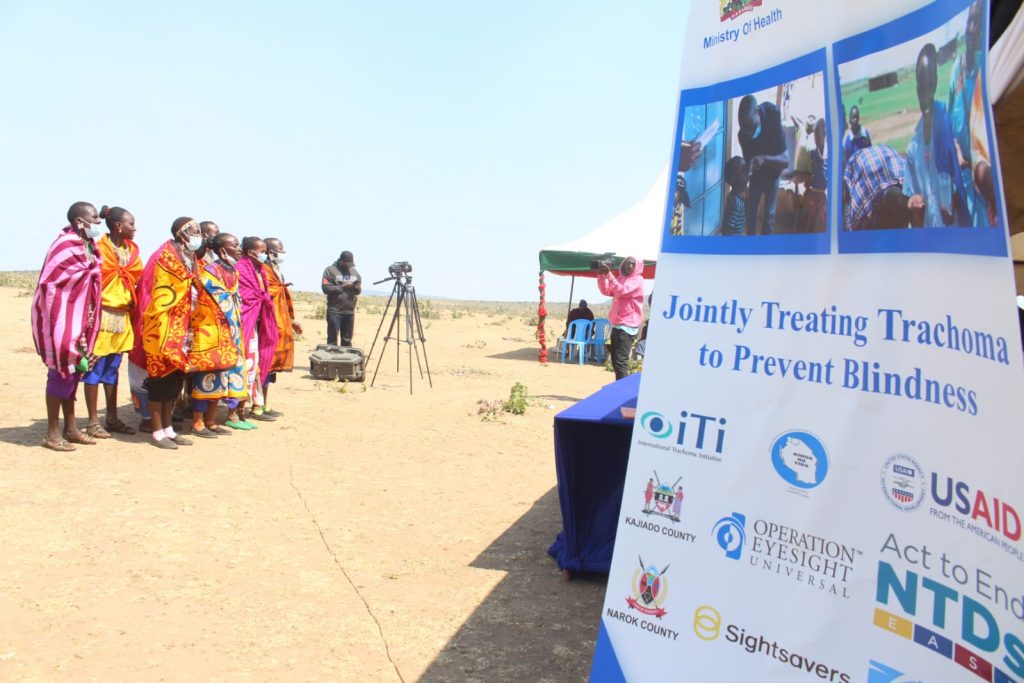
In Kenya, trachoma is endemic in 12 counties, impacting a combined population of approximately 11 million people. If left untreated, this painful bacterial infection leads to irreversible blindness.
“Trachoma knows no borders, and many pastoralist communities in the area are semi-nomadic. Therefore, collaboration between governments is critical to ensure no patient at risk is unable to receive antibiotics,” explains Alice Mwangi, Operation Eyesight’s Country Director for Kenya. “Antibiotics are an effective and proven way to prevent the spread of trachoma. Together, we are eliminating trachoma from entire villages and communities.”

Teams of government health workers and partners like Operation Eyesight will begin efforts in Narok and coordinate work with teams in nearby Tanzania.
Mwangi says the upcoming Mass Drug Administration (MDA) builds on the success of the previous MDA in Narok County, which provided antibiotics to 460,000 people needing treatment last year. Previous efforts by both governments to distribute antibiotics saw sections of the local communities miss out on treatment as they moved in search of pasture.
“Collaboration with both ministries of health is a historic step towards eliminating trachoma from Kenya for good,” Mwangi adds.
We are partnering with national and county governments with the shared goal of eliminating trachoma from Kenya by 2025.
SAFE from trachoma
Although it can be treated with a simple dose of antibiotics, more than 1.9 million Kenyans and 116 million people across Africa are in immediate need of treatment of blinding trachoma. This bacterial infection causes the eyelashes to turn inwards, causing painful scarring on the cornea, leading to permanent blindness if left untreated.
Because trachoma is spread through flies and personal contact, women and children are most at risk of contracting or re-contracting this blinding condition.
Distributing antibiotics is just one part of the World Health Organization’s ‘SAFE’ strategy for eliminating trachoma:
“Eliminating trachoma goes beyond simply treating the disease. It’s also about issues like access to water and sanitation and bringing health education to communities. This plays an integral role in preventing re-transmission of the disease,” explains Mwangi.
“Community eye health activities like these are helping us shift the dial on not only trachoma, but other conditions as well.”
Neglected Tropical Diseases: diseases of poverty and inequality
Trachoma is one of 20 diseases classified as a Neglected Tropical Disease (NTD) – a group of diseases that have one thing in common: they debilitate and disfigure.
They also affect one billion people living in poverty worldwide.
Operation Eyesight is inviting governments, institutions and organizations globally to join us in signing the Kigali Declaration – a pledge to partner together to ensure that trachoma and other NTDs are eradicated, eliminated or controlled by 2030.
“Ending Neglected Tropical Diseases at its core is about addressing the root causes of these conditions – poverty and inequality. That’s why Operation Eyesight endorses the Kigali Declaration,” says Kashinath Bhoosnurmath, President and CEO of Operation Eyesight.
“As we move globally towards achieving universal health coverage and achieving the UN’s Sustainable Development Goals, we see each one of these are also steps towards ending needless vision loss.”
Bhoosnurmath says the Kigali Declaration is not just about eliminating trachoma and other NTDs, but also about taking steps to address inequality, strengthen health systems and leverage the unique strengths of communities.
“We hope that by signing this joint declaration, we can build on our success to date and take more steps forward as a global community.”

Making strides
Mwangi says the number of active trachoma cases in the region has steadily decreased due to the efforts of Operation Eyesight, governments and other partners. Rates of infection have steadily decreased from 2004 when trachoma infection rates in endemic areas of Kenya were above 30 per cent, to between 12.6 and 19.8 per cent in 2018.
The Kigali Declaration invites us all to a shared commitment to achieve the UN’s Sustainable Development Goals that target NTDs over the next decade.
“We have made great strides in eliminating trachoma from entire regions,” adds Mwangi. “But more work needs to be done in Africa in particular.”
Donate today to help prevent blindness and restore sight.
We all believe and say, 'Seeing is believing.' I personally hold this belief dear and often repeat it, as it resonates deeply with me. As the President and CEO of Operation Eyesight Universal, one of my roles is to help our growing global community to see how our collective actions and partnerships – as employees and volunteers, as donors and partner organizations, as governments and communities – are transforming our vision of eliminating avoidable vision loss into a reality, community by community.
When I travel to our countries of work and to the target villages, I see that eye health is about far more than sight. I have learnt that eye health is about children being able to learn, play at school and practice hygiene. It is about adults being able to work and run businesses, access clean water, herd animals, grow crops and care for children. It is about seniors who can meet their friends, travel and chase after their grandchildren. Eye health is about reaching everyone in a community, addressing all the avoidable vision loss issues and empowering the community to take care of their eye health themselves. Often, this is the impact of partnerships between organizations and governments, hospitals and communities with a shared vision to improve quality of life. Actually, health and partnerships are so important that they have been identified in the 17 Sustainable Development Goals (SDGs) of the United Nations (UN) as necessary for a peaceful and prosperous world.
This June, I am attending the International Agency for the Prevention of Blindness (IAPB) global event, 2030 IN SIGHT LIVE in Mexico. (See above for a photo of my eye health peers and I at last year’s event.) As an elected IAPB board member and someone who has been leading health and eye health care programmes for more than 35 years, I will join hands with fellow experts and organizations in the eye health sector to apply our collective knowledge to address:
1. What needs to be done to transform the vision of universal eye care into a global reality by 2030?
2. What ground-breaking approaches will accelerate action and transform eye health?
3. What steps can we take to embed conscious, inclusive and sustainable best practices across the eye health sector?
4. What can we do to harness our strengths and diverse skills to increase momentum together to empower change?
5. To address diverse needs and shape the future of eye health, how can we meet the rising demand and changing landscapes with strategic sustainable solutions?
My experience has shown me that a key part of the answer to all these questions lies in the power of partnerships. By working together, we can build sustainable strategies that connect international agencies, national governments, hospitals, and health care workers, and extend right down into the communities and each person there.
Partnerships at the strategic, implementational and program levels will ensure that multiple players can focus on their strengths – from sharing eye health care data with international agencies that set global goals, to working with national governments to include eye health in health care and education policies, to supporting hospitals and training health care workers who treat vision issues, to empowering communities to identify and address vision problems for everyone who lives there. Through partnerships, we stand together so we have more visibility. We have more influence and more funding. We have more technical expertise, and we have more community connections.
Over more than 60 years, Operation Eyesight has developed a sustainable model of community empowerment. I take great pride in our flagship model, which is not only sustainable but also scalable. This model serves as evidence to the successful implementation of the World Health Organization's five recommendations outlined in its World Report on Vision 2019: making eye care a part of universal health care, integrating people-centred eye care into health systems, promoting high-quality implementation and health systems research that compliments evidence for effective eye health care interventions, monitoring trends and evaluating progress for effective eye care interventions, and raising awareness, engaging and empowering people and communities about eye care needs. I attribute the success of this model to our dedicated partners and the communities we serve.
When we partner with others, we become the bridge between health care services and communities. While many organizations work down to the hospital level, we start with the hospital and work down to the community level where we reach all those individuals who are in need of eye care. With the hospital, we identify a service area and build a local vision centre. Next, we train local community health care workers in the community. In our nine countries of work, our network of more than 2,500 community health care workers conduct door-to-door surveys, knocking on doors and identifying people with vision challenges. These workers then refer people to the vision centre for eye exams and prescription eyeglasses or treatment for eye diseases. Those with issues that require services beyond the vision centre, such as cataract, are referred to the local hospital for surgery. Once all avoidable vision loss cases are addressed, the community is declared avoidable blindness-free. The community can then sustain this as they now have ownership of their own eye health care.
Time and time again we have seen this model work. We are publishing research on the results, investing in resources to replicate it, and harnessing partnerships to bring this model to new communities and new countries of work.
In Mexico City, I plan to reconnect with current partners and meet new partners. I will learn from them about their perspectives on the five key questions IAPB is asking and share my views with them. Additionally, I will discuss what more Operation Eyesight can do to further strengthen our partnerships and chart a future course that allows us to collectively reach out to many more individuals and communities. I look forward to seeing so many global community members in Mexico City and to working together to answer the five IAPB questions. I believe that together, we have the power to transform eye health care – For All The World To See.
Join our global community, partner with us and we will transform more lives together.
In spring 2023, Operation Eyesight welcomed Dr. Ritu Ghosh as the newest addition to our leadership team. As Global Director – International Programmes, Dr. Ghosh will play a key role in helping us expand our work to more countries and reach more communities in our countries of work, as well as set up examples of programme excellence with the public and private health sectors.
Dr. Ghosh brings with her 25 years of experience in directing international development programs, including research, policy development, business, advocacy and health system strengthening, as well as implementing multi-country large-scale health and nutrition programs. She has also led many digital technology initiatives and has experience developing and fostering partnerships between public, private and non-profit sectors.
She has an impressive string of credentials: high impact leadership training at Cambridge University, a PhD in healthcare and nutrition, a double Master's in social work and English, and a Gold Medalist in Bachelor of Mass Communication, just to name a few.
Dr. Ghosh describes herself as a believer in innovation and transformation. Using the power of data and analytics, she has led many research and behaviour change projects that have helped bring new perspectives to program implementation and evidence-based planning.
If her experience and credentials aren’t enough, Dr. Ghosh is also a poet and has plans to publish an anthology of her Hindi language poems.
I sat down with her recently to talk about her hopes and plans for Operation Eyesight.
Q: Why did you choose to work in eye health, and why did you choose to work with Operation Eyesight?
Dr. Ghosh: I have a passion to contribute to community development; that’s why I originally pursued social work.
Vision loss can impact a person’s independence, mobility and has been linked to injury. It impacts the quality of life as significantly affects mental health, social standing, cognition, employment, even educational attainment, which can in turn impact livelihood, not only among seniors but also in younger generations.
I appreciate the approach that Operation Eyesight is taking when it comes to gender equality and ensuring eye care is available and accessible in the local community, especially through the strategic use of door-to-door surveys and community vision centres.
Operation Eyesight also has a robust gender policy, which ensures that gender perspectives and attention to the goal of gender equality are central across all program models, interventions and partnerships. Numerous studies have shown gender disparity has various negative health outcomes. Many times, women don’t go for checkups because a health facility is not available in the nearby area. When it comes to eye health, affordability, availability and accessibility are significant barriers for women. They can only have equal opportunities to earn, learn and grow when we put them at the centre of the development of all programming, be it in the public or private sectors.
Q: What role does research play in global eye health, and what role do you want to see it play in Operation Eyesight’s work?
Dr. Ghosh: Research informs the direction, focus areas and interventions of our work. We conduct Knowledge, Attitude and Practice (KAP) surveys to understand the local culture, beliefs and community needs, and design the projects accordingly. As a result, the sustainability of our programs is very high.
If we don’t know the impact of our work, we can’t say that our model is successful. Further baseline and endline studies are vital to know the impact of our programs, without which we would be unable to declare entire villages avoidable blindness-free. We should measure impact quantitatively as well as in qualitative terms, like improved health-seeking behaviours, adherence to spectacles, improved WASH practices, etc.
Operation Eyesight also engages in advocacy in order to influence government policies and strengthen national guidelines. In many countries, eye health data is not available, and we have a chance to build eye health indicators in a country’s government database and track progress in different districts and provinces. One major gap here is the need for more gender disaggregated data to show whether women are accessing services or not. For example, if we say 40 people received cataract surgery but don’t know the gender breakdown, maybe it’s 35 males and only five females.
Q: We know that eye health is linked with many other development issues. How do these areas factor into our work?
Dr. Ghosh: Eye health cuts across the United Nations Sustainable Development Goals. Poverty and hunger are a good example. If a person becomes blind, there is impact on their livelihood, for both them and their entire family; if one person loses their sight, their entire family suffers.
Similarly, when it comes to empowerment of women and women’s health, without empowering women to access eye health and other health services, we can’t move towards that goal. Similarly, when it comes to primary education, we know that if a child can’t see the blackboard, they cannot learn and study. So, the distribution of prescription eyeglasses is a key contributor to this goal.
I would like us to further enhance our research to see how we can understand eye health as well as its determinants, such as maternal health, water, sanitation and hygiene (WASH) programs, immunization and nutrition. Therefore, if we – civil society and governments – all focus on enhancing access to eye health, it will help achieve the global SDGs.
Q: The world is changing quickly. What’s the biggest challenge we now face as an organization when it comes to achieving our mission and vision?
Dr. Ghosh: A number of things have changed since the COVID-19 pandemic. During the pandemic, I observed that entire health systems were jeopardized. The primary focus of many governments shifted to how to control the spread of COVID-19. As a result, other health programs were frequently put on the backburner. The need of the hour is for governments and other sectors to refocus on other health areas, including eye health.
The question we need to ask is: how do we strengthen health systems, so that eye health is mainstreamed?
Across the board, people are spending more time on screens. This is impacting people’s health, especially their eyes. Increasingly, people are using digital technology as the primary way to interface and get information, so we as an organization have to move at the pace the world is moving. That’s why we’re planning to use digital survey tools, digital behaviour change communications, digital job aids, digital training module with digital messaging, because this is the way forward. Moreover, technological excellence such as teleophthalmology is necessary to adopt to reach more communities in far-flung areas, because this is the way forward. We are now mixing both approaches of digital and interpersonal communication to access patients and families, and we are considering how we can enhance services and further strengthen health systems.
We customize our programs based on the needs of individual countries. Therefore, our digital strategy also needs to be tailored to the communities where we work. For example, many rural areas have limited Internet access, and in many areas women face barriers to accessing digital technology. So, if we want to convey messages to women in these areas, we need to see which tool and medium is really useful for them. Literacy rates are also important to consider; some areas where illiteracy is prevalent may require visual or audio messages in the local language to understand our messages.
Q: When it comes to tailoring our approach in each country, how does that work?
Dr. Ghosh: Our country directors are our change champion. They work on the frontlines as the face of Operation Eyesight. There are lots of opportunities for them to develop strategic partnerships with like-minded agencies, develop coalitions, identify capacity building needs with partner hospitals and their staff, develop appropriate training modules and build partnerships with governments.
Our country teams are at the forefront of quality program delivery; without them we couldn’t do what we do. When our staff, partners and donors are working in sync, we are able to contribute meaningfully to global eye health in different countries.
Q: What do you most want to achieve at Operation Eyesight?
Dr. Ghosh: I have a number of goals, the first being to reach more communities.
Second, I want us to have multi-country research that includes different parameters, besides just eye health, with increased emphasis on evidence-based planning, to deliver care to more communities in hard-to-reach areas. We will also focus on behavior change interventions, so that communities are able to take charge of their own eye health.
All of this work will help build the capacity of partner hospitals and staff, while delivering cost-effective program models that can be scaled up quickly in different contexts in regions in Africa and Asia. Globally, we will focus on health system strengthening in the public and private sectors.
Third, I hope to develop the donor base in our countries of work and identify in-country partnership opportunities, with governments, hospitals, local leaders, corporations and like-minded partners. In the long run, I want to see Operation Eyesight version 2.0, where we cater to more countries and are having a ripple effect in a range of other development areas. We just celebrated our 60-year milestone as an organization, and as we continue to adapt and grow in an ever-changing world, I think our future is very bright.
Asafora is like many other small villages in central Ghana; its several hundred residents are mostly farmers growing cassava and plantain, and many community members have faced barriers to accessing eye health care.
What sets this community apart? It is the first village in the country we declared Avoidable Blindness-Free.
The December 2022 declaration event was several years in the making and is the product of collaboration between the community, the local government and our partner, Saltpond Government Hospital.
“Avoidable Blindness-Free means that the village is free of untreated vision loss,” explains Emmanuel Kumah, our country director for Ghana. “It also means that people in the community know where to receive care. This is important in communities like Asafora, where there has historically been resistance to receiving eye care.”
Our partnership with Asafora began in 2017 with primary eye care training for 10 local community health nurses. This team conducted door-to-door surveys to identify people with eye conditions, distributed vitamin A supplements and provided basic immunizations. Patients with cataract and other eye conditions were referred to the hospital for treatment.
We conducted a second door-to-door screening in 2021 to see how patients were doing and discovered several patients had refused care.
“We realized there was a lot of resistance to receiving eye care within the community, due to misconceptions about surgery,” Emmanuel explains. “We had to double down on our efforts to educate the community and inspire behavioural change.”
Community health nurses were deployed. They knocked on doors and attended churches, mosques, and child and newborn care sessions where they provided eye health education. Creating awareness and encouraging people to seek eye care helps ensure a village becomes, and stays, Avoidable Blindness-Free.
The declaration event was a landmark for public health in Ghana, and Asafora is the first of many rural villages to be declared Avoidable Blindness-Free in the country.
Anyone who has ever experienced vision loss can appreciate the difference quality eye care makes. For a parent, it means the chance to provide for their family. For a child, it’s the chance to learn and thrive at school. For a senior, it means independence.
That’s why Vision Group has chosen to partner with Operation Eyesight Universal, year after year.
“We believe that everyone deserves access to clear vision, regardless of where they live – it’s universal,” says Darren Yaphe, Chief Marketing Officer of Vision Group, based in Montreal, Quebec. “Partnering with Operation Eyesight allows us to expand our mission beyond our clinic walls.”
It’s a partnership that has given their patients and staff the chance to have a wide-ranging impact in communities across South Asia and Sub-Saharan Africa by helping to improve access to quality eye care.
Since its early days as two LASIK MD clinics in Montreal and Toronto in 2001, Vision Group has grown to include 10 brands with over 60 clinics across Canada and the United States, which provide laser eye surgery, refractive lens exchanges and other ophthalmic services. The organization has been donating to Operation Eyesight for the past 10 of the company’s 22 years of operations in North America.
Darren explains that Vision Group’s founders, Dr. Mark Cohen and Dr. Avi Wallerstein, were interested in Operation Eyesight’s efforts to eliminate avoidable blindness, particularly our work to prevent blinding trachoma.
“We wanted to find an organization that aligned with our goal and mission to improve and preserve eyesight,” Darren adds. “It was a natural match for our organizations.”
Vision Group has given its staff and patients across the country the chance to give back. Through payroll deductions, staff are able to give a set amount from each paycheck to Operation Eyesight and receive a tax-deductible receipt. In 2021, the organization took its giving to the next level and began donating two dollars for every online review they received.
“We make a donation for any review we receive. So, if at the end of the year we have 10,000 reviews on Google and/or Facebook, that’s $20,000 that goes to Operation Eyesight,” he explains.
Our work extends beyond providing life-changing eye surgery and glasses to patients and families that need them. Through our partnerships with local hospitals and governments, we are providing ophthalmic equipment and infrastructure as well as equipping people to look after their own eye health, through staff, volunteers and health facilities in the community. This ensures our impact is felt long after we’ve left a project area.
Danielle Gibbie, our Director of Strategic Partnerships, says Vision Group’s staff and patients are helping address the root causes of avoidable vision loss, including poverty, poor sanitation and nutrition, and gender inequality.
“Through our outreach in the community, clean water and sanitation projects, and health education, we’re addressing the drivers behind avoidable vision loss,” Danielle says.
“Corporate giving programs like the one at Vision Group are giving staff and patients the opportunity to have sustainable impact in the lives of individuals and entire communities.”
It’s an ethos that Darren says resonates with Vision Group’s patients and staff.
“Together, we’re working to improve and preserve eyesight, one patient at a time. Beyond the work we do at our clinics, partnering with Operation Eyesight is part of being a responsible global citizen,” he explains. “Giving back is part of our DNA.”
Last year, the partnership between our two organizations helped support projects in Bangladesh, India, Nepal, Ethiopia, Ghana, Kenya, Liberia and Zambia. Darren explains that, for this year, Vision Group plans to partner with Operation Eyesight on specific community projects, which will allow staff and patients to directly see their impact in action.
“This is life-changing work we are doing together, and we’re proud to support it,” he says. “The future is bright.”
Thank you to everyone at Vision Group for their dedicated support! To learn more about how your company can give back, click here or email philanthropy [at] operationeyesight.com.

What is Corporate Social Responsibility?
Corporate social responsibility (CSR) has been a buzz term in the business world for nearly a decade, but what exactly does it mean? Essentially, CSR is a self-regulating business model that helps a company be socially accountable. It’s a set of ethical standards that guides the company’s commitment to manage the social, environmental and economic effects of their operations responsibly and sustainably.
The climate of the business world is rapidly evolving, and stakeholders are no longer concerned only with companies’ profits. Educated, engaged consumers want to support companies that make a positive impact on society. When companies contribute to meaningful social projects, they are able to cultivate positive associations with their brand and demonstrate how they’re promoting their values.
Why CSR?
In today’s digital reality, CSR is an important tool to help companies establish a good reputation and attract top talent. CSR has become the key component in the “S” aspect of Environmental, Social and Governance (ESG) initiatives undertaken by corporations. CSR initiatives can also serve as a means to boost the digital visibility of a company. Engaging in positive corporate citizenship can help improve your public image, increase brand awareness and recognition, increase your client engagement, and give you a competitive edge. Ethical, socially responsible companies tend to attract employees who are eager to make a positive difference in the world and are there for more than just the paycheque. This increases productivity and boosts employee morale, which will contribute to the bottom line.
Leveraging Existing Expertise
Not all companies have the existing resources to develop and implement a robust CSR strategy, but here’s the good news: you don’t have to. Decide what your values are as a company. Maybe your company really values family, or diversity. Maybe your company is seeking to align itself with one of the Sustainable Development Goals, such as good health and well-being, gender equality or clean water and sanitation. Decide what it is your company wants to promote through your CSR program, and then find a charity or non-profit group that aligns with your values.
Chances are, non-profits already have the talent and ability to help achieve your CSR goals, but they may lack the necessary resources. By partnering with the non-profit of your choice, you’re able to achieve your CSR goals and help them continue to make a positive impact reflective of your shared values. Instead of having to build your own CSR strategy from the ground up, you can work with them to reach a mutually beneficial solution. Aligning yourself with reputable non-profit organizations can help you leverage your company’s profile and reputation.
Operation Eyesight: Local, Global, Accountable
As part of my CSR initiatives, I choose to support Operation Eyesight, an international development organization working to eliminate avoidable blindness in countries in South Asia and Africa. They are an international development organization working to eliminate avoidable blindness in countries in South Asia and Africa. They work with local governments, medical professionals and non-governmental organization partners to build essential resources that give all people, regardless of age, gender, or ability to pay, access to the help they need to achieve quality eye health care and vision for all.
Operation Eyesight is headquartered in Calgary, Alberta, where they’re backed by a loyal Canadian audience and offer a unique viewpoint to the dozens of organizations vying for support from Ottawa. They’ve been around for over 57 years, demonstrating a strong reputation and proven track record of success. Operation Eyesight has also been recognized by Charity Intelligence Canada in both 2018 and 2019 as one of the nation’s Top 10 Impact Charities.
If you’re interested in finding out more about Operation Eyesight, I encourage you to attend their Sight Is Life events on May 11 in Calgary or May 14 in Vancouver. The event website will provide the details.
I hope to see you there!
-Andrew Judson, Sight is Life Committee Member
Earlier this month, we had the privilege of hosting Dr. Gullapalli N. Rao (center), Founder and Chairman of the L V Prasad Eye Institute (LVPEI), and Dr. Taraprasad Das, Vice-Chairman of LVPEI (right), in Calgary.
LVPEI has been our partner for the last 17 years. Together we’ve made eye care possible in some of the most underserved communities in India. Over coffee and donuts (from the very Canadian Tim Hortons, of course), our Calgary staff heard more about Dr. Rao’s and Dr. Das’s professional experiences, values and hopes for the future. Naturally, the quality of eye care was a recurring point in our discussion.
When Dr. Rao left the United States after 12 years of studies and practice as an ophthalmologist, he returned to India with the dream of making quality eye care a reality for all. In 1987, his efforts gave way to the renowned LVPEI, situated in the city of Hyderabad. During the organization’s first five years, Dr. Rao noticed an increasing number of economically underprivileged people suffering from avoidable blindness – mostly cataract. This led to the development of the community eye care model in which vision centres were established in rural or economically disadvantaged communities and quality eye care was made accessible for everyone regardless of their financial status.
“It has been a glorious journey,” says Dr. Rao. “The hospital thus far has touched millions of lives through quality eye care and careers, and continues to have dedicated partners, donors and volunteers. It gives me immense satisfaction to witness the transformations in the lives of our patients and employees, and the contributions from people around the world in terms of their time, talent and treasure.”
In addition to making quality eye care accessible for rural communities in India, with the help of a generous donor family, we opened the Operation Eyesight Universal Institute for Eye Cancer at LVPEI’s Hyderabad campus in 2015. To combat the growing number of eye cancer incidences in India, the facility provides cancer treatment for children and adults, all at low or no cost.
“It is the insistence on quality that sets Operation Eyesight apart from other organizations,” says Dr. Rao.
Thank you, Dr. Rao and Dr. Das, for spending time in Calgary and sharing your experiences with us! It was an honor to host you both. We’re proud to call LVPEI our partner, and we look forward to transforming many more lives together in the years to come – For All The World To See!
