
From her earliest days in school, 13-year-old Zara in Nepal struggled to get by. She couldn’t read what her teachers wrote on the blackboard, and she often rolled her eyes around and made unusual body movements, instantly making her stand out as “different” to her peers. We can only imagine how lonely and confusing life was for the girl – not knowing why she was so unlike the other children.
What nobody realized was that some of Zara’s actions – the eye-rolling, the strange movements – are typical self-stimulatory behaviours seen in some children with severe vision impairment. As a result of these behaviours, children like Zara are sometimes misdiagnosed with autism or developmental disabilities if their low vision continues to go unrecognized.
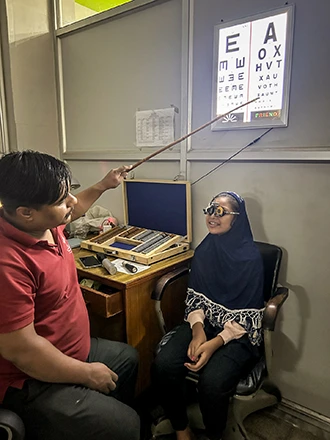
Fortunately for Zara, her school was included in a school eye screening project we had implemented in collaboration with our partner, Nepal Eye Hospital. During the screening, community health workers discovered that Zara had cataracts in both of her eyes, a condition she’d been born with, and that had severely clouded her vision throughout her young life.
The outreach team met with Zara and her mother, explained the condition to them, and told them that treatment was available. They referred the family to the nearby Simara Vision Centre for a thorough examination, where doctors confirmed the diagnosis of congenital cataracts. From there, Zara received a further referral to Nepal Eye Hospital in Kathmandu for surgery.
The Operation Eyesight project team provided crucial support, guiding Zara and her parents through the treatment process and helping them access surgery at a reduced cost, making it affordable for the family, who had limited financial resources.
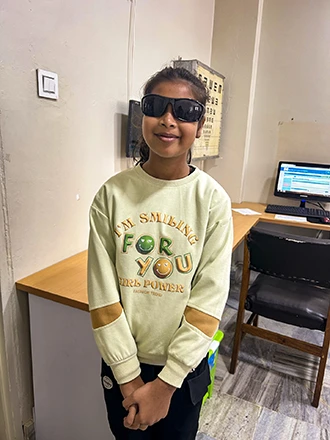
Zara’s first eye surgery was a success, and a month later she returned to the hospital for surgery on the second eye. On her second visit, when she spotted Operation Eyesight’s Project Coordinator from across the hospital, she waved enthusiastically – something that would not have been possible before her first surgery.
Zara’s transformation was profound. The eye rolling stopped, her unusual movements decreased, and she became more sociable with family and friends, even interacting withstrangers. For the first time in her life, she could recognize people from a distance, read the blackboard in class and fully participate in school activities.
Zara’s mother was overwhelmed with relief to see her daughter blossom. She had been extremely worried about her child’s future, and was amazed to see Zara playing, learning and interacting like other children her age. She and her family expressed deep gratitude to the hospital, the doctors and healthcare workers, and to Operation Eyesight’s generous donors, for making this life-changing transformation possible.
Make a donation to help us reach more children like Zara with life-changing eye surgery.
Written with files from Anisha Gurung, Operation Eyesight’s Project Coordinator at Nepal Eye Hospital.
All his life, Kamal has worked as a farmer. He raised two boys on money he earned working the land, and even now, at age 69, he continues to farm. But in recent years, he struggled with the work because of his failing vision.
Kamal lives alone with his wife in Auraha, a village in Nepal’s southern lowlands. His youngest son passed away due to illness, and his eldest moved out to start his own family. Due to financial difficulties, Kamal had never gotten an eye exam until recently, despite his poor eyesight.

Happily for Kamal, his village is covered under a community eye health project that we are running in collaboration with the Nepal Eye Hospital, our partner in Kathmandu. A community health worker visited his home and quickly noted that Kamal had cataracts in both eyes. The health worker encouraged Kamal to visit the nearby vision centre for a formal diagnosis.
At the vision centre, Kamal’s cataracts were confirmed. In his right eye, he was reduced to Hand Motion vision, meaning he could not even count someone’s fingers, but could only detect a hand waving in front of his face.
After being reassured that he would receive treatment free of charge, Kamal decided to go ahead with the cataract surgeries.
He recovered well from both operations, and as he was still nearsighted, he also received a pair of prescription eyeglasses.
Now, Kamal proudly sports his eyeglasses every day. He says he is grateful to the team from the Nepal Eye Hospital for taking on the role of his absent son – providing emotional and logistical support throughout the process. He is also very thankful to Operation Eyesight donors for making his sight-saving surgery possible.
Thank you to all our donors for helping Kamal regain his sight!
Before she had cataract surgery, Ratna’s family worried about her non-stop. Each day, her husband, son and daughter-in-law would leave her at home with her young grandson so they could tend to the farm. But due to her fading vision, Ratna couldn’t safely care for the boy, and eventually she even had trouble looking after herself.
After taking a few bad falls, the family decided her daughter-in-law would have to stay home with her, a move that had a serious effect on the family’s income.
“I felt very depressed,” says Ratna of her loss of independence. The grandmother, who lives in Tokha, Nepal, explained that she couldn’t even recognize her own son and had to ask him to call out to her so she could identify him. She needed an escort just to get to the bathroom and back, and she despaired about not being able to care for her family the way they were caring for her.
When a community health worker visited the household, Ratna was referred to the Nepal Eye Hospital, where she was diagnosed with cataracts. She explains that she hadn’t realized that her condition could be treated, and initially she was nervous about getting surgery.
“I gathered strength,” she says, “Because the community health worker told me the treatment would change my world.”
Thanks to our partnership with the Nepal Eye Hospital, Ratna underwent phacoemulsification surgery – a technique that doesn’t require sutures and has a short recovery time – free of charge.

Soon, Ratna was back in the family home, thrilled to get back to a more independent lifestyle.
With her son sitting as a ward chairman in the community, Ratna feels that she can set an example by telling others about her success with the surgery.
“Now I am a strong pillar for the family, setting an example for others to get the eye care services without fear,” she proudly says.
But the best part, according to her son? “Now, she is happy,” he says.
Give the Gift of Sight today and help restore sight and independence for more women like Ratna. Vision impairment disproportionately affects women and girls, but they are less likely to be prioritized for eye health care. That’s why our Hospital-Based Community Eye Health projects are aimed at reaching everyone in need of eye care, regardless of gender or family income.
Chiri lives in Thankot, Nepal where she loves helping on the family farm and looking after her grandchildren. About a year ago, her vision began to get cloudy. Gradually, it became difficult for her to go about her daily tasks unassisted. Not wanting to lose her independence, Chiri continued to try to do things on her own, until she injured her head during a bad fall. Her family didn’t know what to do. They feared her vision – and her independence – would be gone permanently.
Fortunately, an Operation Eyesight-trained community health worker named Meena visited their house as part of her door-to-door screenings. Meena diagnosed Chiri with cataracts, but Chiri was afraid to go for surgery because she also has diabetes and struggled to keep her blood sugar stable. Over the next few months, Meena regularly visited Chiri to help her stabilize her blood sugar. Once it was safe for her to receive surgery, Meena escorted Chiri the 15 kilometres to Nepal Eye Hospital for the operation. With her diabetes now under control and her vision restored, Chiri is back to her normal life and doing better than ever.
We’re so grateful for our community health workers. Their dedication to their communities drives them to go above and beyond to ensure that good vision and healthy eyes are in the reach of as many people as possible.
Bulal is a 97-year-old man from Thankot, Nepal. He, along with several members of his family, run a local butcher shop that they depend on for their livelihood. Several years ago, Bulal was diagnosed with diabetes. Recently, Bulal’s vision has been steadily declining. His family took him to the doctor, who identified that he suffered from cataracts, but were told that his blood sugar wasn’t stable enough and his blood pressure was too high for anything to be done. After visiting the doctor and hearing that nothing could be done, Bulal was crushed and lost hope that he would ever be able to see again.

A few months later, Meena, an Operation Eyesight-trained community health worker, approached his family during her door-to-door eye screening activities. His family described their situation to her and explained that although they knew what was causing his vision impairment, the surgery was too risky. Meena told the family that she had encountered cases similar to Bulal’s and that all hope was not lost. She was confident that she could help Bulal.

Over the next several months, with Meena’s guidance, Bulal was able to stabilize his blood sugar levels and lower his blood pressure significantly, making it safe for him to receive surgery. With Meena’s support, Bulal underwent cataract surgery at the Nepal Eye Hospital in Tripureshwor. His family is overjoyed that Bulal is back to his old self, and Bulal is thrilled to once again be able to actively participate in his family and community.

Although Operation Eyesight-trained community health workers are specifically trained in eye health care, they are passionate about helping their communities and go above and beyond to make sure that good vision and healthy eyes are in reach for as many people as possible. Donate today to help us train more community health workers and bring hope to more families.

Amita lived the typical life of a young woman in Tokha Saraswati village in Nepal. Married at the age of 19, she kept busy taking care of her family. She had dreams of a rewarding career serving her community as a nurse, but her family couldn’t afford for her to go to school.
The opportunity to become a community health worker gave Amita the fulfillment she always wanted. She is so happy that it allows her to help people in her community. She’s educated people to understand that superstitions do not affect health issues.
Also, she’s helped them learn what they need to do to look after their own eye health. She has become a respected expert in the area where she lives.
“Now whenever people have problems with their eyes, they come to me for a solution,” she says proudly.
Your generous support provides training and fulfilling opportunities for women to make a huge difference in their communities! Thank you!

Hira is 74 years old and lives in an ancient village in central Nepal with her husband and her son and his family.
The whole family depends on Hira’s son, who works as a labourer to make enough for them to get by. To help out, Hira gardens and sews clothing for the family, while taking care of her two granddaughters.
She was happy she could contribute at home, but she was able to help less and less over time, as her vision dimmed. She felt like there was some invisible film over her eyes that she couldn’t blink away, and it only got worse. Two years later, she was completely blind.
“I was too afraid to seek treatment,” says Hira. “My sister had cataract surgery done that left her blind, and she died blind. I was so afraid the same thing would happen to me.”
But our donors made it possible to help Hira through her fear.
Two community health workers arrived at Hira’s home and screened her eyes. They explained that her condition could be treated, and they counselled her on the procedures that would restore her sight. Then they referred her to an Operation Eyesight-established vision centre for examination.
Though she was afraid, Hira did go to the vision centre, where she was diagnosed with bilateral cataracts. She was then referred to Nepal Eye Hospital for surgery.
Hira still wasn’t convinced. “I was so afraid, but the community health workers introduced me to an older man who had received sight-restoring cataract surgery himself. His story calmed me, and finally I felt brave enough to get treated.”

Now, thanks to the support of eye health heroes like YOU, Hira’s sight has been restored!
“I am very happy about the treatment I received! Now I can do my daily activities on my own. My family can concentrate on their work, and I can help them when they need me.”
Hira is now an eye health advocate in her own community! She is so grateful to the community health workers and the doctor who helped her regain her sight.
And most of all, she’s grateful to kind people like you who made it all possible!
Thank you so much for helping people like Hira get their lives back through the precious gift of sight! There are still thousands more women like Hira who need your help. Donate today and become an eye health hero.
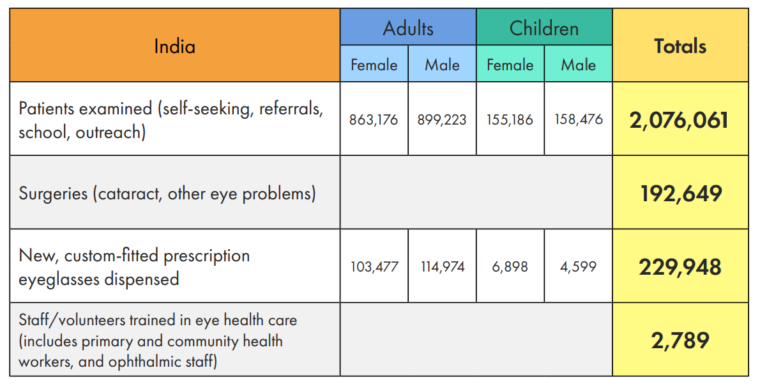
India had an exciting year! Thanks to our donors and partners we screened more than two million people who were at risk of losing their sight. Declaring villages avoidable blindness-free is the pinnacle of our work. We’re ecstatic to say that we declared our 500th village free of avoidable blindness in 2017.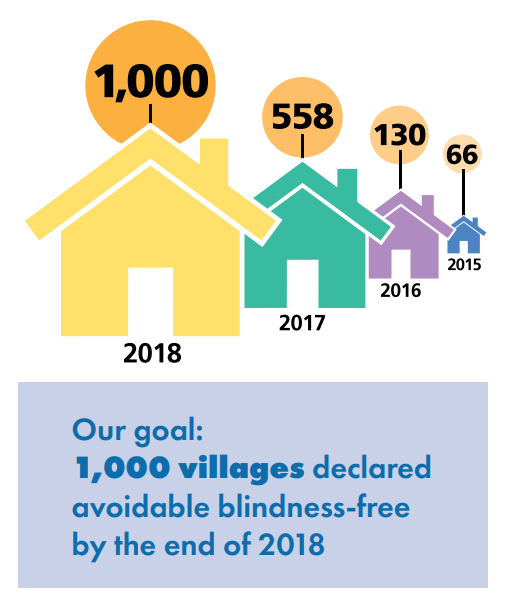 With the help of our partner Gerald A. Cooper-Key Foundation we declared 11 of those villages avoidable blindness-free. In fact, the Director General of Health Services of the Indian government recognized our work in reaching remote areas.
Gerald A. Cooper-Key Foundation also supported more than 500 eye surgeries.
Successful partnerships contribute to our accomplishments. Standard Chartered Bank’s Seeing is Believing supported us in establishing 12 new Vision Centres. With their help we passed another landmark when we opened our 100th Vision Centre. We’re delighted to report that by the end of the year we’d opened 108 Vision Centres.
We’re also grateful for the continued support from Bharat Financial Inclusion. Thanks to their generosity we performed more than 5,000 cataract surgeries in eight Indian states.
With the help of our partner Gerald A. Cooper-Key Foundation we declared 11 of those villages avoidable blindness-free. In fact, the Director General of Health Services of the Indian government recognized our work in reaching remote areas.
Gerald A. Cooper-Key Foundation also supported more than 500 eye surgeries.
Successful partnerships contribute to our accomplishments. Standard Chartered Bank’s Seeing is Believing supported us in establishing 12 new Vision Centres. With their help we passed another landmark when we opened our 100th Vision Centre. We’re delighted to report that by the end of the year we’d opened 108 Vision Centres.
We’re also grateful for the continued support from Bharat Financial Inclusion. Thanks to their generosity we performed more than 5,000 cataract surgeries in eight Indian states.
 On the technology front, our partnership with Pellucid Inc, a Singapore based eye tech firm, is thriving. With Pellucid technology:
 And for fun, our Indian team marathoners ran in the Airtel Hyderabad Marathon. Raising an impressive $11,000, Operation Eyesight was recognized as an official charity for the marathon. The fun’raising was the easy part and our team did the hard part — running distances ranging between 10 and 42.2 km. Remarkable!
In addition, we expanded our Community-Based Diabetic Retinopathy project to two new cities last year — Udgir, Maharashtra and Udaipur, Rajasthan.
And for fun, our Indian team marathoners ran in the Airtel Hyderabad Marathon. Raising an impressive $11,000, Operation Eyesight was recognized as an official charity for the marathon. The fun’raising was the easy part and our team did the hard part — running distances ranging between 10 and 42.2 km. Remarkable!
In addition, we expanded our Community-Based Diabetic Retinopathy project to two new cities last year — Udgir, Maharashtra and Udaipur, Rajasthan.
 Thanks to our amazing donors India had a dynamic year!
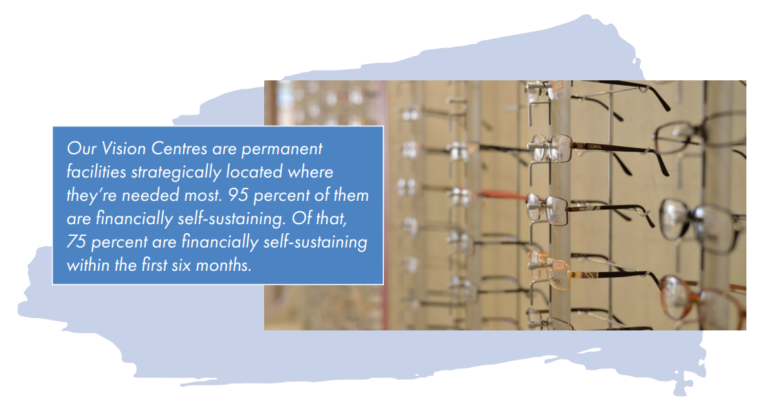
Thanks to Gerald A. Cooper-Key Foundation and the Koehle Family Trust, these Vision Centres are permanent facilities. Each Vision Centre is now financially self-sustaining and provides eye care services in areas where none existed. Also, with Gerald A. Cooper-Key Foundation support, we’re proud to announce the inauguration of the upgraded out-patient department at Fateh-Bal Eye Hospital last year.
Thanks to our amazing donors India had a dynamic year!
Thanks to Gerald A. Cooper-Key Foundation and the Koehle Family Trust, these Vision Centres are permanent facilities. Each Vision Centre is now financially self-sustaining and provides eye care services in areas where none existed. Also, with Gerald A. Cooper-Key Foundation support, we’re proud to announce the inauguration of the upgraded out-patient department at Fateh-Bal Eye Hospital last year.
 We’re just getting started in Nepal, and our future in the country promises to give new-found hope and freedom to thousands of people.
We couldn’t do it without our loyal donors. Thank you!
We’re just getting started in Nepal, and our future in the country promises to give new-found hope and freedom to thousands of people.
We couldn’t do it without our loyal donors. Thank you!
 Our momentum continues in Nepal as we move into our second year working in the county. With great support from our donors and partners, we trained 14 new eye health care staff. Working with Nepal Eye Hospital and Fateh-Bal Eye Hospital we established three new Vision Centres linked to these hospitals.
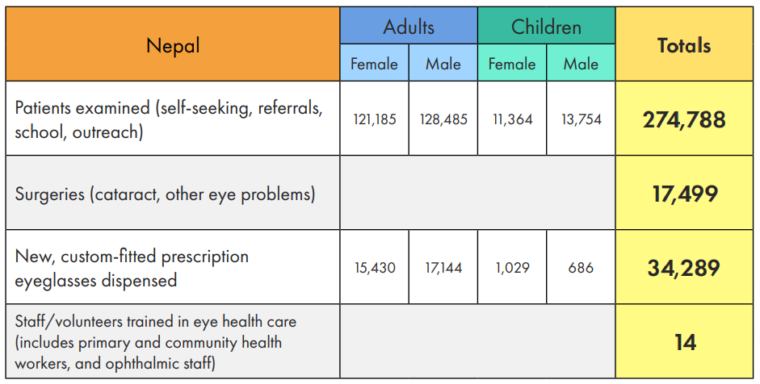 Thank you for making 2017 another fantastic year!
Cataract: a clouding of the lens of the eye. In developing countries, a cataract can rob someone not only of their sight, but their livelihood and hope as well.
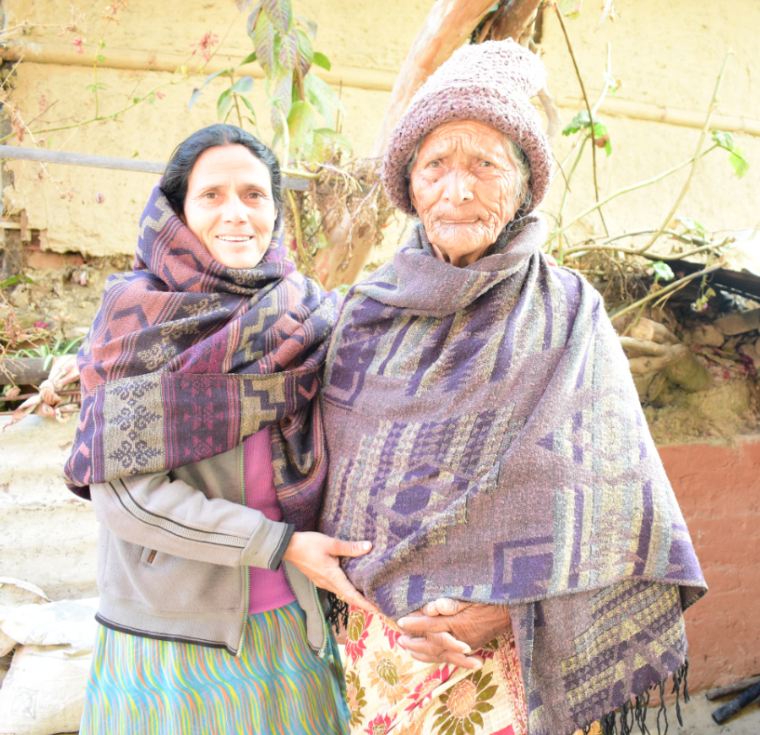
Em was suffering from depression after her husband passed away. She was heartbroken, and nothing felt right. She was lonely, as most of her children had already moved out into their own homes, all but one of her daughters.
Living in Nepal and struggling to get by on what little income she and her daughter could make doing farm work, 83-year-old Em was devastated when her vision started to fade.
Without her sight, she had to depend on her daughter to care for her, but someone needed to make an income to afford their living. Many days went by with Em left alone at home, sad and afraid.
Em and her daughter thought there was no cure – it wasn’t uncommon for the elderly to lose their sight in their advanced years. They thought there was nothing to be done, and Em feared that her life as she knew it had ended.
She so missed going over to visit with her neighbours, but since her sight started failing her, she no longer recognized their faces. And without her daughter to guide her, she couldn’t get around on her own. One time, she fell down the stairs of her home! And sometimes she would trip in pot holes in the streets.
For Em, daily life became dangerous and scary.
“I was fearful about what was happening in my life. I was having trouble doing even the simplest things and I hated to constantly trouble my daughter. She had already done so much for me…”
Em’s daughter was also affected by her mother’s condition. She used to love to paint and sew in her free time, but between working and taking care of her mother, Em’s daughter rarely had time left over. Em felt terrible – she truly missed watching her daughter paint and sew.
This went on for two long years, and Em could barely stand it… Until something incredible happened. Something made possible by incredible people like you.
Em was visited by a community health worker trained by Operation Eyesight who screened her eyes and referred her for further examination at our partner, the Nepal Eye Hospital. Once there, she was diagnosed with cataract in both eyes and booked for surgery free of charge to Em or her daughter!
“I can’t imagine what my life would have been like had I not been helped. My life would have become so much harder, and my daughter would have needed to look after me even for small daily activities. I was afraid I might not live much longer…”
Em was apprehensive about the treatment at first. According to Em’s daughter, her mother was already on anti-depressant medication, which only worsened her fear of cataract surgery. But after some counselling, Em agreed to the treatment.
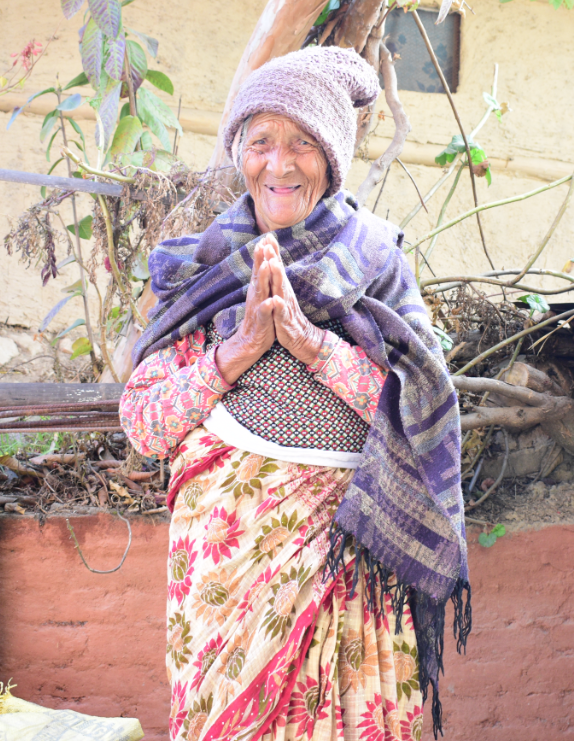
“I feel like I have been born again!” Em exclaims. “Now I have hope. I hope that my daughter can go back to painting and sewing, and reclaim her life. I look forward to visiting with the neighbours again, not that I’ve regained my independence.”
Now Em has become an eye health advocate, recommending that others in her village seek help and treatment. “I want others to be as happy as I am, now that I have my sight back. I came from darkness into the light, and I want others to receive that gift too.”
And em isn’t the only one celebrating. Her daughter is so happy too!
“With my mother’s sight restored, now she can recognize her neighbours and friends, she can talk and smile with them. She doesn’t need my help for her daily activities. And most importantly, though it might seem like a small thing, but it always puts a huge smile on my face when she picks small stones from the grains of rice we harvest while I’m working.”
Em and her daughter are so happy. They send their deepest gratitude to people like you who gave them new hope for the future.
“I want to thank the kind donors in Canada for doing such wonderful work in our country and for our community. There are still many more communities that need their help, so please continue doing such great work.”
Thank you so much for all that you do… Thanks to you, Em, her daughter and her community are receiving the eye health education and care they need! Just as Em said, there are still many who need our help. Have you ever considered becoming a monthly donor? Your monthly gift will have a lasting impact, and will ensure that help is always available when it’s needed. Please consider becoming a monthly donor today!
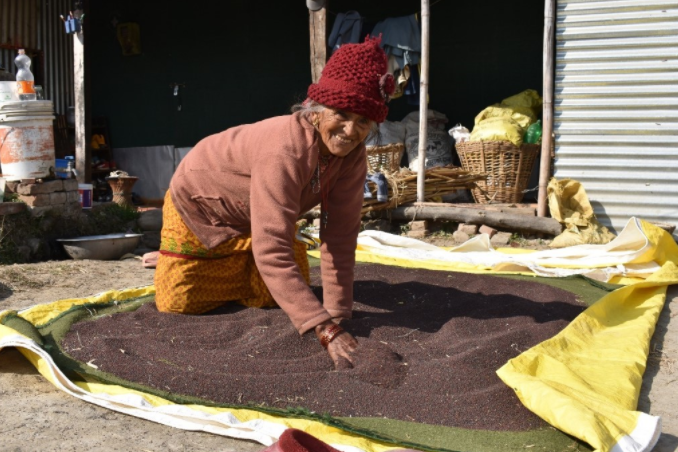
What would you do if you had an eye condition that was easily treated with a 15-minute surgery? You’d accept treatment, wouldn’t you?
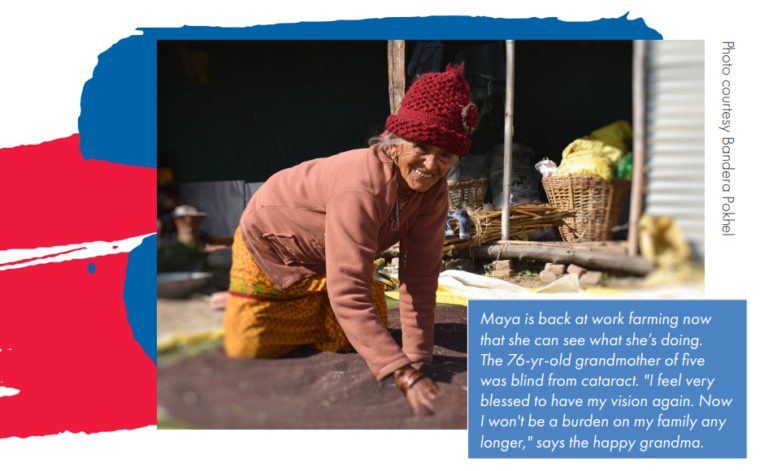
Maya suffered with cataracts for a year, to the point that she was forced to stop doing the things she loved, like making garlands in her free time and spending time with her family. Eventually, she was forced to stop working too.
This wasn’t just difficult for Maya. Her whole family works as daily wage labourers on a farm in a small village in Lalitpur, Nepal.
Living with her husband, son, daughter-in-law and young grandson means that every day is a struggle to put food on the table. The family depends on each other’s wages to afford their living. So when one family member becomes disabled, the whole family suffers from the loss.
Months before, Maya had been diagnosed with cataract and referred for surgery at the nearest hospital, but Maya was afraid. “I was scared because I thought it would hurt,” says Maya. She was also worried about the cost, and though she was told that she needed surgery, she didn't go through with it. “I didn’t tell my son or daughter-in-law about my eyes because I knew they couldn’t afford it.”
But she couldn’t ignore her need forever. Maya was bumping into things, and she needed help just to perform basic tasks at home.
It got so bad that one day she couldn’t even recognize the faces of her friends and family anymore. Unable to do the things she loved, or see her family's faces, Maya grew more and more sad by the day.
“I was fearful that I would have to live a dark life, being a burden on my family,” says the 76-year-old woman. “But I didn’t think anything could be done to help me since I was already so far along in years.”
Then a few months later a knock came on Maya’s door that would change her life!
Two community health workers trained by Operation Eyesight stood at Maya’s doorstep. They screened her eyes, and immediately referred her to our partner, the Nepal Eye Hospital, for treatment at no cost to her and her family. With the financial barrier out of the way, Maya decided to face her fear and underwent sight-restoring cataract surgery!
Now that she can see, she’s thrilled to be back at work, and she can see the faces of her friends and family again. “I’m so happy now I can contribute to my family and make my garlands again.” Maya says joyfully. “And even better, I am so happy to have my sight back so one day I can watch my grandson get married. Even though I was scared before, now I tell everyone to go have their eyes checked.”
"Now I can see my family living happily, not having to worry about me anymore, and I am so grateful. I want to thank to doctors for painless surgical treatment and restoring my vision. I want to thank the community health worker from the bottom of my heart, and thank you so much to the generous donors who made it possible for community health workers to reach me and refer me for treatment!”
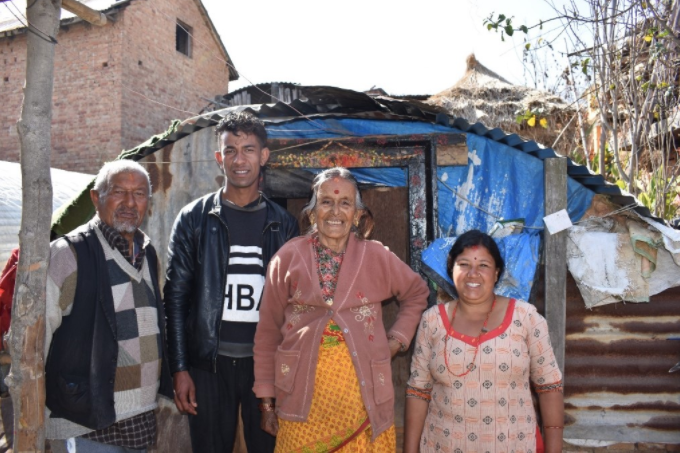
It’s thanks to incredible people like you that Maya was helped. But there are thousands more people like Maya who need access to quality eye health care. Please consider making a donation today and help us give the Gift of Sight to many more – For All The World To See!
