
In the hills of Meghalaya’s Ri-Bhoi District, Robiroy, a young community health worker from Nongpoh Vision Centre, was assigned to serve 47 villages with a population of more than 16,000.
Initially, he encountered skepticism from the community, as people feared medical interventions or had misconceptions. For many, fading vision was simply part of growing old.
To overcome these barriers, Robiroy put aside his medical charts and stepped into courtyards, looking to connect with people with warmth and empathy. Over cups of tea, he listened, shared stories, and spoke of restored sight as a path to dignity and independence.
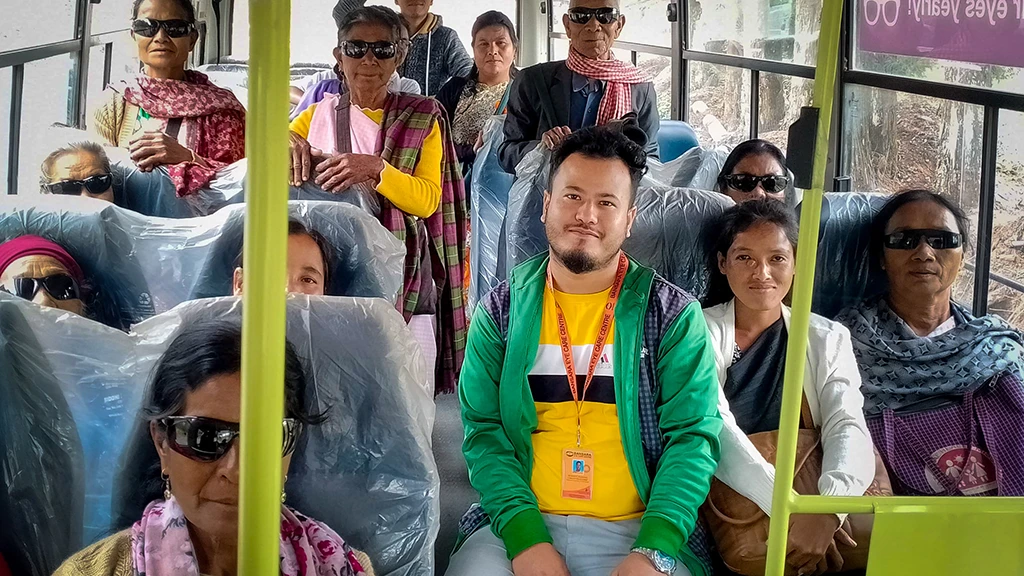
Small victories soon blossomed. An elder who had received eye care could weave again. A farmer saw his fields clearly. Success stories spread across villages. Soon, Nongpoh Vision Centre saw patients surge, and 520 seniors received cataract surgeries. Families began prioritizing eye care across generations.
Currently, five of Robiroy’s 47 villages will soon be declared Avoidable Blindness-Free. He is not just restoring vision – he is sparking an eye care movement!
With files from Emmanuel Benia Tanti, Program Manager, India.
Did you know? Donations to Operation Eyesight help us train community health workers like Robiroy to deliver primary eye care in remote, rural and underserved communities. Donate today.
Eight-year-old Fassikaw lives in Bahir Dar, where he goes to a local primary school. A second-grade student, he once faced challenges that threatened his education and well-being.
When Fassikaw was in first grade, he began to have trouble seeing objects far away. Reading books and the blackboard became difficult. Sitting in the middle or back of the classroom, he often had to borrow his classmates’ exercise books to copy notes.
At home, reading took him a long time. His eyes often watered, and his grades began to drop. More than his grades, his parents worried about his worsening vision and the way it was affecting his mood and sleep. Fassikaw even spoke about leaving school.
Around this time, his family learned about our School Eye Health Program run in partnership with Partners in Education Ethiopia. The program offers free diagnosis and eyeglasses to students in need.
After hearing this, his family went to the hospital and Fassikaw’s eyes were checked. At the hospital, tests revealed that Fassikaw’s vision required strong corrective lenses: +15.00 for his left eye and +16.00 for his right. Thanks to our partners and generous donors, he received the eyeglasses at no cost.
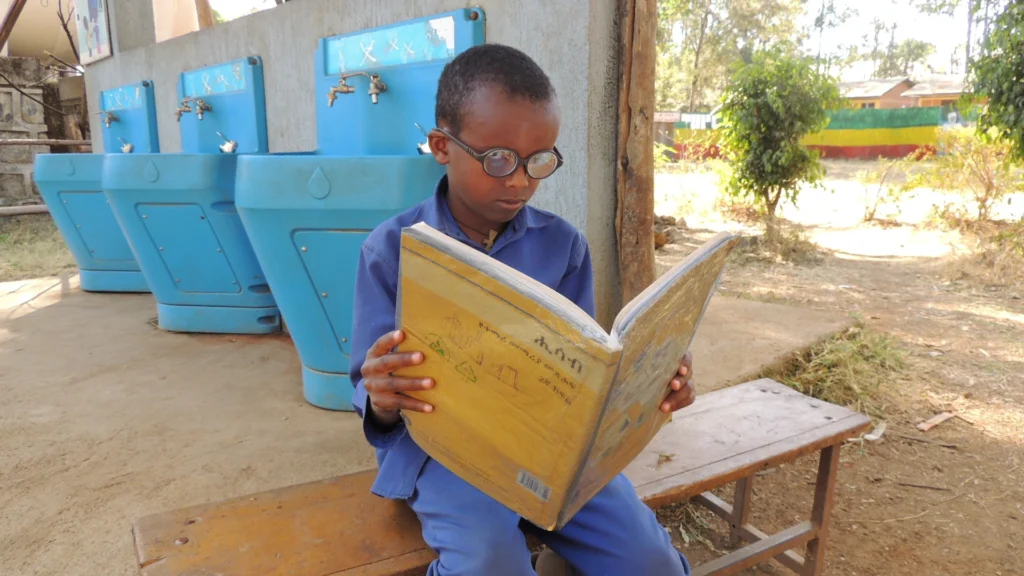
Today, Fassikaw can read easily from anywhere in the classroom. At home, he reads without headaches or watery eyes. His grades have improved, and his class ranking has risen from 27th to 21st, with steady progress.
His father says their son is now happy and confident, and the family can sleep without worry. “With God’s help, we hope you will never have to worry about anything,” he says with gratitude.
By providing eyeglasses through school-based eye health programs, we can transform the lives of children like Fassikaw, helping them see clearly, succeed in school and embrace a brighter future. Give the Gift of Sight today.
Our Work in Ethiopia
Since beginning our work in Ethiopia in 2018, we’ve made significant strides toward preventing avoidable vision loss. In 2024, our programs reached more than 33,424 people through eye health screenings, treatment, training and community outreach. From surveying over 14,000 residents in Debre Work to training frontline workers and teachers, screening students and providing eyeglasses, we are building lasting capacity for quality eye care. Read more about our work in Ethiopia in our 2024 Annual Report. Download it here.
On the day I arrived in Garbatulla, Kenya to begin my work with Operation Eyesight, there was no electricity, so I couldn’t let my colleagues back in Nairobi know that I had made it. The next day, the network came back online, but the incident sums up one of the challenges of working in this area – the difficulty in connecting with people, including many of our community health promoters who live in villages without network coverage.

Many people here in Isiolo County, in Kenya’s arid upper eastern region, are semi-nomadic. They move from place to place in search of pastures for their cows, sheep, goats and camels. Recently, flash floods cut off access to several villages. That’s why the new vision centre we’ve established in Garbatulla – in partnership with Garbatulla Sub-County Hospital – is so important. Now there’s a permanent eye clinic people can visit whenever the roads are open or when herders are back from distant pastures.
When I got here, I stayed at a local mission as I hadn’t found a permanent place to live.
A woman there named Hellen was very kind to me, making sure I got my tea each morning and that I had everything I needed to get settled. When I explained what had brought me to Garbatulla, she said she was struggling with her vision. I encouraged her to come to our clinic, where she was diagnosed with a cataract in her left eye. She was concerned that taking time off would disrupt her duties at the mission, but on the day of her operation she showed up and got it done.
I just had lunch with Hellen recently, and she is doing very well and has made a full recovery. I’m grateful to have helped someone who made me feel so welcome when I first got here

Samson Ngyongesa started working for Operation Eyesight in March 2025. He is the Program Coordinator supporting our Johnson & Johnson–funded Hospital–Based Community Eye Health Project in Garbatulla, Kenya. Samson previously worked for the Asante Africa Foundation, implementing a digital transformation strategy in remote parts of East Africa, and he has a background in economics.

My recent visit to Uttarakhand, India, was an eyeopening experience, showcasing the profound impact of our projects. In January, I joined a team from our partner institute, the Vivekananda Netralaya Super Specialty Charitable Eye Hospital, during a community outreach exercise in the rugged terrain of Rudraprayag, where many villages are accessible only via steep, challenging footpaths.
What touched me most was witnessing elderly men and women blessing our community health volunteers with heartfelt wishes for good health and long life. It’s moments like these that remind us of the true essence of service – not just reaching but becoming a part of the community.
Since 2021, our team has tirelessly brought eye care to the doorsteps of those in the area. Whether braving freezing winters, scorching summers, relentless rains or storms, their commitment has never wavered.
Mountains may test our resolve, but they also teach us resilience and purpose. My sincere appreciation to the entire team for their steadfast dedication to transforming lives in these challenging conditions.
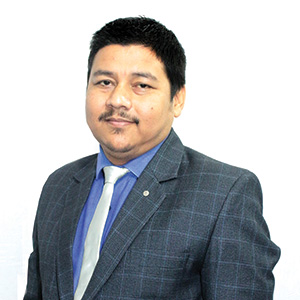
Emmanuel joined our team in India in 2021. As a Program Manager, he oversees programs in the states of Arunachal Pradesh, Meghalaya, Bihar, Uttar Pradesh and Uttarakhand, often joining teams in the field to check in with partners and monitor projects. He has a Master of Social Work and has been working in the development sector for 15 years. He lives in Shillong, Meghalaya with his wife and two sons.
Water is flowing once again at this borehole in Chisamba Village, Zambia. For months, the water point – originally drilled by another organization – was out of service. But thanks to the efforts of William, a 28-year-old Area Pump Minder, it's working again.
Area Pump Minders are volunteers who are trained to repair boreholes in their communities. In 2022, we collaborated with the local government to fund William’s training in borehole maintenance. Today, we’re proud to employ many of the Area Pump Minders we’ve previously trained to assess the dysfunctional water points, source materials and carry out the repairs. After several weeks of work on the Chisamba borehole, William had the hand pump working and water flowing freely again.
The effects of a broken hand pump can be devastating to the local community. In Chisamba, teenaged girls had to walk long distances to fetch water for their families, missing school and facing risks of gender-based violence along the way. Without clean water, the community was vulnerable to infectious diseases like cholera and trachoma – an eye infection that can cause blindness if left untreated.
For one local grandmother, seeing the water flow has brought a renewed sense of hope for her grandchildren, who had been walking up to three kilometres each day to fetch water.
The work we do goes far beyond just creating access to safe, clean water. The borehole becomes a focal point for community interaction and allows people raise extra income by growing vegetables and selling the produce – strengthening both livelihoods and resilience within the community.
Story written with files from Program Manager Tony Kazembe.
Learn more about the ripple effects of clean water by watching our video about boreholes in Zambia's Sinazongwe District.

Sopilal is known for her warmth and kindness throughout Ormakau Village, Kajiado. Her cozy home, with its doors always open, is a sanctuary of joy and laughter for her children and grandchildren who have always admired her perseverance…
You see, a childhood accident left Sopilal nearly blind in her left eye, so she relied entirely upon the right for most of her life. It was a struggle at times, but she managed, and she felt fortunate to see the bright smiles of her family and the tiny beads, needles and string she used to create beautiful artisan jewellery.
But at 78 years old, the one eye she relied upon was no longer clear. Sopilal’s vision faded, her already limited eyesight blurring more and more. No longer could she create her jewellery, nor make out the faces of her children and grandchildren that brought her so much happiness.
She was physically present with her family, but Sopilal felt all alone.
Until one day when a community health worker, trained by Operation Eyesight in primary eye care, made his way, through the rough terrain of nearly impassible roads, to the remote Ormakau village to screen residents for eye conditions. With an initial check, Sopilal was encouraged to seek help for her failing vision. There was likely a simple solution to her predicament.
Accompanied and guided by her daughter, Sopilal visited a nearby health centre where she received her diagnosis – it was indeed a cataract that had been fogging her vision. But there was good news – a simple surgery could restore her sight.

Although the procedure seemed simple and straightforward, Sopilal still found it daunting. What if it didn’t work? What if she could never see her loved ones’ faces clearly again? Sopilal hesitated at first, but her daughter’s gentle insistence convinced her to give it a try.
The day of the surgery arrived, and Sopilal was more nervous than she’d ever been. The procedure was quick, and soon she was resting in the recovery room with her right eye bandaged, still feeling unsure of the outcome.
But the following day her bandage was removed. Sopilal blinked a few times as her eyes adjusted to the light, and then she gasped. The world was no longer a blur of grey! She could see her daughter’s beautiful face!
The next few weeks were filled with joyful reunions and rediscoveries. Sopilal could walk on her own and bead her jewellery once again, unhindered by blurred vision.

Because of donors like you, Sopilal’s isolation ended. She no longer felt alone and was once again filled with the simple joy of living in the company of her children and grandchildren, catching unobstructed glimpses of their smiling faces.
With files from Patrick Wainaina Muthii.
Back in 2013, Dan Pallotta’s TED Talk, The Way We Think About Charities is Dead Wrong, created a ripple effect in the non-profit sector, advocating for the investment in non-profits and a change in the way the sector and the public at large think about overhead. I first had the chance to hear Pallotta speak live in 2019, when Operation Eyesight and other partners brought him to Calgary as part of an educational series focused on maximizing philanthropic impact. I was in awe of Pallotta’s clear passion and his knack for delivering the key messages in such a simple yet inspiring way.
Of course, I jumped at the opportunity to catch his new film, “UnCharitable,” thanks to a screening organized by the Canadian Partnership for Women and Children’s Health. While the documentary, which is based on Pallotta’s book of the same name, had several powerful moments, there was one idea presented in particular that I’ve been reflecting on: Ask organizations about the size of their dreams, not the size of their overhead.
The size of our dreams?
At Operation Eyesight, our vision is the elimination of avoidable vision loss. Our dreams span the globe. Our dreams transcend borders.
Our biggest dream is a world where universal health care, including eye care, is the reality.
Today, 1.1 billion people live with vision loss. Although 90 per cent of vision loss is treatable or preventable, many people worldwide still don’t have access to eye health care.

Eye health care is a critical part of good health and well-being. For a child, good eyesight means the ability to go to school, learn and build friendships. For a parent, healthy vision means being able to care for their children or work to provide for their family. For a senior, access to eye care services means the ability to live with dignity and watch their grandchildren grow up. For adults and children alike, healthy vision means a chance to pursue their dreams.
We believe everyone has the right to healthy eyes; however, many countries globally do not have national eye health policies and strategies that meet the needs of patients and families. This leaves quality, affordable eye health care out of reach for many people. As a result, millions are living with vision loss and blindness that is completely curable, or that could have been prevented from happening in the first place.
It’s time to create a world where avoidable vision loss is a thing of the past, not the thing holding people back from the futures they’ve dreamed about.
At Operation Eyesight, we are currently working with local partners across 10 countries to prevent blindness and restore sight, and we have plans to expand to five more countries over the next five years. As part of our 2024-2028 Global Strategy, we will:
To achieve this, we will generate more awareness of, and support for, our mission, making strategic investments in all aspects of our organization along the way, just as Pallotta encourages. We have already started laying the foundation, investing in areas such as infrastructure and technology, recruitment and team capacity-building, and digital marketing.
We will also create new partnerships – with international NGOs, grant funders, corporations, institutions and other supporters – while strengthening our existing partnerships.
We will continue to join hands with the International Agency for the Prevention of Blindness and our eye health peers around the world to advocate for the integration of eye health care into primary health care systems, with the goal that someday, everyone, everywhere will have access to affordable eye health care.
Through our collective action and the support of our global community, we hope to transform national eye health policies and realize our shared vision of the elimination of avoidable blindness – For All The World To See.
So, ask us about the size of our dreams. And ask us how you can help make these dreams a reality.
The northeast Indian state of Meghalaya is known for its hilly terrain and rainy weather. While that makes for excellent tea-growing conditions, it also means that roads are often rugged, muddy and difficult to navigate.
For residents of remote communities, getting from the village into the city for healthcare can be challenging at the best of times.
It’s especially difficult for those experiencing vision loss.
Now, thanks to a new 14-seat TATA Winger Van, residents in the state’s South Garo Hills have better access to eye health care. The vehicle is bringing health care workers to the area’s most remote villages to deliver eye screenings and referrals, and to transport patients who need further diagnosis or treatment to the Patharkhmah Community Health Centre.
Operation Eyesight’s Dr. Ritu Ghosh handed over the keys to the vehicle to Dr Sapna Dey, State Program Manager, NPCB & VI, with Mr. Ram Kumar, MD NHM of the Government of Meghalaya in February, and the patient transport vehicle is now serving communities in the region.
Thanks to Dan Parlow, member of the Operation Eyesight Canada Board of Directors, for the donation that made this patient transport vehicle possible!
Reaching the remote village of Kachikata, in India’s northeastern Assam state, is no small task. The journey from Jorhat, the nearest city, begins by jeep on rough roads leading down to the Brahmaputra River. From there, travellers climb onto a tiny ferry, big enough only for a handful of passengers, that takes them to Majuli Island. After the boat arrives on the island’s shores, the journey continues by motorcycle, tractor or bullock cart to reach the village.
This makes medical care difficult to access, especially for seniors like Gadami.
For six years, the grandmother lived with cataracts in both eyes. As her vision worsened, she became reliant on family members to help with even simple tasks.
“There was no doctor, no eye camp, nothing,” says our Program Manager Tapobrat Bhuyan, describing the community when he first visited it in 2021.

When community health volunteer, Dipen, met Gadami during a door-to-door screening, he referred her to a nearby eye camp. There, she was diagnosed with bilateral cataracts, and agreed to make the long journey to Jorhat, where she received sight-restoring surgery at our partner hospital, Chandraprabha Eye Hospital, free of charge.
Gadami’s granddaughter, Junu, was by her side to comfort her during the hospital stay and share in her joy when the bandages came off.
Back in Kachikata, Gadami’s world has opened up. With her independence restored, she can once again walk around the village, visit friends and fully enjoy her time with her grandchildren.
Watch a video about our work on Majuli Island!

At first, a trachoma infection looks a bit like a case of pink eye: red, irritated eyes, maybe some swelling and discharge1. But for many people in the world, a trachoma infection is a serious concern. If left untreated, it can lead to severe pain, vision loss and even blindness. The bacteria that cause trachoma spread through direct personal contact, through shared towels and clothing, and through flies that have been in contact with an infected person. And there’s a simple solution for reducing its spread…
Clean water.
When communities have access to abundant clean water, they can wash their hands and faces regularly, do laundry more often, and prevent the otherwise relentless transmission of the disease. That’s why we are working hard with communities and partner organizations to make sure that the people in our project areas have access to a local, sustainable clean water source.

There’s been a lot of good news in the eradication of trachoma in recent years. In 2023 alone, Benin, Iraq and Mali each received certification from the World Health Organization (WHO) for eliminating trachoma as a public health problem. Also, the number of people at risk of getting the infection fell from 125 million in 2022 to 115.7 million in 2023, a significant reduction.2
But the hard work must go on.

Ethiopia has some of the highest rates of trachoma worldwide, with the prevalence in the Amhara Region estimated to be nearly 63 per cent. In that country, trachoma is the second leading cause of blindness overall.3
Trachoma continues to infect people in 42 countries and has caused blindness or visual impairment in roughly 1.9 million people. It remains the leading infectious cause of blindness worldwide. And the effect on the workforce in these countries is huge. According to a recent paper by the WHO, the loss of productivity due to trachoma costs somewhere between US $3-8 billion each year.4
To people like Stephen, in Narok County, Kenya, having trachoma meant not being able to support his family. The father of four, who works as a motorcycle courier, struggled with the infection for years. He tried eye drops, eyeglasses and several surgeries before the trichiasis in his right eye, caused by repeat trachoma infections, was fully resolved.
Since undergoing a successful final surgery at one of our partner hospitals, the young man now acts as an eye health ambassador in his community, making sure people know what the infection is, the role of hygiene in stopping its spread, and how to get it treated.
Years of repeat infection from trachoma causes scarring to the eyelid. This scarring can be so severe that the eyelid turns inward, causing the eyelashes to rub against the eyeball. This leads to severe pain, light intolerance and scarring of the cornea.
If left untreated, the damage to the cornea can cause vision impairment, usually between the ages of 30 to 40 years5, although it can happen in children as well. Trachoma causes 1.4 per cent of blindness globally.6
Women become blind from trachoma four times as often as men. This is likely due to frequent infections they get while caring for small children, who often pass trachoma on to others.
At Operation Eyesight, we follow the WHO’s SAFE strategy for controlling and preventing trachoma. SAFE stands for:
S: Surgery to treat trichiasis (the painful late stage of the disease)
A: Antibiotics to eliminate infection
F: Face washing and hygiene education
E: Environmental improvement including wells and latrines

The foundation for the strategy is environmental improvement, namely – providing access to clean water. Over the decades, we’ve worked with communities to rehabilitate and drill hundreds of boreholes. In recent years, most of our work with water has been concentrated in Zambia and Kenya, but we are also getting involved in more water projects in Ethiopia as we expand our programs there.
Along with drilling and rehabilitation, we work with local governments to make sure people can fix the boreholes when they break down. In Zambia, that means financing the training of volunteers called Area Pump Minders (APMs) to do routine maintenance and repair of boreholes. The program helps ensure that there is a system for repair work, with locally-available toolkits and spare parts, and that monitoring of the water supply is happening at the village level. In addition to helping their communities, some of the APMs go on to find paid work repairing privately-owned boreholes. Over the last two years, we’ve seen several women join the traditionally all-male teams, and we hope to recruit more in future.

The community involvement doesn’t stop there. We also work with volunteers to form WASH committees who help educate other people, especially children, in Water, Sanitation and Hygiene. In Ethiopia, we are working with partners to train teachers in WASH so they can pass on their knowledge to thousands of students. Our work in Ethiopia has also involved fixing up latrines and providing menstrual supplies, both of which can help keep teenaged girls in school longer.
Antibiotics also go a long way to preventing and treating existing cases of trachoma. We work with local governments and partner organizations to provide these antibiotics to areas with high prevalence of trachoma. Earlier this year, we collaborated with partners in a Mass Drug Administration project in Kenya’s Narok County. Despite wet road conditions that made it challenging for crews to access all the communities, the project managed to administer the antibiotic azithromycin to more than 215,000 people!
Throughout the process, our trained community health volunteers work tirelessly to provide education on the importance of facial cleanliness and environmental improvements in stopping the spread of trachoma.
Finally, with help from our generous donors, our partner hospitals can offer surgeries free of charge to people with advanced stages of trichiasis to alleviate the pain and prevent further loss of sight.
We’re involved in clean water projects as a means of preventing trachoma, but the effects of providing clean water to communities are countless. The installation and maintenance of boreholes prevents dozens of waterborne diseases that sicken and threaten the lives of many, and that keep whole communities trapped in the cycle of poverty. Sustainable boreholes help people grow gardens full of fresh vegetables, allow them to raise livestock and improve the quality of life for everyone around them.
The effects of access to clean water are especially beneficial to women and girls. Here’s why:
Education and economic opportunities: In many communities, women and girls are responsible for fetching water, a task that can be extremely time consuming and physically demanding. This can prevent girls from attending school and women from pursuing income-generating activities. When clean water is locally available, girls are more likely to complete their schooling, and women have more time for activities that empower them economically.

Reduced gender-based violence: Providing access to clean water within communities reduces the need for women and girls to travel long distances for water, decreasing their vulnerability to the violence and harassment that they risk when collecting water.
Hygiene and menstrual health: Clean water is essential for maintaining proper hygiene, including menstrual sanitation. When women have access to clean water and sanitation facilities, it positively affects their overall health and dignity.
Community development: Women are often key contributors to the well-being of their communities. When they have access to clean water, they can actively take part in and lead initiatives that enhance the overall living conditions in their communities.
In 2023, we partnered on two new boreholes at schools in Ethiopia’s Amhara Region. In Zambia, we repaired 25 boreholes in the Mkushi District, trained 20 new Area Pump Minders and set up more WASH committees.
You can help us continue our water projects in 2024 by making a donation today. Thank you for your support!

