
Sriramappa, from Karnataka, India, was living with vision loss from cataracts. This left him dependent on his family for his daily needs, and he could no longer support them by grazing his cows and goats. When his wife passed away from an illness, and he lived in darkness, mentally and physically, for three years.
His hope returned when a community health worker visited his home. Sriramappa took part in eye screening and was diagnosed with cataracts. Referred to our partner, Netradeep Eye Hospital (Globe Eye Foundation), Sririmappa accessed sight-restoring surgery free of charge.
Sriramappa expressed his gratitude to our donors. He is now enjoying life’s simple pleasures, especially roaming the forest with his animals, which helps to support his family.
Did you know?
There is a strong correlation between vision loss and age. People who are 50 years of age and older experience 73 per cent of all vision loss according to the IAPB Vision Atlas (2025). This puts people at risk of poverty, dependence and reduced health and well-being. At times, beliefs that vision loss is inevitable or that older people are not worthy of treatment can be barriers to overcome.
Fortunately, 90 per cent of all vision loss is avoidable. This means it can be prevented or treated. Of all the treatments, cataract surgery is one of the most cost-effective solutions. It costs approximately $75 CAD for one cataract surgery and associated cost, such as travel.
Learn how you can support sight-saving work here.
For most of her life, Napolo, from Narok West Sub-county near the Kenya-Tanzania border, lived with constant eye pain. Now 78 years old, she first noticed discomfort in her 30s. Her eyes often felt irritated, as if filled with sand, and she experienced tearing and discharge that made it difficult to see. This attracted flies, but Napolo had no access to clean water to wash her face.
Napolo wasn’t aware that she was suffering from trachoma, a bacterial infection of the eye and the leading cause of blindness in areas with shortages of water and crowded living conditions. The bacteria spreads easily through contact with eye discharge from infected people on hands and clothing, and also through direct transmission by flies.
If left untreated, trachoma causes the eyelids to turn inward, making the eyelashes rub painfully against the surface of the eye. This causes permanent scarring of the cornea and irreversible vision loss.
Without access to regular health care, Napolo turned to traditional remedies. Her family members would pluck out her eyelashes to help ease the pain, but the relief never lasted. The irritation always returned, and over time, Napolo’s vision became worse.
In her Maa community, many people had similar symptoms, and plucking one's eyelashes out was considered normal. Health workers occasionally visited their community, but Napolo often missed them because she was always out looking after her animals, sometimes even crossing over the border to let the animals graze in Tanzania. She somehow managed despite her diminishing vision and increasing pain.
One fateful day, an Operation Eyesight-trained Community Health Promoter visited Napolo’s home – and the visit changed everything.
You see, for many years Operation Eyesight has been working to eliminate trachoma in communities like Napolo’s. Through the Kenya Trachoma Elimination Program, funded by Sightsavers International, Operation Eyesight and partners are working to eliminate trachoma in Narok West Sub-county and the entire country by 2028. With this support, and in collaboration with the Narok County Department of Health, we launched a door-to-door screening initiative to identify remaining cases of trachoma trichiasis – the painful late stage of the disease. We provided training and resources for local Community Health Promoters. They screen people in their communities and refer those in need of eye care to our nearest partner facility.
During a community screening in November 2024, Napolo was identified and referred to Talek Health Centre, an outreach site that provides surgical treatment for trachoma patients. At the health centre, the ophthalmic team examined Napolo’s eyes and confirmed her diagnosis.
Napolo agreed to undergo eyelid surgery to correct her inward-turned eyelids. The procedure was successful, and her recovery brought immense relief, preventing further damage to her eyes and preserving her remaining vision.
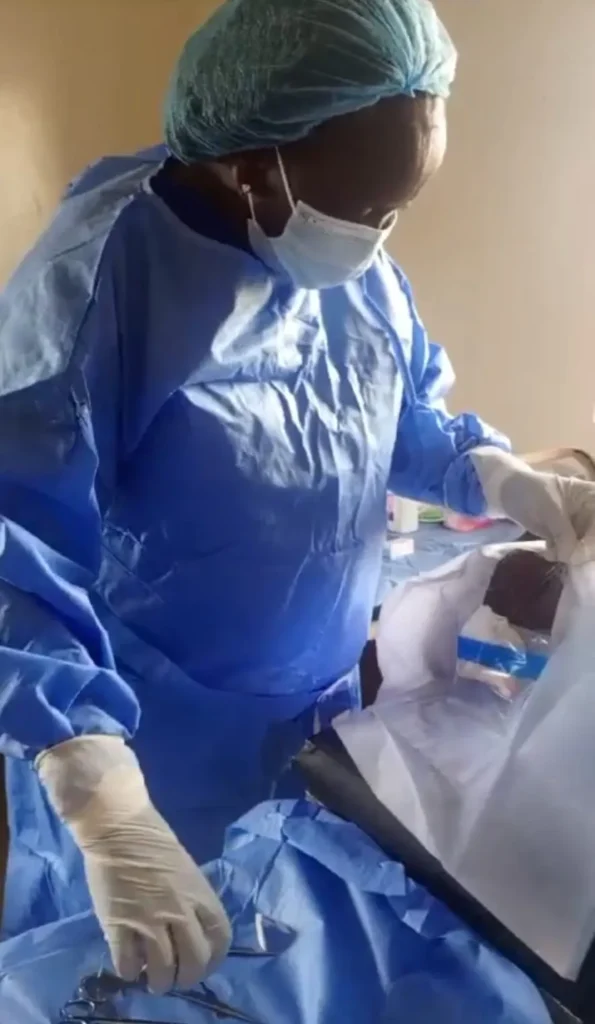
“I have longed for this comfort for decades. There is no more discomfort, and I can open my eyes freely,” Napolo said. “I thank Operation Eyesight and the doctors who assisted me, and I will definitely refer anyone in my community that has the same problem so that they can be assisted.”
Napolo’s story shows how access to quality eye care can transform lives.
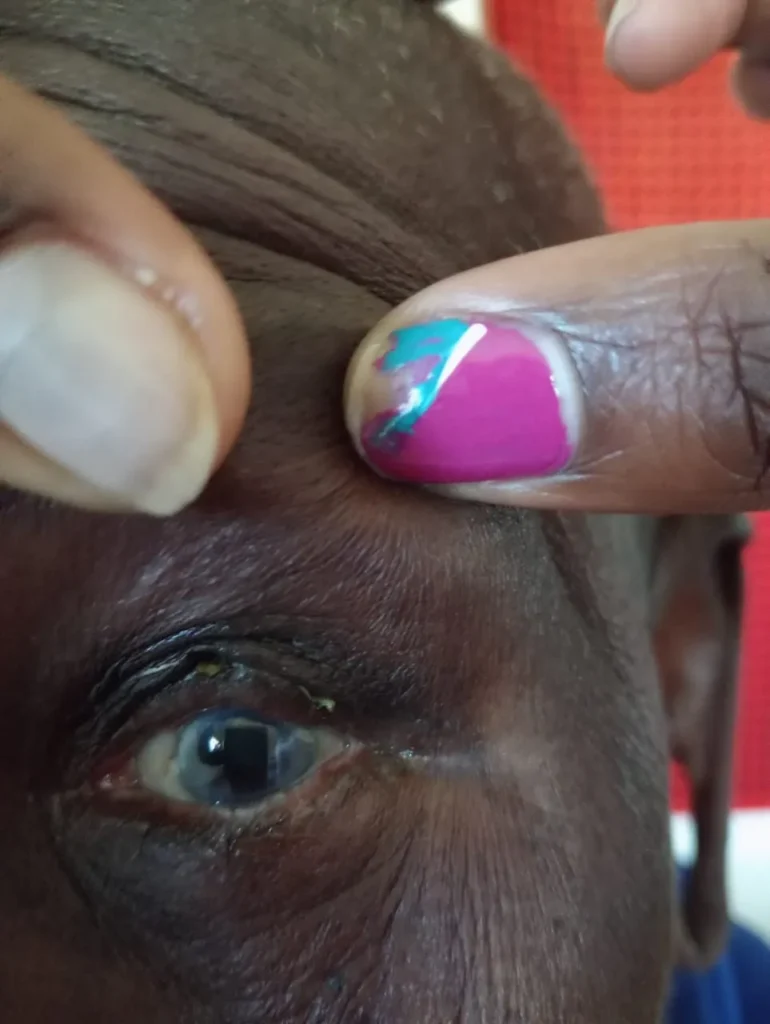
Did you know? Trachoma is the leading cause of infectious blindness.
Currently, 103 million people live in trachoma endemic areas and are at risk of trachoma blindness, and presently 1.9 million people are experiencing vision impairment or blindness due to the disease.1 It is found in 32 countries, in areas with shortages of clean water and crowded living conditions. Caused by the bacteria Chlamydia trachomatis, trachoma is spread by eye-seeking flies and personal contact. Children and women are at particular risk.
Operation Eyesight follows the World Health Organization-endorsed SAFE strategy, which has proven effective in eliminating trachoma. The SAFE strategy is a comprehensive treatment and prevention program that includes Surgery to treat the late stage of the disease, Antibiotics to eliminate infection, Face washing and hygiene education, and Environmental change including wells and latrines.
Join us in supporting programs that bring vital vision care to people like Napolo and also address the root causes of vision loss. Together, we can eliminate trachoma and ensure everyone has access to the eye care they deserve. Give the Gift of Sight today. Join us in supporting programs that bring vital vision care to people like Napolo and also address the root causes of vision loss. Together, we can eliminate trachoma and ensure everyone has access to the eye care they deserve. Give the Gift of Sight today.
Eight-year-old Fassikaw lives in Bahir Dar, where he goes to a local primary school. A second-grade student, he once faced challenges that threatened his education and well-being.
When Fassikaw was in first grade, he began to have trouble seeing objects far away. Reading books and the blackboard became difficult. Sitting in the middle or back of the classroom, he often had to borrow his classmates’ exercise books to copy notes.
At home, reading took him a long time. His eyes often watered, and his grades began to drop. More than his grades, his parents worried about his worsening vision and the way it was affecting his mood and sleep. Fassikaw even spoke about leaving school.
Around this time, his family learned about our School Eye Health Program run in partnership with Partners in Education Ethiopia. The program offers free diagnosis and eyeglasses to students in need.
After hearing this, his family went to the hospital and Fassikaw’s eyes were checked. At the hospital, tests revealed that Fassikaw’s vision required strong corrective lenses: +15.00 for his left eye and +16.00 for his right. Thanks to our partners and generous donors, he received the eyeglasses at no cost.
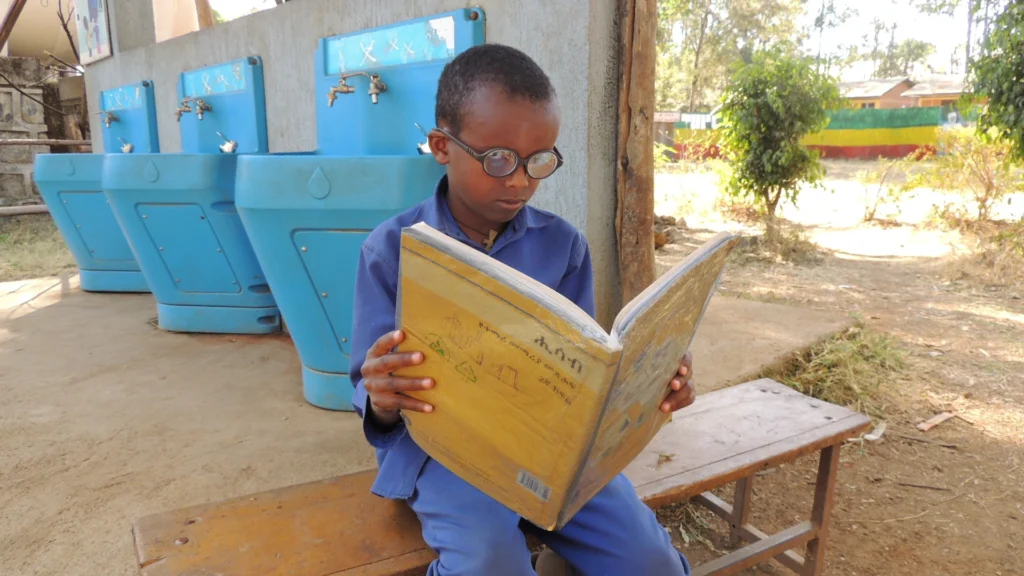
Today, Fassikaw can read easily from anywhere in the classroom. At home, he reads without headaches or watery eyes. His grades have improved, and his class ranking has risen from 27th to 21st, with steady progress.
His father says their son is now happy and confident, and the family can sleep without worry. “With God’s help, we hope you will never have to worry about anything,” he says with gratitude.
By providing eyeglasses through school-based eye health programs, we can transform the lives of children like Fassikaw, helping them see clearly, succeed in school and embrace a brighter future. Give the Gift of Sight today.
Our Work in Ethiopia
Since beginning our work in Ethiopia in 2018, we’ve made significant strides toward preventing avoidable vision loss. In 2024, our programs reached more than 33,424 people through eye health screenings, treatment, training and community outreach. From surveying over 14,000 residents in Debre Work to training frontline workers and teachers, screening students and providing eyeglasses, we are building lasting capacity for quality eye care. Read more about our work in Ethiopia in our 2024 Annual Report. Download it here.
In a small village in Bangladesh, 60-year-old Gulbahar lives alone and supports herself. She works as a maid, stretching every ounce of strength to make it through each day.

Her world grew darker as cataracts began to cloud her vision and left her nearly blind. Everyday things like walking through crowded streets, cooking with the right spices and finding her way around her home became uncertain and difficult.

Despite the challenges, her spirit stayed strong as she searched for the right eye health treatment, only to discover that the surgery she needed was far beyond what she could afford.
One day she heard about a nearby outreach eye care camp by Operation Eyesight. Gulbahar made her way to the camp and embraced the chance for cataract surgery.

She received cataract surgery at no cost. When the bandages were removed, she smiled.
"I can see my world again,” she said. “I don’t need to stumble in the dark anymore. I’ve been given a second chance.”

Today Gulbahar is back on her feet. She works and moves through her days with confidence and no longer depends on others. Her restored vision gave her more than sight. It gave her freedom.
But stories like Gulbahar’s are far too common.
You can help change that. Your contribution provides people with the knowledge and resources they need to regain their vision and independence.

By giving the Gift of Sight, you can help prevent blindness, restore sight and create second chances for more people like Gulbahar. Thank you for your support!
Vision loss affects nearly every facet of a child’s life. Some studies suggest that up to 80 per cent of learning is visual. That’s why we’re bringing eye health services to students in classrooms across our countries of work.
“Our school eye health program is giving students more than just access to eyeglasses or sight-saving procedures,” says Dr. Ritu Ghosh, our Global Director of International Programmes. “Together we are giving children the chance to attend school, build social connections and thrive.”
Using innovative technology, such as the Peek Acuity app and KoboToolbox, we are training teachers and community health nurses to identify and refer students with eyesight problems. This enables us to connect students and their families with eye health care as well as their local health care systems.
“By equipping staff and teachers to identify eye health issues, and by creating a referral network with our partners, we are creating sustainable solutions that ensure families have access to eye health care long after a school eye health project wraps up,” Dr. Ghosh adds.
In 2023 in Zambia, we provided primary eye care training to 20 school teachers from 15 schools. As a result, more than 3,500 students were screened for eye health issues, and 269 students received a free pair of eyeglasses.
“These glasses are changing everything in my life for the better,” Salome says. “I am focusing on improving my grades so that I can become a doctor and help other kids like me!”

“I spent many nights crying that I couldn’t be there for my mom who does so much for our family,” Isaac shares. “I feel more confident and happier now that my vision has returned to me.”

"Our corporate elations program is an exciting opportunity for companies to financially support eye health initiatives and engage their staff by providing volunteer opportunities,” explains Subhadip Bhattacharya, our head of fundraising in India.

Eileen Giuliani’s support for Operation Eyesight is rooted in her compassion for others and her own battle with avoidable vision loss.

In 1988, while waiting for her semiannual eye exam at a local clinic in Vancouver, Canada, she saw a poster for Operation Eyesight on the wall. By then, Eileen had been at risk of glaucoma for 37 years. Frequent eye checkups were crucial to monitor the risk.
In 2004, she was diagnosed with closed-angle glaucoma, which could lead to severe increase in eye pressure and vision loss. Eileen’s vision was saved, thanks to regular checkups, quick diagnosis and immediate laser surgery.
Eileen then became an advocate for Operation Eyesight. Since her first gift in 1988, she has helped bring eye care to many across South Asia and sub-Saharan Africa.
A healthcare professional herself, Eileen worked for the welfare of others. In 1970, she volunteered as an X-ray technician in the Caribbean Island of Dominica. It informed her of the disparities in healthcare and deepened her love for humanitarianism. A few years later, she became one of the early technologists to learn ultrasound, a role she cherished for 39 years.
“I can only imagine what it would be like to be blind,” Eileen says.
“I believe in Operation Eyesight and encourage others to look into its programs.”
Thank you for your dedicated support, Eileen!
The power of the Gift of Sight is something Rob and Connie both learned early in life. It is part of a legacy of giving that now spans four generations.
Connie’s parents, Walter and Sara Derewianchuk, were active donors to Operation Eyesight, and they shared with their children the power of giving. Likewise, Rob’s parents, Bill and Nora Holland, were also Operation Eyesight donors. For both families, early memories of Dr. Ben Gullison, the physician who inspired Art Jenkyns to found Operation Eyesight, left lasting impressions. Connie remembers him standing before the congregation at her family’s church in Emerson, Manitoba, discussing Operation Eyesight’s work.
“I was in the front pew as a child, listening to Dr. Gullison speak. While he spoke, my younger sister dropped a ball that rolled directly down to him,” Connie recalls. “He simply picked it up and threw it back to my older sister, who was so embarrassed to have to catch the ball from Dr. Gullison. He was not phased by anything.”
Rob, who began donating at just 17, recalled Dr. Gullison showing slides of cataract surgeries performed on patients. These slides soon became real for him, when he encountered a woman with cataracts while he was travelling in Morocco.
“I realized that for many, like the woman I encountered, there was no special support for an older woman experiencing cataracts,” he says. “Although I was in Canada where we have all kinds of support for people experiencing eyesight issues or blindness, I recognized there is something I can do for others through Operation Eyesight.”
After they were married, Connie and Rob passed on the importance of the Gift of Sight to their children. Over their kitchen table, they would discuss philanthropy and what a donation could achieve. They say their goal was to instill in their children the idea and feeling of gratitude.
In a book Rob recently wrote for his children and grandchildren, he notes that donating to Operation Eyesight is his greatest pride. “With our donations to Operation Eyesight, you know that somebody who was blind last month – this month they can see,” Rob says. “So, it is a concrete way of giving.”
Rob’s book has inspired his grandchildren to begin their own fundraising efforts for Operation Eyesight.
“By giving to Operation Eyesight, you know that your donation will help people. It is good to think about who you are giving to, where, and the practicality of your donation,” Connie says.
Rob agrees.
“Whatever your motivation, I think giving should be part of everyone’s life. My giving is an expression of gratitude. Probably until I die, I will give something to Operation Eyesight.”
Thank you, Rob, Connie and family, for your generous support!
Today, we are one of the few nongovernmental organizations partnering with the Government of India to open vision centres in existing government health facilities, bringing quality eye health care to underserved communities.
Together, we are establishing and equipping vision care facilities, training existing healthcare staff and developing a continuum of care for patients – from diagnoses at the community level, to referrals for specialized treatments at hospitals, to follow-up care.
The approach was initially launched in three districts in the state of Arunachal Pradesh, in partnership with Jhpiego (an affiliate of Johns Hopkins University) and the state Ministry of Health. Based on the project’s early success, with the support of Optometry Giving Sight, we are now replicating the model in the states of Madhya Pradesh and Meghalaya.
“It’s not about re-inventing the wheel. Integrating basic eye care into the existing primary health care system helps ensure that patients can receive care in a way that is cost-effective, practical and, above all, sustainable," explains Dr. Troy Cunningham, our country director for India.
“This is how we reach the most disadvantaged populations, as patients who are able to pay most typically seek care at for-profit facilities, rather than attending government services.”
Asafora is like many other small villages in central Ghana; its several hundred residents are mostly farmers growing cassava and plantain, and many community members have faced barriers to accessing eye health care.
What sets this community apart? It is the first village in the country we declared Avoidable Blindness-Free.
The December 2022 declaration event was several years in the making and is the product of collaboration between the community, the local government and our partner, Saltpond Government Hospital.
“Avoidable Blindness-Free means that the village is free of untreated vision loss,” explains Emmanuel Kumah, our country director for Ghana. “It also means that people in the community know where to receive care. This is important in communities like Asafora, where there has historically been resistance to receiving eye care.”
Our partnership with Asafora began in 2017 with primary eye care training for 10 local community health nurses. This team conducted door-to-door surveys to identify people with eye conditions, distributed vitamin A supplements and provided basic immunizations. Patients with cataract and other eye conditions were referred to the hospital for treatment.
We conducted a second door-to-door screening in 2021 to see how patients were doing and discovered several patients had refused care.
“We realized there was a lot of resistance to receiving eye care within the community, due to misconceptions about surgery,” Emmanuel explains. “We had to double down on our efforts to educate the community and inspire behavioural change.”
Community health nurses were deployed. They knocked on doors and attended churches, mosques, and child and newborn care sessions where they provided eye health education. Creating awareness and encouraging people to seek eye care helps ensure a village becomes, and stays, Avoidable Blindness-Free.
The declaration event was a landmark for public health in Ghana, and Asafora is the first of many rural villages to be declared Avoidable Blindness-Free in the country.
A group of women and men cluster around a table, peering at an illustration on a digital drawing tablet held up by artist Anil Kumar. The illustration depicts a young girl showing her mother a school certificate. One of the women looks closely at the illustration before making a comment. “The girl should be holding a trophy,” she says. The others agree – a trophy is a better symbol for school achievement than a certificate alone. The artist begins sketching a trophy into the girl’s other hand. The group nods their approval of the change.
The scene above was one of many such moments observed by the Operation Eyesight team during a recent community workshop in the city of Udhampur in northern India. The goal of the workshop was to get input on some new educational materials from members of the communities where they will be used.
The illustration described above is from a series of flash cards that tell the story of a mother with vision problems who doesn’t understand why her daughter has received an award at school because she can’t read the writing on the certificate. The story is meant to jumpstart conversations about why women in the region are often hesitant to seek out eye health care.

Over two days, eight community members from several villages in our project area worked with an Operation Eyesight team that included an artist, a writer, a gender equality specialist and several of our program managers.
“It’s important to note that the community was the driver for these materials,” says Dr. Troy Cunningham, our Country Director for India. “Our experts took the backseat. The images were decided by the community members, the stories were decided by them. Even before the artist and writer sat down with the community, we took them around the villages to meet people with eye problems.”

The new educational materials are just one small part of a larger eye health project we are undertaking in the region. Called “Empowering Women in Rural India by Debunking Feminine Eye Health Myths,” the project was launched in 2022 in partnership with the nearby Rotary Eye and ENT Hospital in Udhampur, and Edmonton’s NorQuest College. The project is being funded by the Inter-Council Network’s FIT program, which stands for “The Fund for Innovation and Transformation”. The program is designed to support Canadian organizations so they can test innovative solutions for advancing gender equality in the Global South, and is funded by Global Affairs Canada.
The Udhampur Block stretches over miles of hilly Himalayan terrain in India’s Union Territory of Jammu and Kashmir. Roads connecting the region’s villages are prone to flooding and landslides. For many, it’s difficult to leave the village to seek any kind of health care, so vision problems often go ignored, especially for women and girls.
What’s more is that there are a number of gender-related eye health myths that also create barriers to seeking medical care. As a result, our team designed a custom project for the region, which includes sending a four-wheel drive mobile vision clinic staffed with an all-female healthcare team into the area. We have also trained local women as community health workers. These health workers use the new educational materials in their daily work.
Here is a snapshot of some of the new materials that our team and the community members have developed.

Jhanoo is the oldest rhinoceros in her clan. She can’t see well because of her cataracts, but she thinks that she is too old to have them treated. The youngest member of the clan, Banoo, convinces her that she should see the local community health worker. After the visit with the health worker, Jhanoo agrees to get cataract surgery, and after the operation she enjoys a more independent lifestyle. She also gets back to a key role she plays in her community – teaching math to the local children.
This story is designed to ease fears of surgery and show the community how important eye health is to even its oldest members. It is presented to the community participants as a series of flash cards that they put in order to tell the story.
Cunningham says that, initially, his team was concerned that the community members would be offended by the artist’s use of animals to depict people, but they decided to wait and see what feedback they would receive at the workshop in Udhampur. To the team’s surprise, the community members loved the rhinos and told the artist to stick with the theme.

Rani is an embroidery artist. She has a pair of eyeglasses, but she doesn’t wear them because her parents worry they will affect her chances of finding a good life partner. As a result, she makes a lot of errors in her work and her supervisor is unhappy with her. She speaks to a friend who convinces her to wear her glasses more often. Her work improves and she gets a promotion.
This story, shared through a poster, is aimed at getting more young women to seek treatment for vision problems and to wear their eyeglasses. It’s meant to combat the stereotypes that prevent many women from addressing their vision problems.
For the past few months, community health workers in the Udhampur region have been piloting these new materials as they conduct surveys and workshops throughout the project area. Along the way, the team has been continuing to tweak and update the materials to make sure they best serve the communities.

Project Manager Tapobrat Bhuyan says the materials are important tools for understanding the issues in each village.
“They can explore the main concepts and myths through the stories told in the materials,” he says. “All the materials come with a session guide, and there are some excellent questions in the guide that help them to understand the problems in the community.”
The project is just one more way we are working towards the United Nations’ Sustainable Development Goals (SDGs), particularly SDG number five, Gender Equality.

