
When I first met Mary*, she told me how she had been blind since 2012. She had started losing her vision when she was very young – when she was a new bride and expecting her first child. Living in a rural area, far from any hospitals, she went to a traditional healer for help but continued to lose her sight. People whispered that she must have been doing witchcraft that backfired on her… asking what else could explain blindness in someone so young. Believing the witchcraft rumours, Mary’s husband left her before the baby was born. Her family abandoned her too. The only person who helped Mary was her niece, who has been supporting her and her child all this time.
When the niece heard that Operation Eyesight was offering free eye exams, she brought Mary to a surgical camp we were hosting. After all her years of alienation, Mary had little confidence in getting her sight restored, but she agreed to a checkup in hopes that it would reduce the eye pain she was experiencing. The team diagnosed her with bilateral cataracts and recommended surgery, which she agreed to.
I went to check on her in hospital shortly after her bandages came off. I was initially disappointed because she kept saying, “No, I can’t see you. I can't see anything.” Worried something had gone wrong with the operation, I called her over to see the doctor, when she finally said, “Actually… I can see you, but I’ve been blind for so long, I thought I was imagining you! I’ve been able to see you the whole time.”
She erupted into laughter, then tears. Her niece joined in.
We escorted her home by bus, and the whole time she was pointing and smiling at things she saw rushing by through the window. She said her greatest excitement was seeing the face of her daughter – now 12 years-old – as soon as she got home.
*name has been changed to protect the patient’s privacy

Candy Siadibbi joined our Zambia team in 2022, first working in the Lusaka area before relocating to Mkushi, in Central Province. She has a bachelor’s degree in psychology and public administration from the University of Zambia. Before joining Operation Eyesight, she worked as a research assistant, freelancing with various nonprofit organizations.
Eye health care is more accessible than ever for people in Zambia’s Chikankata District, thanks to the new eye clinic at the Kafue Gorge Hospital.
The clinic was inaugurated in December with music, dance and speeches. We supported the construction of the building and provided ophthalmic equipment and furnishings, all made possible by the generosity of donors like you.

Zambia Country Director Phiri Kennedy says, “This is a proud moment for Operation Eyesight. We will continue to support the government through this and many other interventions, to take services closer to the people and prevent avoidable vision loss. We urge the community in Kafue Gorge to fully utilize this service to prevent people from losing sight unnecessarily.”
The clinic now offers a variety of services, from comprehensive eye exams to surgical services and referrals.
The OneSight EssilorLuxottica Foundation, our longstanding partner, is supporting the project by equipping the optical shop to dispense eyeglasses.
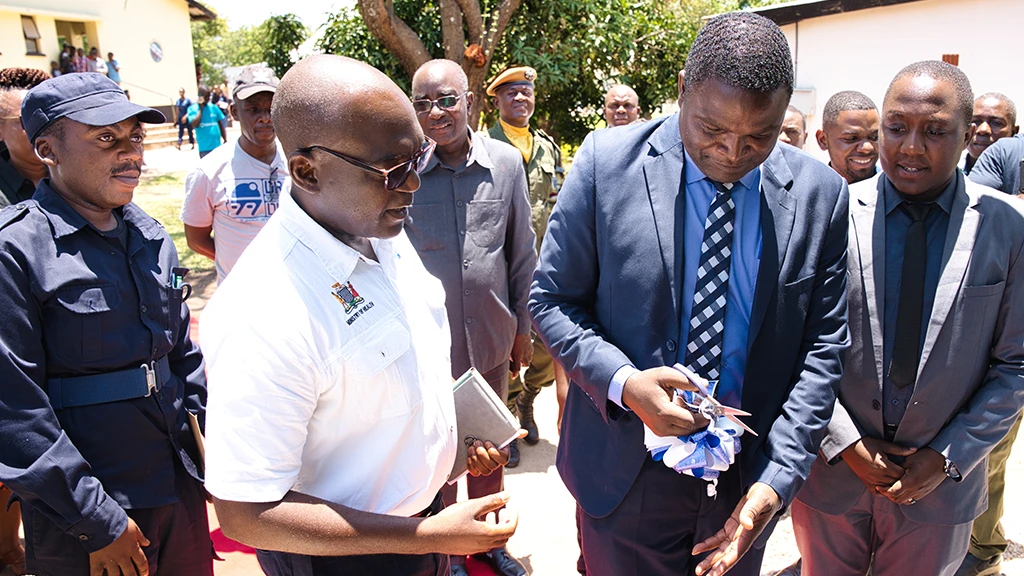
Beyond the 16,000 people directly served by the clinic, there are another 15 health centres that refer patients to Kafue Gorge Hospital, meaning our investment in this new eye clinic will benefit thousands more people – and their families – in the surrounding districts.
Learn more about our work in Zambia.
Water is flowing once again at this borehole in Chisamba Village, Zambia. For months, the water point – originally drilled by another organization – was out of service. But thanks to the efforts of William, a 28-year-old Area Pump Minder, it's working again.
Area Pump Minders are volunteers who are trained to repair boreholes in their communities. In 2022, we collaborated with the local government to fund William’s training in borehole maintenance. Today, we’re proud to employ many of the Area Pump Minders we’ve previously trained to assess the dysfunctional water points, source materials and carry out the repairs. After several weeks of work on the Chisamba borehole, William had the hand pump working and water flowing freely again.
The effects of a broken hand pump can be devastating to the local community. In Chisamba, teenaged girls had to walk long distances to fetch water for their families, missing school and facing risks of gender-based violence along the way. Without clean water, the community was vulnerable to infectious diseases like cholera and trachoma – an eye infection that can cause blindness if left untreated.
For one local grandmother, seeing the water flow has brought a renewed sense of hope for her grandchildren, who had been walking up to three kilometres each day to fetch water.
The work we do goes far beyond just creating access to safe, clean water. The borehole becomes a focal point for community interaction and allows people raise extra income by growing vegetables and selling the produce – strengthening both livelihoods and resilience within the community.
Story written with files from Program Manager Tony Kazembe.
Learn more about the ripple effects of clean water by watching our video about boreholes in Zambia's Sinazongwe District.

Between textbooks, whiteboards and videos in class, most of the information that’s presented to kids at school is visual. So what does that mean for a child who can’t see clearly?
In countries where eye health care is difficult to access, a simple eye condition like myopia (nearsightedness) can cause a student to fall behind and even drop out of school, which in turn could affect the child’s income for the rest of his or her life.
Ensuring that Quality Education is available to all children is one of the 17 Sustainable Development Goals set by the United Nations’ 2030 Agenda. We’re working towards this goal by ensuring that more children get the eye health care they need to thrive at school and take charge of their education.
According to a survey by the World Bank, children with visual impairments in sub-Saharan Africa are five percentage points less likely to ever be enrolled in school or to complete primary school. They are six percentage points less likely to be literate.1
The links between academic performance and visual impairment can be harder to draw given the complexity of the issue, but one survey from francophone countries in Africa found that primary school students – who self-reported difficulties with their vision – performed worse on standardized tests in math and reading in all but one of the 10 participating countries.2 Similarly, a Stanford study of 20,000 fourth and fifth graders in rural China found that eyeglasses boosted the standardized test scores by 18 per cent over six months.3

Even studies from higher income countries, where children have better access to eye health care, show that students with poor vision tend to read more slowly than their peers and are more likely to report that they don’t like reading.4 Visual fatigue is a likely culprit for both, and the resulting headaches and tiredness that these kids experience are also thought to play a role in behavioral issues at school.
Roughly 22.16 million children ages 14 and under have Moderate to Severe Vision Impairment (MSVI) and 44.6 million have mild vision impairment, according to a panel of global health professionals called the Vision Loss Expert Group.5
Only 20-50 per cent of the children who need prescription eyeglasses worldwide actually own a pair.6 Often, this is due to a lack of access to eye health care. In rural, remote or underserved communities, especially in low- and middle-income countries, many kids don’t get regular eye exams or have access to prescription eyeglasses and other treatment. This could be due to financial constraints, lack of education about the importance of eye health, or simply because there aren’t any optometry clinics nearby.
Across lower-income communities, schools may also lack electricity or lighting, making it even more difficult for a student with vision impairment to read information written on a blackboard. Lack of adequate lighting at home can also cause difficulties in completing homework. For a secondary student who is already falling behind in class, not being able to finish homework in a timely manner could end their school career, and cause them to drop out early.

Isaac Baffoe, who manages our school eye health programs in Ghana, says one student’s story really stuck with him. The girl reported that her eyesight started to fade when she was about 12 years old, and by age 15 she had severe vision impairment. For years, she relied on a classmate to read the blackboard out loud to her during class. Isaac often wonders what would have happened to her if her friend hadn’t been so helpful, or even more importantly, if our school eye health program hadn’t reached her school and she hadn’t gotten prescription eyeglasses.
Our field staff hear a lot about the difficulties that students face before they get eyeglasses. One student in Ethiopia reported that she and her friend were frequently scolded when the friend read the blackboard notes aloud to her. Others reported that their grades dropped sharply, or that they lost interest in their studies. Many children say that they asked their parents to take them to the eye doctor, but due to tight finances or difficulty in reaching a clinic, they weren’t able to get the eye care they needed.
The good news is that, with your ongoing support, we are changing all of this – one school and one child at a time.

Part of our goal at Operation Eyesight is to reach every single member of a community with eye health care, ensuring that nobody gets left behind. Increasingly, we’re screening school-aged children for eye issues right in the classroom.
In 2023 alone, our school eye health programs helped us screen more than 240,000 students in Bangladesh, Ethiopia, Ghana, India, Kenya, Nepal and Zambia.
In Kenya, we’ve partnered with the United States Agency for International Development’s (USAID’s) Child Blindness Program and Peek Vision to deliver an innovative program where teachers are trained to do the initial eye health screenings using a simple smartphone app. This allows us to screen more students overall, while still providing referrals to those children identified with eye problems to get a complete eye exam with a healthcare professional.

In Ghana, we train community health nurses to help deliver our school eye health programs, also in partnership with USAID and with funding from the Church of Jesus Christ of Latter-day Saints and Latter-day Saints Charities. In addition to conducting school eye health screenings, the nurses provide the students with eye health education sessions, where they learn how to prevent eye injuries and infections and learn about various conditions, like refractive errors (the need for eyeglasses). By making sure children have basic eye health information and know where to go for subsidized eye care, whole families are made aware of the services that are available to them.
Isaac, who has been on hand during several of these school screening events, says the children are always very eager to get involved. “The children show lots of interest. They want to participate,” he explains. “During all the screenings we’ve attended to audit, the children are very cooperative, they really want to know what is going on.”
He adds that it’s not just the students who are happy with getting a pair of eyeglasses.
“It’s not only a relief to the children, but also to the teachers,” he says, “because it also made their work difficult to spend extra time with these children who were struggling with their studies prior to receiving eyeglasses.”
In November 2020, the borehole in the Zambian village of Kangwa broke down. The COVID-19 pandemic was in full swing, and the need for clean water was more urgent than ever. For Natasha, a teenager who was in high school at the time, the breakdown had devastating consequences. As the family member tasked with fetching water, Natasha now had to walk several kilometres each day to complete the chore, meaning she could no longer attend school. She wasn’t alone – other teenage girls in her community were in the same situation.

When our team in Zambia found out about the broken borehole, they sprang into action and quickly got it fixed. They were well equipped to do so, because we have been working with communities to repair and drill boreholes for many years to curb the spread of trachoma.
Trachoma is a bacterial eye infection that’s common in areas with water shortages and crowded living conditions. The bacteria spreads easily through contact with eye discharge from infected people on hands and clothing, and also through direct transmission by flies. If left untreated, it can cause severe pain, vision loss and even blindness. In fact, it is the leading infectious cause of blindness worldwide.
When we work with communities in areas of Zambia, Ethiopia and Kenya where trachoma is endemic, we ensure that water and sanitation issues are part of our intervention. In communities like Kangwa, this means training local volunteer teams to help maintain and repair broken boreholes, and training community WASH (Water, Sanitation and Hygiene) teams to educate their neighbours about preventing trachoma transmission in the home.

In order to ensure that girls have equal access to quality education, clean water and sanitation facilities must be part of the solution. (Watch this video to learn more about the ripple effects of clean water.)
Myopia (nearsightedness) rates are on the rise all over the world. In 2020, the global prevalence was 30 per cent. It’s estimated to rise to 50 per cent by 2050.7
In China, where the rise in myopia in children is being described as an epidemic, the government has rolled out a nation-wide strategy to curb the growth, which includes school-based eye screenings, public health education campaigns, a reduction in homework and an increase in time spent outdoors.8
As suggested by China’s strategies, many of the factors contributing to the rise of myopia are likely due to modern lifestyles: more time spent indoors, doing near-work like homework, and more time spent parked in front of digital devices.
But there may be more at play in the phenomenon, including environmental risks like increasing urbanization and changing diets. As low- to middle-income countries become more urbanized and educational pressures mount, children everywhere are at increased risk of developing the refractive error. In parts of Africa and Asia where families already face difficulties accessing eye health care, the gap between eye health services and those in need of treatment will continue to grow.
As part of our 2024-2028 Global Strategy, we are committed to providing eye health care and clean water to more children so that they can take full advantage of any educational opportunities they are presented with. This means integrating WASH projects with school eye health projects and rolling out more school eye health programs across our countries of work.
We have already seen much success with our school eye health programs in countries like Kenya and Ghana, where we’re working with the local ministries of health and education. Now, it’s time to scale our efforts to more schools, more districts and more countries. With your ongoing support, we can expand our reach and improve the quality of life for more kids around the world.
Donate today and help us restore sight and prevent blindness for more children. The Gift of Sight is the gift of education and the gift of opportunity. Thank you for your support!
For most of his adult life, Abraham made a living as a cobbler, supporting his wife and raising six children on his earnings. But several years ago, he started having trouble threading needles. Initially, he pricked himself repeatedly, and eventually, he couldn’t get the needles threaded at all. Due to his poor eyesight, Abraham had to shut down his shoe repair business.
His story is a common one. Global estimates suggest that people with moderate to severe vision impairment are about 30 per cent less likely to be employed than those with good eyesight.1 For lack of a pair of eyeglasses, for want of a simple cataract surgery, millions of people are unable to work. It can keep entire families stuck in the cycle of poverty.

Abraham’s story has a happy ending. After meeting a community health volunteer during a door-to-door eye health screening, he was diagnosed with bilateral cataracts and got sight-restoring surgery on both of his eyes at one of our partner hospitals. He started taking in shoes for repair once again.
But many people won’t get back to work like Abraham did. And that’s because basic eye care isn’t available or accessible to them. According to estimates, about 2.2 billion people worldwide have vision impairment, and in roughly half of those cases, the vision loss could have been prevented or hasn't yet been treated.2
For many people across the globe, the neighbourhood optometry clinic simply doesn’t exist. While people in Western Europe enjoy a ratio of one optometrist to every 3,877 people, countries in central sub-Saharan Africa reported a ratio of one to every 1,198,141 people, according to a 2023 study.3 Even when there is an eye care provider in a nearby city, the barriers to reaching them can be insurmountable for some people living in remote and rural areas. Many can’t afford the bus or train fare, let alone the fees for diagnosis and treatment. And for women and children, travelling alone can be dangerous, so they often need to wait for someone – usually the family breadwinner – to take time off work to escort them. For those with seriously impaired vision or other disabilities, travel might be nearly impossible.
Every day, the community health workers who do eye screenings on our behalf meet people who have previously tried to solve their vision issues without success. Many patients had visited the nearest healthcare provider, often a local dispensary, and were sent home with eyedrops or told their vision couldn’t be treated. Some had bounced around from clinic to clinic, others had resigned themselves to living out their days in blindness. That is why we are working hard to provide eye health care services at the community level.
By connecting people with our partner vision centres and hospitals, helping cover fees and offering safe transportation to the hospital, we can help restore vision to people who may never have gotten treatment otherwise. It’s just one of the ways we are working towards the United Nations Sustainable Development Goal number one: No Poverty. By addressing some of the root causes of poverty, like poor eyesight, we can help people stay employed and stay in school.
The global productivity loss attributed to impaired vision is estimated at US $411 billion annually.4 And those effects can be seen on the individual level as well.
A recent study looking at workers with presbyopia between the ages of 35-65 in Bangladesh found that those who had reading glasses made 33 per cent more than those who did not.5 The study, published in PLOS ONE, tracked the incomes of more than 10,000 participants who work in near-vision intensive occupations – like tailors, mechanics and carpenters – over eight months. Half of the participants received reading glasses right away, while the control group only got a pair after the eight months of data collection. The eyeglasses themselves cost only about US$3-4 per pair but had the potential to transform the lives of the workers.
Another study of tea pickers with presbyopia in India found similar results in 2018.6 In that case, the three-month study found that a pair of reading glasses increased productivity for the plantation workers – who are paid by the kilogram of leaves picked – by about 22 per cent, and 32 per cent for those over the age of 50.
As these studies show, addressing vision loss can increase productivity and provide greater economic opportunities for individuals.
Like many other health issues, it can be difficult to untangle the relationship between low incomes and eye health problems. Poor vision can lead to poverty because people often lose or quit their jobs when they’re no longer capable of doing them effectively or safely.

Take Junmoni in India, for example. The mother of two dreamed of sending her daughter to college with her earnings making handwoven fabrics on her loom. But when her vision became blurry, she had to stop weaving. Money got so tight that she was on the brink of selling her handloom. Fortunately she met a community health worker who told her she just needed to visit the local vision centre to get a pair of eyeglasses. Junmoni now wears her prescription eyeglasses while working at her handloom, her dreams for her daughter back on track.
But just as vision loss can lead to poverty, the opposite may also be true.
An infectious eye disease, called trachoma, continues to cause vision loss and blindness in dozens of countries around the world. It is widespread in some rural areas, and also in regions where there are high rates of poverty. The bacteria spreads through personal contact, via hands, clothes and bedding, and by flies that have been in contact with discharge from an infected person. It is most common in areas where people don’t have access to clean water or have to travel long distances for water.
If left untreated, trachoma causes the eyelashes to turn inward and scratch the cornea, leading to severe pain, vision loss and even blindness.
The spread of trachoma can be managed when people have access to clean water, allowing for more frequent hand and face washing, and the cleaning of clothing and bedding. Antibiotics can also help prevent and treat trachoma in areas where it is endemic.

We work with partners and communities in Ethiopia, Kenya and Zambia to prevent the spread of trachoma by helping establish water boreholes and latrines and administering antibiotics.
Ninety per cent of vision loss is preventable or treatable, but people living in underserved communities are more likely to go blind. In fact, 90 per cent of people with vision loss live in low- and middle-income countries, which is why we’re working in these areas.
Lack of education is another factor that keeps vision loss in lockstep with poverty. Some people don’t seek eye health care simply because they believe their condition is untreatable. Many older patients believe that vision loss, even blindness, is just an inevitable part of aging. In some communities there may be additional fear or distrust of medical authorities based on previous experiences, myths or other cultural stigmas.
By reaching people in their homes and communities through door-to-door eye screenings and eye camps, we can offer basic eye health education and choice to those who might never get treatment otherwise. And in cases where a patient might be hesitant to get surgery, our community-based approach enables health workers to continue counselling patients over weeks and months, reassuring them, explaining the benefits of a procedure and often convincing them to get treatment in the end.
Another way we work to prevent the devastating effects of vision loss is by making sure the youngest people in our project areas learn about eye health. By offering eye screenings and education in schools, organizations like ours can reach thousands of families through their children, who go home brimming with excitement over the vision test they took at school, and what they learned about eye health. By providing children with referrals to the nearest vision centre or partner hospital, the whole family is made aware of the services that are available to them.

The effects of a cataract surgery often ripple down through the beneficiary’s entire family. We hear of many young women who have given up jobs or dropped out of school to care for a senior family member who has gone blind. Once the family member has had their vision restored through cataract surgery, they often regain their independence, freeing up their caregiver to devote that time to work, school or other economic opportunities.
And parents who have had their vision problems corrected, like Junmoni, are better placed to keep their children in school longer, and even send them off to advanced education, potentially lifting future generations out of poverty.
Finally, children with vision problems who get corrective eyeglasses or treatment fare better at school. In fact, prescription eyeglasses have been shown to have a greater impact on academic achievement than other health interventions, like nutrition and deworming programs.7 This is why we are currently expanding our school eye health programs, so we can help more children thrive in school so they can get the best possible start on their working lives.
While many organizations like ours are collaborating with partners, governments and funders to address vision loss and blindness, aging populations and population growth mean that the problem will increase if we don’t act quickly. Some estimates say that by 2050, half of the global population will have myopia.8
You can help us continue our mission to prevent blindness and restore sight by following us on our social media accounts, signing up for our newsletter and sharing what you’ve learned with friends and family. Join our global community today.
At first, a trachoma infection looks a bit like a case of pink eye: red, irritated eyes, maybe some swelling and discharge1. But for many people in the world, a trachoma infection is a serious concern. If left untreated, it can lead to severe pain, vision loss and even blindness. The bacteria that cause trachoma spread through direct personal contact, through shared towels and clothing, and through flies that have been in contact with an infected person. And there’s a simple solution for reducing its spread…
Clean water.
When communities have access to abundant clean water, they can wash their hands and faces regularly, do laundry more often, and prevent the otherwise relentless transmission of the disease. That’s why we are working hard with communities and partner organizations to make sure that the people in our project areas have access to a local, sustainable clean water source.

There’s been a lot of good news in the eradication of trachoma in recent years. In 2023 alone, Benin, Iraq and Mali each received certification from the World Health Organization (WHO) for eliminating trachoma as a public health problem. Also, the number of people at risk of getting the infection fell from 125 million in 2022 to 115.7 million in 2023, a significant reduction.2
But the hard work must go on.

Ethiopia has some of the highest rates of trachoma worldwide, with the prevalence in the Amhara Region estimated to be nearly 63 per cent. In that country, trachoma is the second leading cause of blindness overall.3
Trachoma continues to infect people in 42 countries and has caused blindness or visual impairment in roughly 1.9 million people. It remains the leading infectious cause of blindness worldwide. And the effect on the workforce in these countries is huge. According to a recent paper by the WHO, the loss of productivity due to trachoma costs somewhere between US $3-8 billion each year.4
To people like Stephen, in Narok County, Kenya, having trachoma meant not being able to support his family. The father of four, who works as a motorcycle courier, struggled with the infection for years. He tried eye drops, eyeglasses and several surgeries before the trichiasis in his right eye, caused by repeat trachoma infections, was fully resolved.
Since undergoing a successful final surgery at one of our partner hospitals, the young man now acts as an eye health ambassador in his community, making sure people know what the infection is, the role of hygiene in stopping its spread, and how to get it treated.
Years of repeat infection from trachoma causes scarring to the eyelid. This scarring can be so severe that the eyelid turns inward, causing the eyelashes to rub against the eyeball. This leads to severe pain, light intolerance and scarring of the cornea.
If left untreated, the damage to the cornea can cause vision impairment, usually between the ages of 30 to 40 years5, although it can happen in children as well. Trachoma causes 1.4 per cent of blindness globally.6
Women become blind from trachoma four times as often as men. This is likely due to frequent infections they get while caring for small children, who often pass trachoma on to others.
At Operation Eyesight, we follow the WHO’s SAFE strategy for controlling and preventing trachoma. SAFE stands for:
S: Surgery to treat trichiasis (the painful late stage of the disease)
A: Antibiotics to eliminate infection
F: Face washing and hygiene education
E: Environmental improvement including wells and latrines

The foundation for the strategy is environmental improvement, namely – providing access to clean water. Over the decades, we’ve worked with communities to rehabilitate and drill hundreds of boreholes. In recent years, most of our work with water has been concentrated in Zambia and Kenya, but we are also getting involved in more water projects in Ethiopia as we expand our programs there.
Along with drilling and rehabilitation, we work with local governments to make sure people can fix the boreholes when they break down. In Zambia, that means financing the training of volunteers called Area Pump Minders (APMs) to do routine maintenance and repair of boreholes. The program helps ensure that there is a system for repair work, with locally-available toolkits and spare parts, and that monitoring of the water supply is happening at the village level. In addition to helping their communities, some of the APMs go on to find paid work repairing privately-owned boreholes. Over the last two years, we’ve seen several women join the traditionally all-male teams, and we hope to recruit more in future.

The community involvement doesn’t stop there. We also work with volunteers to form WASH committees who help educate other people, especially children, in Water, Sanitation and Hygiene. In Ethiopia, we are working with partners to train teachers in WASH so they can pass on their knowledge to thousands of students. Our work in Ethiopia has also involved fixing up latrines and providing menstrual supplies, both of which can help keep teenaged girls in school longer.
Antibiotics also go a long way to preventing and treating existing cases of trachoma. We work with local governments and partner organizations to provide these antibiotics to areas with high prevalence of trachoma. Earlier this year, we collaborated with partners in a Mass Drug Administration project in Kenya’s Narok County. Despite wet road conditions that made it challenging for crews to access all the communities, the project managed to administer the antibiotic azithromycin to more than 215,000 people!
Throughout the process, our trained community health volunteers work tirelessly to provide education on the importance of facial cleanliness and environmental improvements in stopping the spread of trachoma.
Finally, with help from our generous donors, our partner hospitals can offer surgeries free of charge to people with advanced stages of trichiasis to alleviate the pain and prevent further loss of sight.
We’re involved in clean water projects as a means of preventing trachoma, but the effects of providing clean water to communities are countless. The installation and maintenance of boreholes prevents dozens of waterborne diseases that sicken and threaten the lives of many, and that keep whole communities trapped in the cycle of poverty. Sustainable boreholes help people grow gardens full of fresh vegetables, allow them to raise livestock and improve the quality of life for everyone around them.
The effects of access to clean water are especially beneficial to women and girls. Here’s why:
Education and economic opportunities: In many communities, women and girls are responsible for fetching water, a task that can be extremely time consuming and physically demanding. This can prevent girls from attending school and women from pursuing income-generating activities. When clean water is locally available, girls are more likely to complete their schooling, and women have more time for activities that empower them economically.

Reduced gender-based violence: Providing access to clean water within communities reduces the need for women and girls to travel long distances for water, decreasing their vulnerability to the violence and harassment that they risk when collecting water.
Hygiene and menstrual health: Clean water is essential for maintaining proper hygiene, including menstrual sanitation. When women have access to clean water and sanitation facilities, it positively affects their overall health and dignity.
Community development: Women are often key contributors to the well-being of their communities. When they have access to clean water, they can actively take part in and lead initiatives that enhance the overall living conditions in their communities.
In 2023, we partnered on two new boreholes at schools in Ethiopia’s Amhara Region. In Zambia, we repaired 25 boreholes in the Mkushi District, trained 20 new Area Pump Minders and set up more WASH committees.
You can help us continue our water projects in 2024 by making a donation today. Thank you for your support!

 I was recently in Kenya and Zambia, where I saw first hand the impact we are having, together.
In Kenya, I attended the grand opening event for the new operation theatre at Iten County Referral Hospital’s Eye Unit in Elgeyo Marakwet County. The facility’s design and construction meet international standards and will offer access to comprehensive eye examinations and treatment, diagnoses, specialist referral and surgery to more people than ever before. With our government partners and community members by our side, it was a powerful reminder of what these lifechanging eye health services mean to residents.

I then travelled to Zambia, where I attended the opening of a new vision centre in Kapiri Mposhi district. I also attended kickoff celebrations for the construction of the new Eye Unit at Kanyama General Hospital, where we are supporting both infrastructure development and staff training.
Brick and mortar facilities are just pieces of a much larger puzzle. Many people had to come together to make these events possible – from the community health volunteers who bring eye health care to people’s front doors, to the teams training healthcare staff in primary eye care, to the frontline staff providing care, to the community members who are adopting eye-healthy behaviours and seeking care when they need it. It truly is a team effort, and it was inspiring to see our global community come together.
For six decades, donors like you have been a key part of our global community and have helped projects like these come alive.
The communities and partners I visited used different languages, but the message was the same: thank you! It speaks to the lives that we are transforming, together.
For the community of Lukanda B in central Zambia, the rehabilitation of the local water borehole has brought new life to the village.
It is one of 38 boreholes in Kapiri Mposhi District that Operation Eyesight repaired in 2022, thanks to a team of pump minders we have trained in the area. Locally available, safe water has made a difference in the lives of parents like Mutinta.
“When the borehole broke down in 2005, I was only able to wash my children’s clothes once or twice a month,” says Mutinta. “Now I’m able to wash clothes almost every day, because there is clean and safe water nearby.”
Before the borehole was fixed, Mutinta says her 15-year-old daughter, Memory, would frequently miss or be late for school because she had to walk long distances to fetch water for the family, a task that traditionally falls to girls. When Memory did attend school, she was often tired and her schoolwork suffered.
“I’m happy that my daughter will now be able to attend school regularly,” Mutinta adds.

Chali Chisala Selisho, our country director for Zambia, says that clean water nearby will play a key role in preventing the spread of trachoma, a bacterial eye infection that leads to irreversible blindness, as well as other diseases.
“Proper hand and face hygiene and sanitation are the best lines of defence against not only trachoma but other diseases like cholera, malaria, dysentery and diarrhea, which are on the rise in the area,” Chali adds.
Thanks to the generosity of our donors and the hard work of pump minders, Lukanda B’s future is bright!
Check out our new video from Zambia and learn more about how access to fresh water and sanitation is transforming the lives of individuals and entire communities.
Sixteen-year-old Vanessa dreams of being a doctor someday. But when she started having trouble reading the blackboard at school, her grades began to suffer, and she worried she would never have the opportunity to study medicine.
The Grade 11 student lives in Matero, a high-density neighbourhood in Lusaka, Zambia. Last year, her school’s health club coordinator suggested that she get her eyes checked at the Matero Vision Centre, a clinic established with Operation Eyesight's support in 2021. From there, Vanessa was referred to Lusaka’s University Teaching Hospital.
At the hospital, Vanessa received a diagnosis for cataracts. She also learned that she has diabetes, a metabolic disease that put her at a high risk of developing various eye conditions, including cataracts. Doctors helped her get her blood sugar levels under control and she underwent surgery on both eyes.
But Vanessa’s struggles weren’t over yet. After the cataract surgery, she went back to school but still had trouble reading the blackboard, and she couldn’t see clearly at night. Her grades continued to slip, and she had trouble concentrating in class. During a follow-up appointment, Vanessa was told she also needed eyeglasses. She received a prescription, but her parents couldn’t afford the cost of the glasses.
Working with our partners at the OneSight EssilorLuxottica Foundation, we paired up Vanessa with the eyeglasses she needed. Since 2021, EssilorLuxottica has provided thousands of eyeglasses to patients at the Matero and Maamba Vision Centres in Zambia so that more children like Vanessa can get a pair of glasses quickly and free of charge.
Now, Vanessa proudly wears her tortoiseshell-framed glasses to school every day. “Now, I can see faraway objects clearly,” she said. “This will help me concentrate in class and achieve my dream of becoming a doctor.”
With files from Zambia Program Manager Kelly Kaira.
Give the Gift of Sight today and help restore sight and independence for more girls like Vanessa. Vision impairment disproportionately affects women and girls, but they are less likely to be prioritized for eye health care. That’s why our Hospital-Based Community Eye Health projects are aimed at reaching everyone in need of eye care, regardless of gender or family income.
When you give the Gift of Sight, not only are you helping to restore sight for individuals, but you’re also helping to prevent blindness for entire communities. Communities like Chitope in central Zambia.
The Chitope water point is one of 20 defunct boreholes that Operation Eyesight-trained teams are rehabilitating across the district, thanks to a team of 20 pump minders we have trained to repair and upgrade dysfunctional boreholes.
For the 350 households in the area, this work could not come soon enough. Chitope has been without a local, clean water source for the past four years. This means women and girls have had to travel long distances to rivers and shallow wells, where water is often not safe to drink.
“Lack of fresh water in this community has in the past prevented the expansion of local health and education facilities. This means women and children have been receiving health services in a thatched hut, and many children are learning under the shade of a tree,” says Chali Chisala Selisho, our Country Director for Zambia.
Chali says many families in Chitiope also depend on raising cattle and goats for their livelihood, which leaves them susceptible to diseases like blinding trachoma, spread by flies. Local access to fresh water will allow residents to wash their hands and face with clean water, helping make fight the spread of trachoma.
“This newly-fixed borehole will help transform this community, thanks to our donors and our community partners.”
Give the Gift of Sight this year to help transform the lives of individuals and communities.
