
Q: What does it take to launch a new organization?
A: A blizzard, a malfunctioning airplane, multiple cancellations and a surprise visit to Iceland.
You’ve heard the expression “no pain, no gain?” Well, getting the guest speaker from Calgary to London for the launch of Operation Eyesight UK last week was no easy task, but the outcome was well worth it.
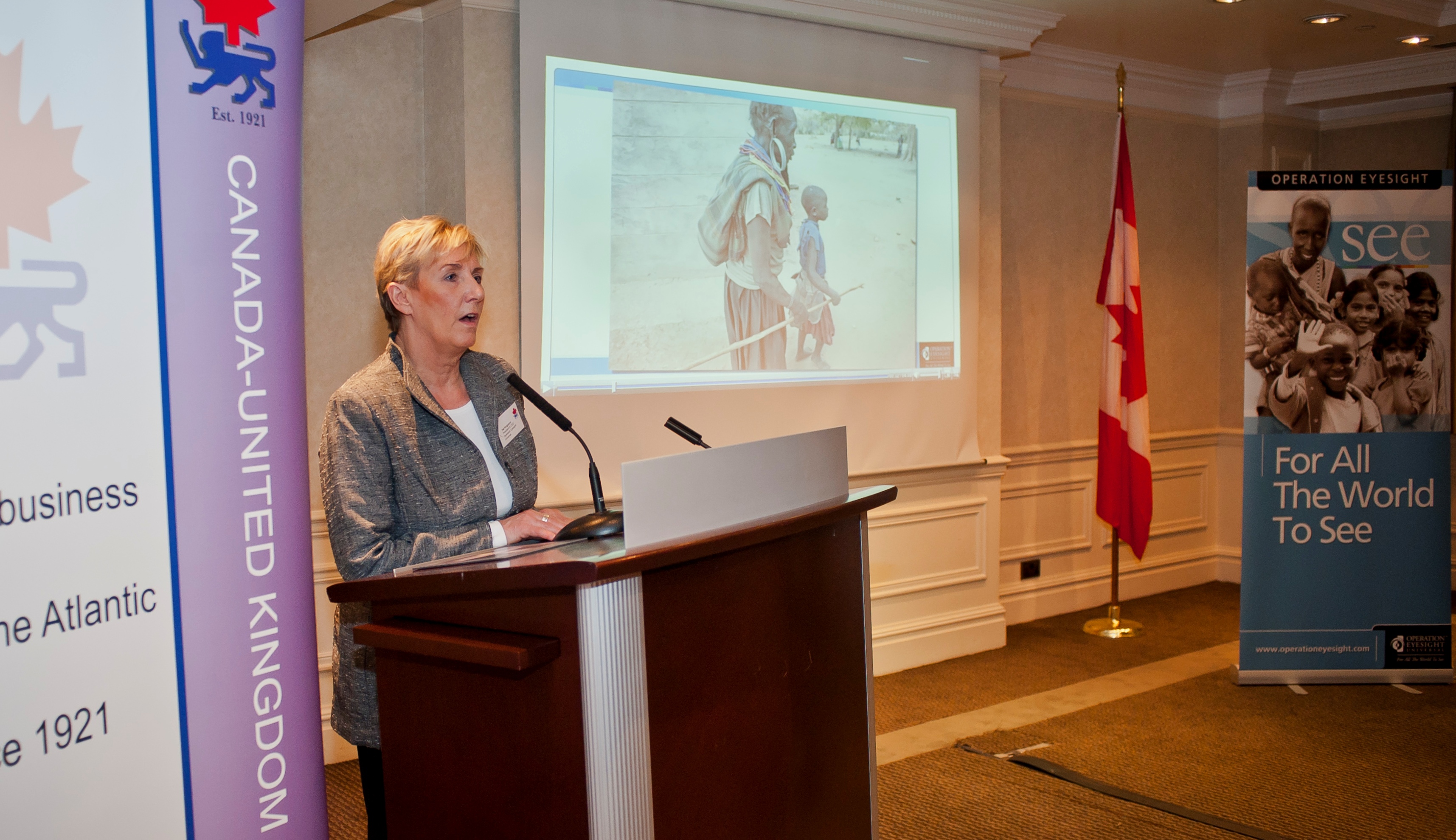
The guest speaker I refer to is Pat Ferguson, our president and CEO (Pat authors many of the blog posts you read here in Grey Mist Lifting). The trustees of Operation Eyesight UK had worked hard to bring their new organization to a point where it could be introduced to the world, and Pat was scheduled to give a speech entitled, “Partner for Development to Minimise Risk and Maximise Opportunity.” Hundreds of invitations had been sent, and all the preparations for the March 7 event were in place. We were all excited, knowing that this event signalled a huge step forward in building support for Operation Eyesight throughout the United Kingdom.
As the event’s lead organizer, I considered getting to London to be one of the easier jobs. We just had to get to the airport on time, and get on a plane; how hard could it be?
However, a blizzard arrived in Calgary the afternoon of our departure, and the flight was cancelled. Rebooked for another flight, that one was also cancelled due to mechanical problems. Using our mobile devices, Pat and I began briefing our colleagues in London on what to do if we didn’t arrive. We finally got on a flight that worked, but upon landing, we spent what seemed like an eternity in customs and on the “Tube” to downtown London. When we finally arrived at the event location, the Canadian-UK Chamber of Commerce, it was only with an hour or two to spare.

But the adventure was not over. Our flight home was diverted to Keflavik, Iceland due to a passenger who required medical attention – the airline had to make a difficult decision which we fully understood. There we had to stay overnight in what appeared to be a grey and rocky wasteland of a place. However, warm Icelandic hospitality made us feel at home.
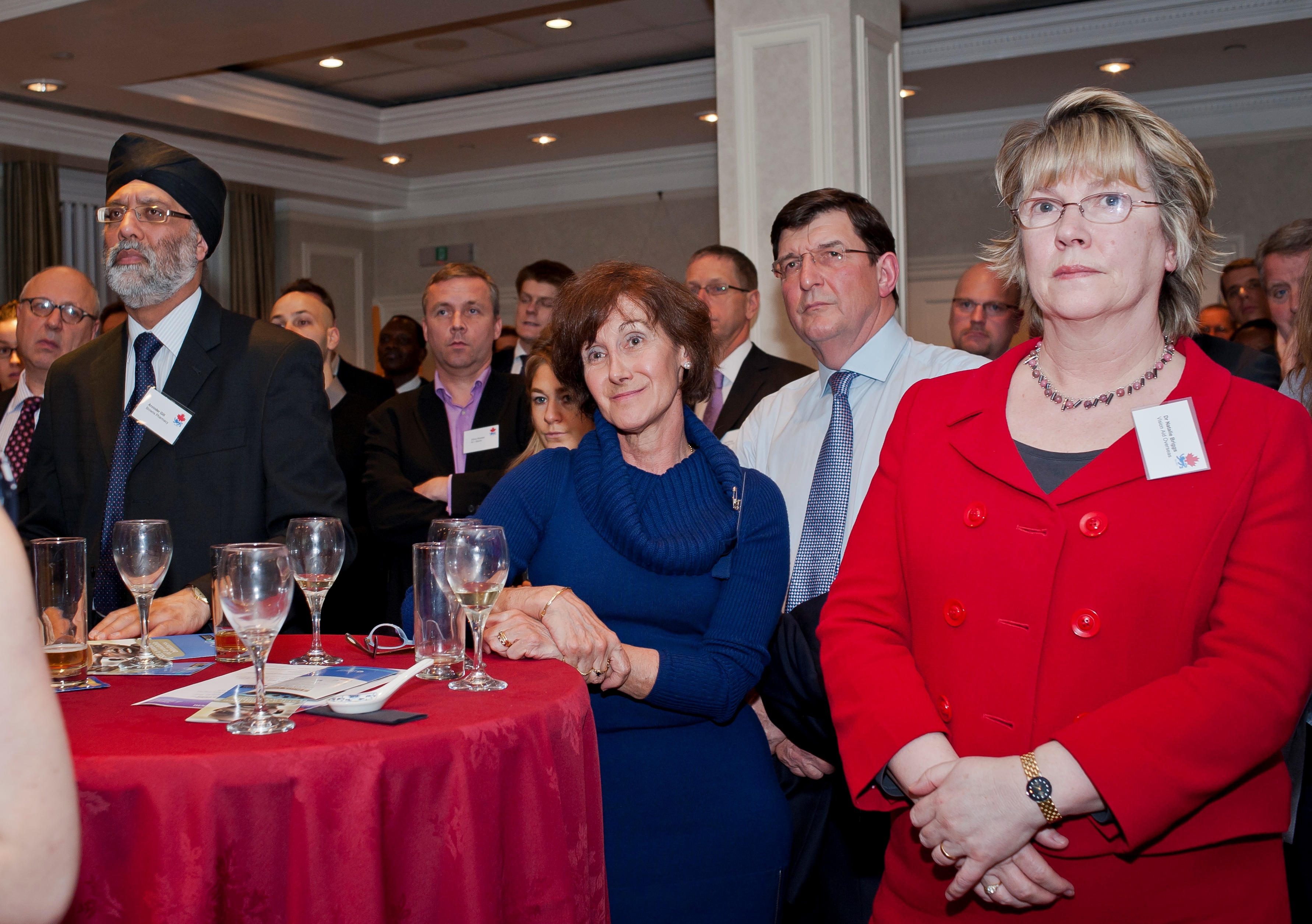
Despite the surprises, none of these travel mishaps dulled our anticipation going to London, nor our elation upon leaving with our mission completed. The launch of Operation Eyesight UK was a great success with more than 100 guests representing the corporate and international development communities. Pat’s speech made a powerful impression and, even now, the trustees are contacting the guests and building relationships that will ultimately bring more awareness and support to bear on the challenge of avoidable blindness.
For Pat and me, the whole experience was a grand adventure that bodes well for the future.
Return next week when Pat Ferguson shares an excerpt from the speech she delivered in London on March 7.
On March 7, I spoke to business leaders and members of the international eye care community at the launch of Operation Eyesight UK in London. We made some important connections, and the trustees of the UK board are off to a great start. We certainly want people in the UK to know that Operation Eyesight has a unique approach to international development, and we made some important points that were well received, leading to further conversations with audience members. Here are just a few of the points from the speech I delivered at the event.
Operation Eyesight believes that partnerships between corporations and development organisations can pay higher dividends and help both entities achieve their ambitions.
You’ve probably seen negative headlines in the media about failed aid. However, they do not take into account the multiple intents behind the large pot of money referred to in these intimidating news reports.
Aid can refer to many different kinds of financial support and can include humanitarian assistance in the face of national disasters such as tsunamis, famines, or the effects of civil war. This type of aid is a critical response in times of need, and greatly appreciated by governments. But it is not development.
***
Where there is a real commitment to sustainable development, it becomes possible for organisations like Operation Eyesight to achieve measurable and lasting results with donor funds – especially if the scale of the project is manageable and the stakeholders represent key government representatives and community grassroots organisations. In fact, we can invest your development funds to play a catalytic role that will support change and progress, without undermining institutional development.
Operation Eyesight manages the risk in international development by using a number of criteria and strategies. For instance, we select countries that have relatively stable governments and are not involved in ongoing conflict. We require stability to engage the necessary stakeholders from government officials to community leaders; we need to plan collaboratively, implement, follow-up and make adjustments.
It is important to know that developing countries do understand their social and economic challenges and usually have the expertise to solve their own problems. But they may not have sufficient human and financial resources.
Operation Eyesight does not impose western solutions or use Canadian medical expertise or expatriate staff. We rely on in-country expertise like the world renowned LV Prasad Eye Institute in India as well as African authorities on development and eye care. We believe in capitalising on their knowledge of local issues and expertise in identifying solutions as well as their contacts in-country, from senior elected and government officials to community leaders.
***
Standard Chartered Bank is an example of a corporation that supports the development of eye care in low income countries where they have business interests.
Through its Seeing is Believing (SIB) global initiative, the bank engages its employees in fundraising and matches every gift. To date they have raised almost $40M and have a goal to reach $100M by 2020. You can see the value proposition to the corporation and the community in a number of projects.
***
In Kenya, the Area General Manager of Standard Chartered Bank supports an annual marathon where proceeds are donated to community initiatives including eye care. The marathon and its charitable objectives are well known in Kenya. Again, the good will generated by this social enterprise is considerable.
In India, Operation Eyesight partners with Standard Chartered Bank to promote eye health and provide eye care in slum communities. We are fortunate to have a number of bank staff with us this evening.
Here’s another example [of a corporation’s social responsibility]. In Zambia, Operation Eyesight is partnering with the Ministry of Health and a steel company from India to construct an eye clinic at the University Teaching Hospital, located in the capital city of Lusaka. This is a market entry strategy that will give the steel company solid public and government recognition in a country where unnecessary blindness and weak health care systems are barriers to social and economic development. The company has the priority naming opportunity on the new clinic.
From Australia, the foundation of the Lonely Planet Books is supporting the cost of water points or boreholes in the Maasai Mara in Kenya. PixiFoto, a photography corporation also out of Australia, is doing the same in Zambia. Both are having a dramatic impact on marginalised communities.
For more about the launch of Operation Eyesight UK, read last week’s post by Brian Foster.
