
Driven by a wealth of community-based data, we are contributing to a global body of health research and informing national eye health policies.
In 2024, we launched two research initiatives to identify learnings and to share our findings. In partnership with the Pragyaan Sustainable Health Outcomes (PRASHO) Foundation we started an evaluation of the survey tools that we use and an assessment of our Avoidable Blindness-Free methodology and its effectiveness. We look forward to sharing our findings with you!
Award-winning presentations at VISION 2020: The Right to Sight – India conference
Our team contributed four presentations to the VISION 2020 The Right to Sight – India conference, which brought together organizations, hospitals, research institutes and others to gain a deeper understanding of the challenges and opportunities across the eye health field. We submitted four presentations.
Senior Programme Manager Tapobrat Bhuyan and Programme Manager Emmanuel Benia Tanti presented. Programme Manager Aditya Sharma (left) brought home the award for Best Paper for Oral Presentation. Operation Eyesight was also honoured with an award as a founding member for its contributions to VISION 2020.
Recognized nationally and globally Our poster focusing on our donor-centric approach won second spot for Best Poster at The Right to Sight – India conference.
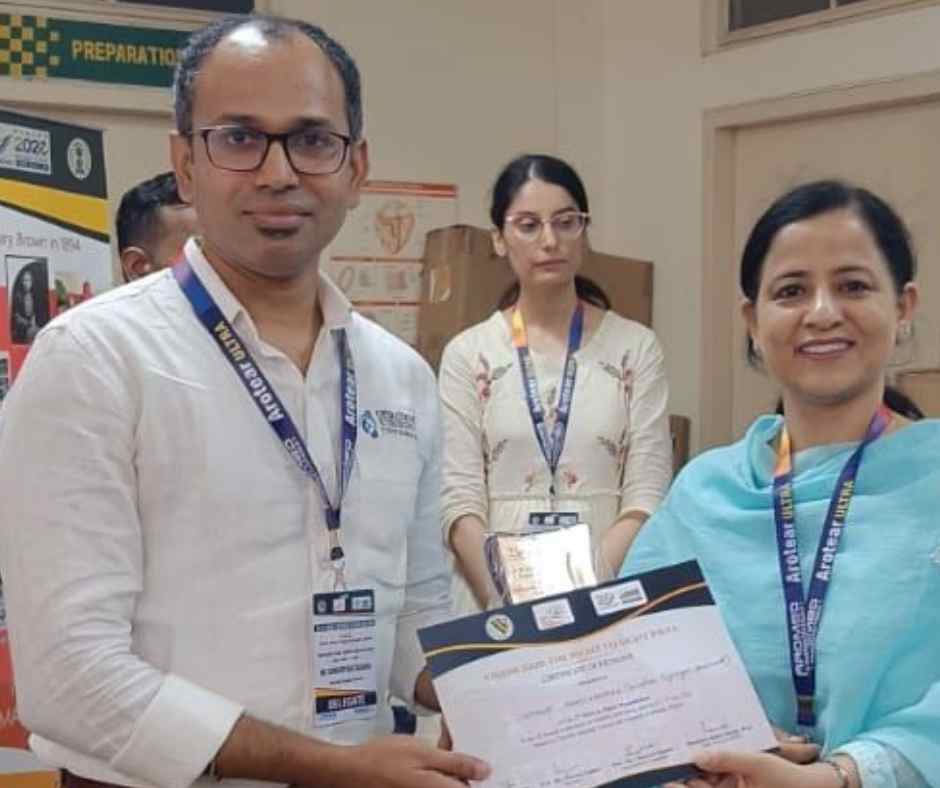
Above, our Head of Resource Mobilization Subhadip Bhattacharya (left) accepts the award. The poster was also selected to be featured at the 2024 IN SIGHT LIVE event organized by IAPB in Mexico City.
Did you know? We share our evidence-based learnings at international, national and state conferences and meetings to inform policies that support universal eye health care for all, particularly in remote and rural areas, which are underserved.
Learn more about our research and advocacy work here.
Heeralal, 45, was a resident of a village near the Community Heath Centre (CHC) Niwas in Singrauli district in India. Passionate about health care, he joined the government as a multipurpose health worker (MPW) to serve people in remote and underserved areas.
In 2010, Heeralal became a para medical ophthalmic assistant (PMOA) after the Government of Madhya Pradesh called for MPWs to undergo PMOA training. He conducted regular eye exams at CHC Niwas but was disheartened by having only two or three patients a day. He took part in school screenings and cataract camps as awareness grew.
In 2022, Heeralal saw a turning point when we launched our Integrated People-Centred Eye Care project in Singrauli. CHCs were upgraded to vision centres, equipped with slit lamps and essential ophthalmic tools. PMOAs received refresher training for comprehensive eye examinations to build eye care capacity. A series of targeted interventions rolled out. We trained community health officers, accredited social health activists (ASHAs) and community health volunteers (CHVs). Screening camps were organized with a mobile vision van to boost awareness. With support from ASHAs and CHVs, Heeralal soon saw 12 to 15 patients daily.
Today, Heeralal feels more inspired than ever by the transformation in rural healthcare. His motivation grows with every person whose sight is restored.
Did you know? Integrating eye care into universal health care is one of the five recommendations of the World Health Organization 2019 World Report on Vision.
Learn more about our work in India here.
Learn why we're working to integrate eye health care into primary health care here.
In 2021, 24-year-old Vishnu decided to be a changemaker. Vishnu hailed from a small village in Rajasthan, India where girls were not encouraged to work. However, she, dreamed of having a career so she could support her family.
Vishnu pursued a community health volunteer (CHV) role at Fatehagar Vision Centre, established through the Promotion of Avoidable Blindness-Free Communities in Rajasthan project. We implemented the project with Alakh Nayan Mandir, through support from Standard Chartered Bank.
Once Vishnu began working, she quickly earned respect. Encouraged by her mentors, she took a two-year diploma in optometry form Aalakh Nayan Mandir. In 2024, she became a vision technician at the Fatehnagar Vision Centre. She now sees 10 patients a day.
“I want to grow, and I will never allow anyone to stop me from doing my job. I’m happy that girls in my community have started dreaming of having careers after seeing me. This job has given me a chance to change my life, and I want to motivate as many girls as possible to dream big and fight for their happiness,” Vishnu says. She remains deeply grateful to Alakh Nayan Mandir and Operation Eyesight for the opportunity that changed her life as she now changes the lives of others.
Did you know? There is a global shortage of eye health care professionals. The World Health Organization recommends four ophthalmologists for every million people. While India has 11 per million, many are based in urban areas, leaving rural and remote areas underserved according to the IAPB Vision Atlas on India.
Learn more about how we help strengthen eye health care resources and grow human resources here.
Learn more about our work in India here.
Seventy-year-old Debeswari, from Golaghat District, Assam, India once led an active life, walking to her nearby village to visit. When cataracts clouded her vision, her world shrank to the four walls of her home.
Once cheerful and independent, she became totally dependent on her family. Financial struggles and fear of surgery kept her from seeking treatment. She felt isolated, helpless and like a burden to her loved ones.
One day, an Operation Eyesight-trained community health volunteer named Daiboki visited Debeswari’s home. Together, they worked through her eyesight issues and her fears. Later, a team from our partner, Chandraprabha Eye Hospital, visited Debeswari and explained cataract surgery. Reassured, she accepted treatment and was transported to hospital that very day.
Now, Debeswari again walks independently to her nearby village – a freedom she hadn’t enjoyed in years. In having her vision restored, she has also recovered her dignity and joy.
Did you know?
Globally, 100 million people have cataracts, the leading cause of blindness. In India, cataract causes 66 per cent of blindness, 81 per cent of severe vision loss, 70 per cent of moderate vision loss and 24 per cent of mild vision loss according to the IAPB Vision Atlas. Cataract surgery is one of the most cost-effective treatments at approximately $75 CAD (surgery and associated costs such as travel).
Learn how you can support cataract surgeries here.
Sriramappa, from Karnataka, India, was living with vision loss from cataracts. This left him dependent on his family for his daily needs, and he could no longer support them by grazing his cows and goats. When his wife passed away from an illness, and he lived in darkness, mentally and physically, for three years.
His hope returned when a community health worker visited his home. Sriramappa took part in eye screening and was diagnosed with cataracts. Referred to our partner, Netradeep Eye Hospital (Globe Eye Foundation), Sririmappa accessed sight-restoring surgery free of charge.
Sriramappa expressed his gratitude to our donors. He is now enjoying life’s simple pleasures, especially roaming the forest with his animals, which helps to support his family.
Did you know?
There is a strong correlation between vision loss and age. People who are 50 years of age and older experience 73 per cent of all vision loss according to the IAPB Vision Atlas (2025). This puts people at risk of poverty, dependence and reduced health and well-being. At times, beliefs that vision loss is inevitable or that older people are not worthy of treatment can be barriers to overcome.
Fortunately, 90 per cent of all vision loss is avoidable. This means it can be prevented or treated. Of all the treatments, cataract surgery is one of the most cost-effective solutions. It costs approximately $75 CAD for one cataract surgery and associated cost, such as travel.
Learn how you can support sight-saving work here.
In the hills of Meghalaya’s Ri-Bhoi District, Robiroy, a young community health worker from Nongpoh Vision Centre, was assigned to serve 47 villages with a population of more than 16,000.
Initially, he encountered skepticism from the community, as people feared medical interventions or had misconceptions. For many, fading vision was simply part of growing old.
To overcome these barriers, Robiroy put aside his medical charts and stepped into courtyards, looking to connect with people with warmth and empathy. Over cups of tea, he listened, shared stories, and spoke of restored sight as a path to dignity and independence.
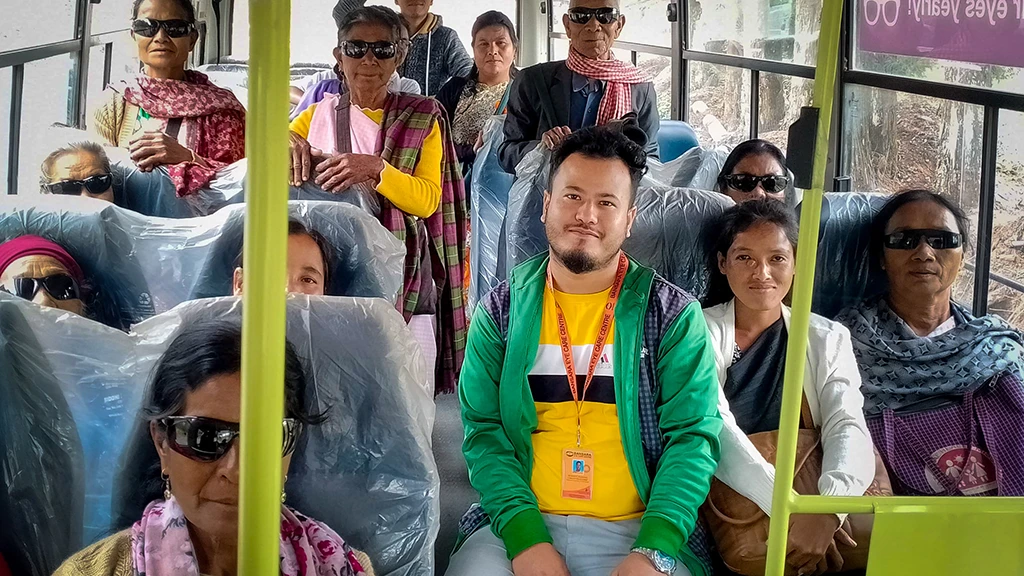
Small victories soon blossomed. An elder who had received eye care could weave again. A farmer saw his fields clearly. Success stories spread across villages. Soon, Nongpoh Vision Centre saw patients surge, and 520 seniors received cataract surgeries. Families began prioritizing eye care across generations.
Currently, five of Robiroy’s 47 villages will soon be declared Avoidable Blindness-Free. He is not just restoring vision – he is sparking an eye care movement!
With files from Emmanuel Benia Tanti, Program Manager, India.
Did you know? Donations to Operation Eyesight help us train community health workers like Robiroy to deliver primary eye care in remote, rural and underserved communities. Donate today.
Four-year-old Priyansh’s story begins in March 2023 when his father, Raj, noticed a strange glow in his little boy’s eyes. It was an observation that would end up saving Priyansh’s life.
Raj and his wife, Ramya, acted quickly and took Priyansh to a local doctor who diagnosed him with a tumor. After more consultations, the family was advised to get treatment at the Operation Eyesight Universal Institute for Eye Cancer at the L V Prasad Eye Institute in Hyderabad, India.
The Operation Eyesight Universal Institute for Eye Cancer was made possible by the generous gift of an anonymous Canadian family, and through our longtime collaboration with the renowned eye hospital. Since 2015, the Institute has provided comprehensive treatment for the entire range of ophthalmic tumors in both adults and children. It is one of just a handful of centres in the world that specializes in this type of treatment.
Once he arrived at the Institute, Pryiansh was examined by an ophthalmologist who diagnosed him with fourth-grade retinoblastoma, a severe form of eye cancer that largely affects very young children.
With the level of danger the cancer presented, the doctor recommended that the affected eye be surgically removed. Although heartbroken by the diagnosis, the family knew surgery was their only hope to save their son. The operation was a success, and Priyansh’s outlook improved, but the journey was far from over. Following the surgery, Priyansh underwent grueling chemotherapy sessions to make sure there were no remaining cancer cells. The little boy was left weakened and frail, but kept his spirits up during treatment.
Due to the demands of Priyansh’s treatment, Raj, who works as a taxi driver, had to take time off work. In order to help free the family from the financial burden caused by Priyansh’s diagnosis, the L V Prasad Eye Institute was able to offer the treatment completely free of charge, allowing the family to focus on recovery.
Today, Priyansh is stable, and his parents are extremely grateful for the care he received.
To date, the Operation Eyesight Universal Institute for Eye Cancer has identified and treated 18,515 patients for eye cancer.
With special thanks to the L V Prasad Eye Institute, who originally reported this story.

My recent visit to Uttarakhand, India, was an eyeopening experience, showcasing the profound impact of our projects. In January, I joined a team from our partner institute, the Vivekananda Netralaya Super Specialty Charitable Eye Hospital, during a community outreach exercise in the rugged terrain of Rudraprayag, where many villages are accessible only via steep, challenging footpaths.
What touched me most was witnessing elderly men and women blessing our community health volunteers with heartfelt wishes for good health and long life. It’s moments like these that remind us of the true essence of service – not just reaching but becoming a part of the community.
Since 2021, our team has tirelessly brought eye care to the doorsteps of those in the area. Whether braving freezing winters, scorching summers, relentless rains or storms, their commitment has never wavered.
Mountains may test our resolve, but they also teach us resilience and purpose. My sincere appreciation to the entire team for their steadfast dedication to transforming lives in these challenging conditions.
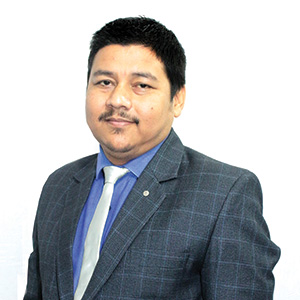
Emmanuel joined our team in India in 2021. As a Program Manager, he oversees programs in the states of Arunachal Pradesh, Meghalaya, Bihar, Uttar Pradesh and Uttarakhand, often joining teams in the field to check in with partners and monitor projects. He has a Master of Social Work and has been working in the development sector for 15 years. He lives in Shillong, Meghalaya with his wife and two sons.

Look at those big, beautiful eyes! This is baby Aarsh, from a small village just outside Moradabad city, in Uttar Pradesh, India. At seven months old, he weighs about seven pounds – what many babies weigh at birth.
Aarsh’s mother, Shabana, was only seven months pregnant when she delivered him prematurely. Little Aarsh had been in an incubator in the neonatal intensive care unit (NICU) at their nearby hospital for 15 days when his parents learned that he needed to have his eyes screened for Retinopathy of Prematurity, or ROP.
ROP is one of the leading causes of vision loss in children, and preterm infants are at high risk of developing this blinding condition. ROP occurs when abnormal blood vessels grow and spread throughout the retina, the tissue that lines the back of the eye. These abnormal blood vessels are fragile and can leak, which can scar the retina and pull it out of position. This causes a retinal detachment and visual impairment.
To save a child’s sight, early detection and treatment of ROP are critical. Unfortunately, many infants go undiagnosed due to the lack of awareness of ROP and the lack of screening services available outside of tertiary-level hospitals. That’s why we are working with partners like C.L. Gupta Eye Institute (CLGEI), located in Moradabad city, to provide remote diagnosis and referral services for at-risk infants and their families. With a case of specialized teleophthalmology equipment and pediatric supplies in hand, optometrists from CLGEI regularly visit 40 NICUs and maternity centres across the Moradabad District, where they capture retinal images of premature infants with assistance from nursing staff who help keep the wriggly babies calm and still.

When Aarsh’s parents first learned their baby could have ROP, they were fearful of the treatment process, and they refused to have Aarsh screened in the NICU. Fortunately, the team at CLGEI are known for their compassion and persistence. After continuous follow-up phone calls and messages from the ROP Coordinator, Aarsh’s parents agreed to bring the little boy, then six weeks old, to CLGEI for screening.
Aarsh’s retinal images revealed that he had ROP in both eyes and required urgent treatment to prevent blindness. First, his eyes would be injected with a drug that inhibits abnormal blood vessel growth, then, at a later appointment, he would receive laser treatment.

Shabana couldn’t help but get emotional she when she heard Aarsh’s little cries from the next room as the doctor did the injections. She knew that timely treatment was necessary to save her son’s sight, but still the tears streamed down her face. Her little one wasn’t even two months old, and he’d already been through so much.
Following the injections, Aarsh’s eyes were covered with bandages, and they were sent home that same day with eye drops and a list of post-procedure instructions. No doubt, the experience was a lot for Aarsh’s parents to take in, worrying about their newborn baby who required special care while also tending to their other children; but they took comfort in knowing that the pediatric staff at CLGEI were available to help them every step of the way.

Later that week, Aarsh received laser treatment. The procedure, which is done with local anesthetic, uses a beam of light to create scar tissue on the outer edges of the baby’s retina, which prevents abnormal blood vessels from forming.
Aarsh’s family went for several follow-up visits. His parents were diligent about making and keeping their appointments, even though it meant that his father, Ajmat, had to close his shop so they could travel to the hospital, which meant a loss of income. They were thankful that Aarsh’s treatment was provided free of charge. They were also grateful to the CLGEI staff who checked in with them and sent them reminders.

Today, Aarsh is doing great, and his vision is good. His mother, who is also happy and in good health, says that Aarsh even watches cartoons on the television like his big brother and sister.
“Little Aarsh's journey is a testament to the transformative power of our ROP screening program. Through the dedication of our team and the support of generous donors, we're not just preventing blindness; we're nurturing futures," says Lokesh Chauhan, Deputy General Manager at CLGEI.
“Aarsh's bright eyes now reflect a world of possibilities, and his story motivates us to continue our mission of bringing vision and hope to every child in need."
Aarsh will require lifelong follow-up visits. Doctors have stressed to his parents the importance of regular eye exams, as infants with ROP are at higher risk for developing other eye problems later in life, such as myopia (nearsightedness), strabismus (crossed eyes), amblyopia (lazy eye) and glaucoma. In many cases, these eye problems can be treated or controlled.

Thanks to the generosity of our donors, the diligence of Aarsh’s parents, and the expertise of the staff at CLGEI, little Aarsh has a big future ahead of him.
Please donate today to help more infants like Aarsh.
For Venkatamma in Karnataka, India, one of the most astounding things about getting her vision back is being able to keep track of time again.
“You can’t imagine what it’s like to look at the clock in the morning,” the 65-year-old grandmother says with a laugh, “and to be able to tell the time!”
Seeing clearly was something Venkatamma had been missing for many years. Her vision, always poor, took a turn for the worse when she was in her fifties. By the time she was diagnosed with cataracts, she could barely make out shapes or colours.

Venkatamma’s cataracts were first diagnosed by a community health volunteer who was doing a door-to-door eye health survey in her village. Initially, she was resistant to the idea of getting surgery as she worried that the financial burden would be too great for her family. But after she learned that the operations would be performed free of charge, she decided to go ahead with surgery.
Venkatamma was thrilled with the transformation. “It was like being reborn,” she says. “I can look outside and see a couple hundred feet away, from leaves on the tree to birds’ nests.”
Now that she can see clearly, Venkatamma is happy that she can spend quality time with her grandchildren and help around the house once again.
Please donate today so that more grandmothers like Venkatamma can regain their independence!
