
Eight-year-old Fassikaw lives in Bahir Dar, where he goes to a local primary school. A second-grade student, he once faced challenges that threatened his education and well-being.
When Fassikaw was in first grade, he began to have trouble seeing objects far away. Reading books and the blackboard became difficult. Sitting in the middle or back of the classroom, he often had to borrow his classmates’ exercise books to copy notes.
At home, reading took him a long time. His eyes often watered, and his grades began to drop. More than his grades, his parents worried about his worsening vision and the way it was affecting his mood and sleep. Fassikaw even spoke about leaving school.
Around this time, his family learned about our School Eye Health Program run in partnership with Partners in Education Ethiopia. The program offers free diagnosis and eyeglasses to students in need.
After hearing this, his family went to the hospital and Fassikaw’s eyes were checked. At the hospital, tests revealed that Fassikaw’s vision required strong corrective lenses: +15.00 for his left eye and +16.00 for his right. Thanks to our partners and generous donors, he received the eyeglasses at no cost.
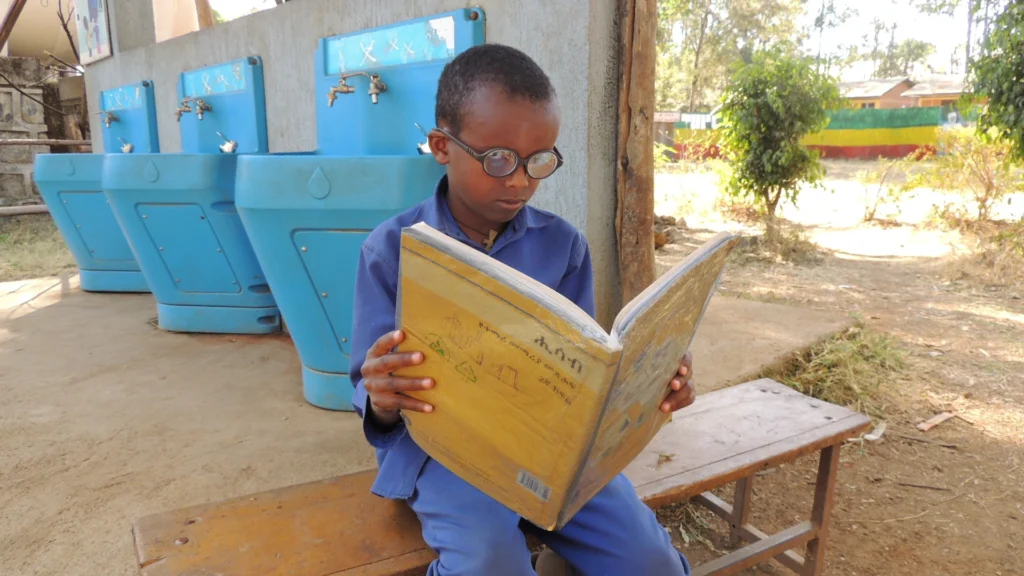
Today, Fassikaw can read easily from anywhere in the classroom. At home, he reads without headaches or watery eyes. His grades have improved, and his class ranking has risen from 27th to 21st, with steady progress.
His father says their son is now happy and confident, and the family can sleep without worry. “With God’s help, we hope you will never have to worry about anything,” he says with gratitude.
By providing eyeglasses through school-based eye health programs, we can transform the lives of children like Fassikaw, helping them see clearly, succeed in school and embrace a brighter future. Give the Gift of Sight today.
Our Work in Ethiopia
Since beginning our work in Ethiopia in 2018, we’ve made significant strides toward preventing avoidable vision loss. In 2024, our programs reached more than 33,424 people through eye health screenings, treatment, training and community outreach. From surveying over 14,000 residents in Debre Work to training frontline workers and teachers, screening students and providing eyeglasses, we are building lasting capacity for quality eye care. Read more about our work in Ethiopia in our 2024 Annual Report. Download it here.
Imagine failing the same grade twice. And the first grade, no less.
That’s an experience 11-year-old Hayat, in Bahir Dar, Ethiopia, has gone through. Today Hayat, held back by difficulties with her eyesight, is continuing to work on her first-grade accreditation, alongside seven- and eight-year-olds.
Born with a twin brother, Hayat had vision problems from the very start. Immediately after birth, she underwent eye surgery. The hospital scheduled her for a follow-up appointment, but due to financial constraints and lack of transportation, the family was unable to return for it.
Her father explained that, as Hayat grew older, she continued to have trouble seeing.
“We knew she had difficulty seeing distant objects, but we couldn’t take her to a health facility because we didn’t have the money for treatment,” her father shared. “It pained us deeply to see her struggle. We began to lose hope in her education because her performance was poor.”
But Hayat persisted with her schoolwork, and she was in class when Operation Eyesight, in collaboration with Partners in Education Ethiopia, started a screening program at her school.
Hayat was quickly identified as having vision problems. Along with other students, she received a referral to our partner institution, the Tibebe Ghion Hospital, for a full eye exam. An optometrist diagnosed her with refractive error.
Just two days after her hospital visit, the project team returned to Hayat’s school with a life-changing package in tow – the students’ eyeglasses.
Hayat went home sporting her new eyeglasses, beaming as she announced that she could finally see clearly. Her family was thrilled, knowing that she now had what she needed to thrive in school.
“Thank Allah!” her father announced, then followed up with instructions for Hayat. “Now you can study well and improve your grades.”
The little girl was more than happy to agree.
Find out how support from our donors is helping us bring eye health care to thousands of children like Hayat through our School Eye Health programs!
Story written with files from Marnat Adugna, Senior Project Officer, Operation Eyesight / Partners in Education Ethiopia
At first, a trachoma infection looks a bit like a case of pink eye: red, irritated eyes, maybe some swelling and discharge1. But for many people in the world, a trachoma infection is a serious concern. If left untreated, it can lead to severe pain, vision loss and even blindness. The bacteria that cause trachoma spread through direct personal contact, through shared towels and clothing, and through flies that have been in contact with an infected person. And there’s a simple solution for reducing its spread…
Clean water.
When communities have access to abundant clean water, they can wash their hands and faces regularly, do laundry more often, and prevent the otherwise relentless transmission of the disease. That’s why we are working hard with communities and partner organizations to make sure that the people in our project areas have access to a local, sustainable clean water source.

There’s been a lot of good news in the eradication of trachoma in recent years. In 2023 alone, Benin, Iraq and Mali each received certification from the World Health Organization (WHO) for eliminating trachoma as a public health problem. Also, the number of people at risk of getting the infection fell from 125 million in 2022 to 115.7 million in 2023, a significant reduction.2
But the hard work must go on.

Ethiopia has some of the highest rates of trachoma worldwide, with the prevalence in the Amhara Region estimated to be nearly 63 per cent. In that country, trachoma is the second leading cause of blindness overall.3
Trachoma continues to infect people in 42 countries and has caused blindness or visual impairment in roughly 1.9 million people. It remains the leading infectious cause of blindness worldwide. And the effect on the workforce in these countries is huge. According to a recent paper by the WHO, the loss of productivity due to trachoma costs somewhere between US $3-8 billion each year.4
To people like Stephen, in Narok County, Kenya, having trachoma meant not being able to support his family. The father of four, who works as a motorcycle courier, struggled with the infection for years. He tried eye drops, eyeglasses and several surgeries before the trichiasis in his right eye, caused by repeat trachoma infections, was fully resolved.
Since undergoing a successful final surgery at one of our partner hospitals, the young man now acts as an eye health ambassador in his community, making sure people know what the infection is, the role of hygiene in stopping its spread, and how to get it treated.
Years of repeat infection from trachoma causes scarring to the eyelid. This scarring can be so severe that the eyelid turns inward, causing the eyelashes to rub against the eyeball. This leads to severe pain, light intolerance and scarring of the cornea.
If left untreated, the damage to the cornea can cause vision impairment, usually between the ages of 30 to 40 years5, although it can happen in children as well. Trachoma causes 1.4 per cent of blindness globally.6
Women become blind from trachoma four times as often as men. This is likely due to frequent infections they get while caring for small children, who often pass trachoma on to others.
At Operation Eyesight, we follow the WHO’s SAFE strategy for controlling and preventing trachoma. SAFE stands for:
S: Surgery to treat trichiasis (the painful late stage of the disease)
A: Antibiotics to eliminate infection
F: Face washing and hygiene education
E: Environmental improvement including wells and latrines

The foundation for the strategy is environmental improvement, namely – providing access to clean water. Over the decades, we’ve worked with communities to rehabilitate and drill hundreds of boreholes. In recent years, most of our work with water has been concentrated in Zambia and Kenya, but we are also getting involved in more water projects in Ethiopia as we expand our programs there.
Along with drilling and rehabilitation, we work with local governments to make sure people can fix the boreholes when they break down. In Zambia, that means financing the training of volunteers called Area Pump Minders (APMs) to do routine maintenance and repair of boreholes. The program helps ensure that there is a system for repair work, with locally-available toolkits and spare parts, and that monitoring of the water supply is happening at the village level. In addition to helping their communities, some of the APMs go on to find paid work repairing privately-owned boreholes. Over the last two years, we’ve seen several women join the traditionally all-male teams, and we hope to recruit more in future.

The community involvement doesn’t stop there. We also work with volunteers to form WASH committees who help educate other people, especially children, in Water, Sanitation and Hygiene. In Ethiopia, we are working with partners to train teachers in WASH so they can pass on their knowledge to thousands of students. Our work in Ethiopia has also involved fixing up latrines and providing menstrual supplies, both of which can help keep teenaged girls in school longer.
Antibiotics also go a long way to preventing and treating existing cases of trachoma. We work with local governments and partner organizations to provide these antibiotics to areas with high prevalence of trachoma. Earlier this year, we collaborated with partners in a Mass Drug Administration project in Kenya’s Narok County. Despite wet road conditions that made it challenging for crews to access all the communities, the project managed to administer the antibiotic azithromycin to more than 215,000 people!
Throughout the process, our trained community health volunteers work tirelessly to provide education on the importance of facial cleanliness and environmental improvements in stopping the spread of trachoma.
Finally, with help from our generous donors, our partner hospitals can offer surgeries free of charge to people with advanced stages of trichiasis to alleviate the pain and prevent further loss of sight.
We’re involved in clean water projects as a means of preventing trachoma, but the effects of providing clean water to communities are countless. The installation and maintenance of boreholes prevents dozens of waterborne diseases that sicken and threaten the lives of many, and that keep whole communities trapped in the cycle of poverty. Sustainable boreholes help people grow gardens full of fresh vegetables, allow them to raise livestock and improve the quality of life for everyone around them.
The effects of access to clean water are especially beneficial to women and girls. Here’s why:
Education and economic opportunities: In many communities, women and girls are responsible for fetching water, a task that can be extremely time consuming and physically demanding. This can prevent girls from attending school and women from pursuing income-generating activities. When clean water is locally available, girls are more likely to complete their schooling, and women have more time for activities that empower them economically.

Reduced gender-based violence: Providing access to clean water within communities reduces the need for women and girls to travel long distances for water, decreasing their vulnerability to the violence and harassment that they risk when collecting water.
Hygiene and menstrual health: Clean water is essential for maintaining proper hygiene, including menstrual sanitation. When women have access to clean water and sanitation facilities, it positively affects their overall health and dignity.
Community development: Women are often key contributors to the well-being of their communities. When they have access to clean water, they can actively take part in and lead initiatives that enhance the overall living conditions in their communities.
In 2023, we partnered on two new boreholes at schools in Ethiopia’s Amhara Region. In Zambia, we repaired 25 boreholes in the Mkushi District, trained 20 new Area Pump Minders and set up more WASH committees.
You can help us continue our water projects in 2024 by making a donation today. Thank you for your support!

Every parent wants their child to be safe, happy and healthy at school – Abichikili Secondary School is no exception.
It’s one of five schools across Ethiopia’s state of Amhara where the attendance rate for girls decreases each year due to inaccessibility of clean water and bathroom facilities.
“Students had to walk for more than 15 minutes to get water from surrounding households. Many would not return to classes after that,” says the school’s principal, Yingesu Meshobiaw. “In the past, when girls felt that their period was setting in, they used to jump over fences and go home for lack of facilities.”
In 2022, in partnership with Partners in Education Ethiopia and the Peter Gilgan Foundation, we launched a Water, Sanitation and Hygiene (WASH) program at Abichikili and four other primary and secondary schools in the state, bringing locally-accessible water to more than 9,000 students.
The project has also helped improve school attendance, particularly among girls, who make up more than half of the student population. Before the project, upwards of 10 students were absent from class for a full week each month, often falling behind in class.
“Water access is vital for everyone. Water sources on school grounds allow for community gardens, which promote a different kind of learning and responsibility of nutrition – for students and adults alike,” Yingesu adds.
Local access to fresh water allows people to wash their hands, faces and clothing, prevention transmission of diseases, including blinding trachoma, which is a key cause of vision loss and blindness across sub-Saharan Africa.
Our teams took a variety of approaches to bring water to the schools, including drilling boreholes to access groundwater, digging trenches and installing water supply lines, and setting up storage tanks, faucets and appropriate drainage.
Faculty and community members received training to maintain their water infrastructure and test water quality. Twenty-one female teachers also received menstrual hygiene training including how to create reusable sanitary pads using local materials.
“Having a water supply line has changed our school for the better,” Yingesu says. “Girls started using the facility the day it opened, and attendance rates have increased tremendously.”
Operation Eyesight Universal has been running programs in Ethiopia since 2018. Late last year, our Director of International Programs Yashwant Sinha travelled to the east African country to check in on our programming. We sat down with him for an update and to learn more about our partnership with Edmonton-based Partners in Education Ethiopia.
They are scattered across one region called Amhara in northern Ethiopia, and the span of the project is about 200 kilometres.
One is a community eye health program, and the other is a WASH-related project, which means water, sanitation and hygiene.
With this particular project, we are working with an international NGO called Partners in Education Ethiopia, which works in the education sector by mobilizing the community and building a school with its support. The goal of the partnership is to improve quality of life of students and staff of the schools, their families and other members of nearby communities through addressing visual impairment.
Under the community eye health program, we train community health workers, who are government employees, in primary eye care and in the implementation of community eye health activities. They go door to door, identify people with eye conditions and refer them to one of our vision centres. At the vision centre they get a comprehensive eye exam by a well-trained optometrist. If they are found to have refractive error, they are prescribed eyeglasses, and if they need any surgical intervention or further diagnosis, they’re referred to the base hospital.
Further, these community health workers raise awareness about eye health with the help of behaviour change communication materials. All these interventions lead to the empowerment of the communities to take care of their eye health care needs, and once that is achieved, we declare the village or community as avoidable blindness-free.
Our hospital partners are the ophthalmic department of Tibebe Ghion Specialized Hospital, Injibara Secondary Hospital, Addis Alem Hospital, Durbetie Hospital and Debrework Hospital.
Yes, we are also training teachers to screen students and identify those who have refractive errors or any kind of eye conditions requiring treatment. Similar to our door-to-door screening program, students identified with eye conditions are referred on to the vision centre for a comprehensive screening, treatment and further referrals.

What we are trying to do is to help the schools and the communities access clean water. You may know that the Blue Nile River originates in Ethiopia from Lake Tana in Bahir Dar, in Amhara. But there is a shortage of clean water in the areas where we are intervening, so people have to struggle and go a long distance to fetch clean water. Sometimes it may be around 10-12 kilometres. They are dependent on seasonal wells and springs. And most of the time, the water is not very clean.
With the support of the Peter Gilgan Foundation, we received funding to provide clean water in three different communities and to support teenage girls by providing them a private place for their menstrual needs. We are also working with the school health clubs in all those schools, and we are educating them about face cleaning, personal hygiene and sanitation.
We work with water and sanitation to reduce the burden of trachoma, an eye infection that leads to vision loss and even blindness if left untreated. How high are trachoma rates in the area?
In the area where we work, the trachoma rate ranges from 5.5 to 20 per cent, so it’s not uniform across the region. The trachoma rate has been reduced a little bit, but it is still a public health issue.
What are some of the challenges of working in this area?
We have a committed team in our project areas that includes community health workers. They are part of the public health system and are responsible for implementing many government programs and projects on top of Operation Eyesight’s community eye health project activities, like door-to-door surveys, health education and awareness sessions. This creates heavy workload on the community health workers and often results in a delay of our projects.
The second is the high cost associated in provisioning clean water to the communities. The price of drilling a borehole in Ethiopia is nearly three times higher than in Zambia. One reason is that the ground water table has gone down, so you need to dig deeper. The second is that you don’t find as many private drilling companies, so it can be harder to find a competitive rate.
Last but not least, the country is currently facing high inflation. Fortunately, there has been little impact on recent projects as we are importing the equipment needed for establishing new vision centres. However, the cost of living for people in the project area has gone up.

Were there any memorable moments from your recent trip you can tell us about?
I was in the Addis Alem project area where we are working with community health workers. We were in a village where they were doing a door-to-door survey, and they took us to a particular family that they were very attached to. They told us that this was the house of a very elderly gentleman who had not been able to see anything for the last six years.
When they first met him during their initial survey, he had lost all hope of getting his sight back. But they had counselled him and then they took that gentleman to the hospital at their own cost to make sure he got an operation.
You could see the smile on this gentleman’s face, and it was incredible! That family is highly grateful to all these health extension workers who are doing marvellous work.
This interview has been edited for length and clarity. You can learn more about our work in Ethiopia here.
Our total impact to date as of May 25th, 2020

Updates from the week ending May 15th, 2020
Updates from the week ending May 8th, 2020
Updates from the week ending May 1st, 2020

Updates from the week ending April 24th, 2020
"During this unprecedented time, Operation Eyesight has successfully managed to come forward to help the people of Ethiopia. The government of Ethiopia is appreciative of this effort knowing it will go a long way in paving paths for other agencies to also come forward and help in saving the lives of people. Kudos to our implementation partner in Ethiopia who are working day and night in reaching out to the unreached with the required support."
- Yashwant Sinha
Updates from the week ending April 17th, 2020
Our team in Ethiopia has procured water tanks/vessels. We are working in partnership with the government to deliver water to the communities. We have also procured the COVID-19 information, education and communication materials in local languages from the Ministry of Health to distribute.
Public sector employees whose roles are not essential have been placed on compulsory leave, and civil servants have been asked to work from home. Non-essential travel is banned, and all airlines have suspended their operations until the end of April.
In Ethiopia we are working to train 50 community health workers to respond to COVID-19. This training will cover topics such as the detection of symptoms, the importance and proper techniques for hand washing, and what to do if you or a family member starts displaying signs of COVID-19.
To ensure the safety of our staff and our community health workers, we are working to procure safety materials such as disposable nose masks, gloves and hand sanitizers.
We plan to install five handwashing stations at prominent locations such as schools and in high density, low income neighbourhoods. Additionally, we will distribute 1,000 sanitation kits to low-income female headed households and to those living with disabilities.
Our goal is to adapt, print and disseminate health education and information materials, with the goal of reaching 30 000 individuals by mid-May.
Learn more about our response to COVID-19 and how you can help here.
