
Charity Intelligence Canada (CI) has announced that Operation Eyesight has been selected as one of their Top 10 Impact Charities of 2020 for the third year in a row, and one of their Top 10 International Impact Charities.
Of the more than 800 Canadian charities rated on the Charity Intelligence site, Operation Eyesight was among the top performers for measurable impact, and the only Calgary-based organization in the international category. This recognition highlights the impact we create for every dollar we receive through donations.
Operation Eyesight makes an impact by restoring sight and preventing blindness for people in developing countries. They partner with local government and hospitals in these countries with a sustainable approach that eliminates avoidable blindness in the most vulnerable communities.
“When people suffer from poor eye health, their quality of life is diminished and the cycle of poverty is perpetuated,” says Candice Naylen, Vice President of Advancement. “When you invest in Operation Eyesight, you support programs that provide quality care to all in the communities where we work, regardless of age, gender or ability to pay. People who have been unreached in the past receive urgently needed eye health care, and entire communities become healthier and more resilient.”
According to the World Health Organization’s World Report on Vision, more than 2.2 billion people suffer from a vision impairment. For at least 1 billion people, their vision impairment has not yet been addressed – but their vision could be restored through a number of interventions, including prescription eyeglasses, cataract surgery, antibiotics or other forms of treatment. By providing these interventions, Operation Eyesight impacts the lives of individuals and their communities by giving them back their independence, helping them break the cycle of poverty.
Operation Eyesight works with local hospital partners to strengthen their capacity and offer a supply of quality, affordable eye care services to more people. They also create demand for these services by encouraging eye health-seeking behavior and empowering communities to take responsibility for their eye health needs. Operation Eyesight currently works in India, Nepal, Bangladesh, Sri Lanka, Ghana, Kenya, Zambia, Liberia and Ethiopia, and they hope to expand to other countries that would benefit from their sustainable sight-saving programs.
To learn more, visit https://www.charityintelligence.ca/giving-with-impact/top-impact-charities
For most of her life, Napolo, from Narok West Sub-county near the Kenya-Tanzania border, lived with constant eye pain. Now 78 years old, she first noticed discomfort in her 30s. Her eyes often felt irritated, as if filled with sand, and she experienced tearing and discharge that made it difficult to see. This attracted flies, but Napolo had no access to clean water to wash her face.
Napolo wasn’t aware that she was suffering from trachoma, a bacterial infection of the eye and the leading cause of blindness in areas with shortages of water and crowded living conditions. The bacteria spreads easily through contact with eye discharge from infected people on hands and clothing, and also through direct transmission by flies.
If left untreated, trachoma causes the eyelids to turn inward, making the eyelashes rub painfully against the surface of the eye. This causes permanent scarring of the cornea and irreversible vision loss.
Without access to regular health care, Napolo turned to traditional remedies. Her family members would pluck out her eyelashes to help ease the pain, but the relief never lasted. The irritation always returned, and over time, Napolo’s vision became worse.
In her Maa community, many people had similar symptoms, and plucking one's eyelashes out was considered normal. Health workers occasionally visited their community, but Napolo often missed them because she was always out looking after her animals, sometimes even crossing over the border to let the animals graze in Tanzania. She somehow managed despite her diminishing vision and increasing pain.
One fateful day, an Operation Eyesight-trained Community Health Promoter visited Napolo’s home – and the visit changed everything.
You see, for many years Operation Eyesight has been working to eliminate trachoma in communities like Napolo’s. Through the Kenya Trachoma Elimination Program, funded by Sightsavers International, Operation Eyesight and partners are working to eliminate trachoma in Narok West Sub-county and the entire country by 2028. With this support, and in collaboration with the Narok County Department of Health, we launched a door-to-door screening initiative to identify remaining cases of trachoma trichiasis – the painful late stage of the disease. We provided training and resources for local Community Health Promoters. They screen people in their communities and refer those in need of eye care to our nearest partner facility.
During a community screening in November 2024, Napolo was identified and referred to Talek Health Centre, an outreach site that provides surgical treatment for trachoma patients. At the health centre, the ophthalmic team examined Napolo’s eyes and confirmed her diagnosis.
Napolo agreed to undergo eyelid surgery to correct her inward-turned eyelids. The procedure was successful, and her recovery brought immense relief, preventing further damage to her eyes and preserving her remaining vision.
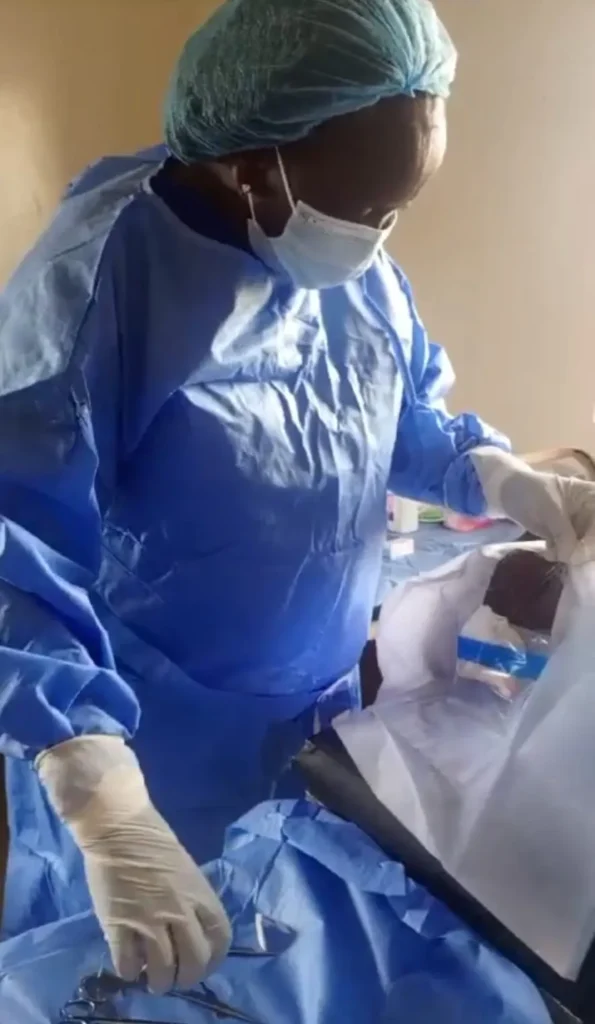
“I have longed for this comfort for decades. There is no more discomfort, and I can open my eyes freely,” Napolo said. “I thank Operation Eyesight and the doctors who assisted me, and I will definitely refer anyone in my community that has the same problem so that they can be assisted.”
Napolo’s story shows how access to quality eye care can transform lives.
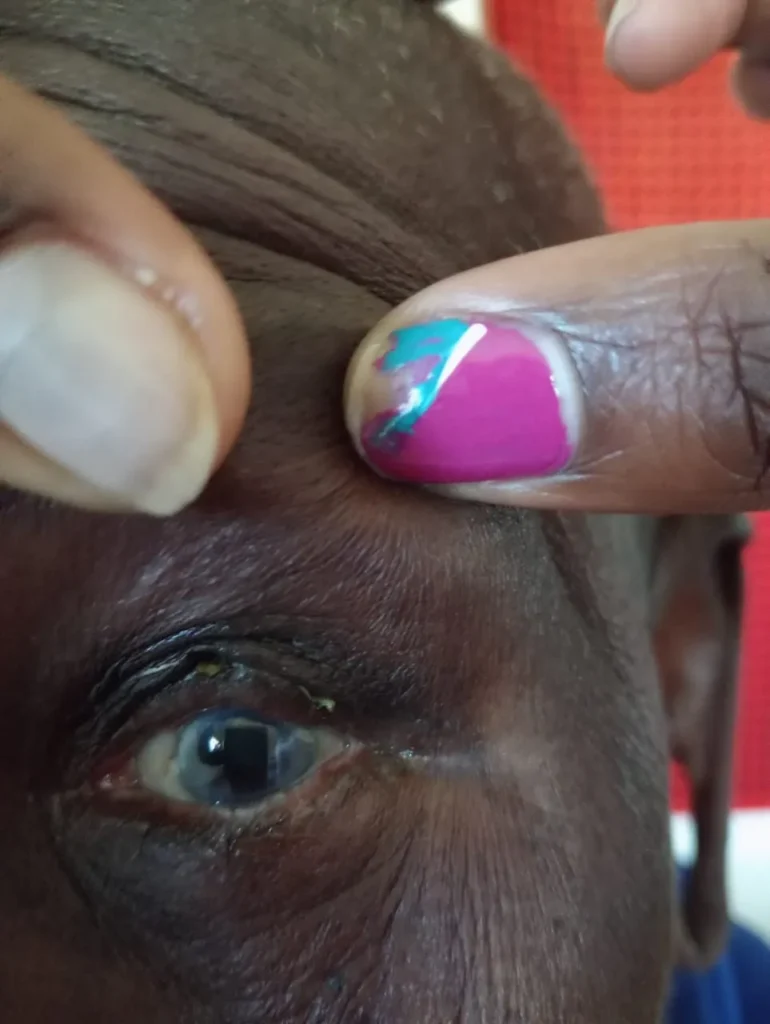
Did you know? Trachoma is the leading cause of infectious blindness.
Currently, 103 million people live in trachoma endemic areas and are at risk of trachoma blindness, and presently 1.9 million people are experiencing vision impairment or blindness due to the disease.1 It is found in 32 countries, in areas with shortages of clean water and crowded living conditions. Caused by the bacteria Chlamydia trachomatis, trachoma is spread by eye-seeking flies and personal contact. Children and women are at particular risk.
Operation Eyesight follows the World Health Organization-endorsed SAFE strategy, which has proven effective in eliminating trachoma. The SAFE strategy is a comprehensive treatment and prevention program that includes Surgery to treat the late stage of the disease, Antibiotics to eliminate infection, Face washing and hygiene education, and Environmental change including wells and latrines.
Join us in supporting programs that bring vital vision care to people like Napolo and also address the root causes of vision loss. Together, we can eliminate trachoma and ensure everyone has access to the eye care they deserve. Give the Gift of Sight today. Join us in supporting programs that bring vital vision care to people like Napolo and also address the root causes of vision loss. Together, we can eliminate trachoma and ensure everyone has access to the eye care they deserve. Give the Gift of Sight today.
In a small village in Bangladesh, 60-year-old Gulbahar lives alone and supports herself. She works as a maid, stretching every ounce of strength to make it through each day.

Her world grew darker as cataracts began to cloud her vision and left her nearly blind. Everyday things like walking through crowded streets, cooking with the right spices and finding her way around her home became uncertain and difficult.

Despite the challenges, her spirit stayed strong as she searched for the right eye health treatment, only to discover that the surgery she needed was far beyond what she could afford.
One day she heard about a nearby outreach eye care camp by Operation Eyesight. Gulbahar made her way to the camp and embraced the chance for cataract surgery.

She received cataract surgery at no cost. When the bandages were removed, she smiled.
"I can see my world again,” she said. “I don’t need to stumble in the dark anymore. I’ve been given a second chance.”

Today Gulbahar is back on her feet. She works and moves through her days with confidence and no longer depends on others. Her restored vision gave her more than sight. It gave her freedom.
But stories like Gulbahar’s are far too common.
You can help change that. Your contribution provides people with the knowledge and resources they need to regain their vision and independence.

By giving the Gift of Sight, you can help prevent blindness, restore sight and create second chances for more people like Gulbahar. Thank you for your support!
For the past three decades, 68-year-old Meleniah has enjoyed doing bead work, a hobby she says brings her comfort. She lives with her husband in Chepaktet, a village in Elgeyo Marakwet County, Kenya, where she raises tree seedlings for a living. She supplements her income by selling her bead work.
When she was forced to put away her needle and thread due to poor eyesight, Meleniah thought her heart might break. She says she felt a lot of stress when she could no longer see to thread a needle, but she didn’t tell anyone about her eye problems because she worried one of her family members would quit work to take care of her. Besides, she figured her poor vision was simply a result of old age.
Eventually, Meleniah’s husband, having previously undergone cataract surgery himself, realized what was going on. He invited one of their granddaughters into the home to help with cooking and housework.
When a community health promoter arrived on their doorstep in January, Meleniah was assessed and told she too had cataracts. They referred her to our partner, the Iten County Referral Hospital, where she was diagnosed and underwent cataract surgery on both eyes. The treatment was provided free of charge, as had her husband’s operations, thanks to the generosity of our donors.
Meleniah recovered quickly, and soon she was back at it – beading late into the night, thrilled she could do the delicate needlework once again.

When Meleniah’s village was declared as Avoidable-Blindness Free, she was there to tell her story and to encourage everyone to seek treatment when they have eye problems.
Always the saleswoman, Meleniah had another motivation for speaking out that day. She brought along some of her fancy work and set up a table, happily selling her beaded gourds, bracelets, necklaces and keychains to neighbours attending the event.
Meleniah is grateful to donors like you for helping to bring the joy of beading back into her life!
When Florence began losing her sight to cataracts, her daughter, Rose, watched helplessly as her mother lost not only her independence but also her joy.
“She was complaining that she could see smoke,” says Rose, who lives with her mother in Kakamega, located in western Kenya. “She would always say that she could see people far away but could not see people who were near.”
Rose brought Florence to Saboti Sub-County Hospital in Kitale and saw a surgical team from our partner, Kitale County Referral Hospital. Florence received sight-restoring cataract surgery, at no cost.
Reflecting on the difference the surgery made in her mother’s life, Rose sums up her gratitude with four simple words: "Thank you so much."

When Rose brought her mother back to the hospital for her checkup, the doctors said she was doing well. Florence’s smile tells a story that words can’t express.
“Even I can see that she is smiling,” Rose says. “I thank God the operation was successful. I would like to thank the people of Operation Eyesight Universal for bringing free treatment that has helped me and my mother.”
Rose says she hopes we can continue to help others in her mom’s situation.
“When someone experiences vision loss, they often become closed off from the world. This is particularly true for seniors,” says Alice Mwangi, our Country Director for Kenya.
“Through the Gift of Sight, individuals are able to start new, happy chapters in their lives.”
Visit operationeyesight.com/GiftOfSight to help provide critical eye care services for more people like Florence. Thank you for your support!
Every child deserves to be healthy, loved and accepted.
After Mahek was born with strabismus – commonly known as a squint – she faced not only the prospect of worsening eyesight throughout her life, but also stigma from others in her community.
“I felt different from other kids my age and wished I had normal eyes,” says the 15-year-old teen and eldest of five sisters.
Strabismus causes the eyes to point in different directions, often causing blurred or double vision. Mahek and her family, who live in the Raisen District of Madhya Pradesh, India, often felt rejected by their community. Their relatives and neighbours said Mahek would not have a bright future and that nobody would marry her.
Mahek’s parents took her to see an ophthalmologist but lost hope when they were told her eyes could not be treated and that she would have to live with the condition for the rest of her life. Heartbroken, Mahek’s parents stopped exploring further treatment options.
The family’s hope was restored when Raisen Vision Centre held an eye health screening camp at Mahek’s school. Staff told Mahek’s father that his daughter’s condition was treatable, but that she should receive treatment without further delay. She was referred to our partner Sewa Sedan Eye Hospital, where she received surgery.
“I was a bit worried, thinking if the surgery didn’t go as planned it would worsen my eyes. But the surgeons there were very caring and made me feel at ease,” Mahek recalls.
Following the surgery, Mahek returned to school, where her friends joyfully welcomed her.
“My squint is gone, and now I look like other children with good eyes. This treatment has boosted my confidence, and I would like to join the defense services when I grow up.”
Visit operationeyesight.com/GiftOfSight to donate today and help give more children like Mahek a brighter future!
At Operation Eyesight, we work to prevent blindness and restore sight in 8 countries, including Ghana.
Here, we’ve helped more than 1.5 million people experiencing blindness or severe vision loss by partnering with government hospitals and other NGOs.
But help is only possible when families are aware of the services available to them…
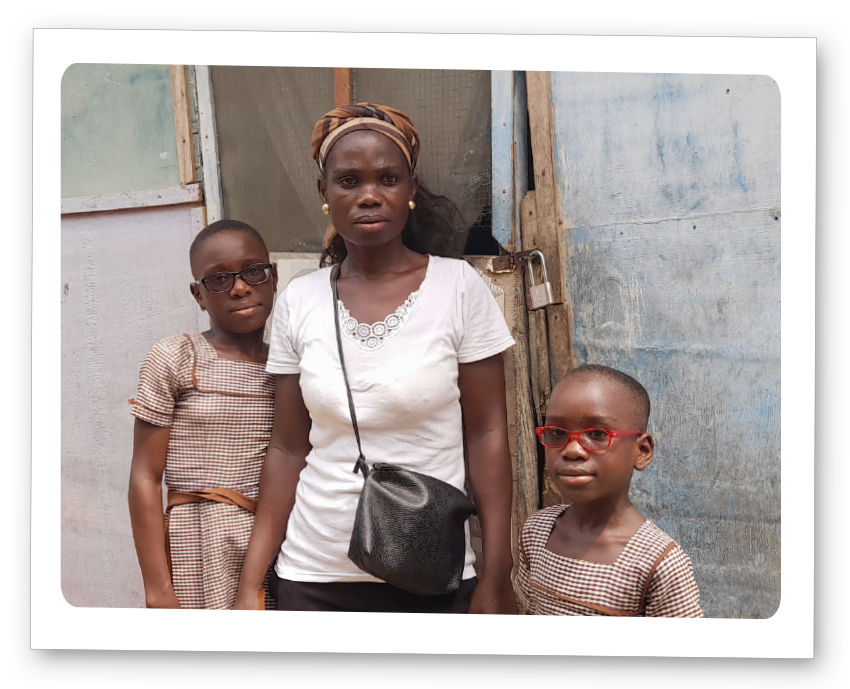
Single mother Mary and her daughters Hannah, 10, and Lydia, 7, live together in Ghana in a modest plywood home. Due to the urgency of keeping her children safe from an abusive father, Mary didn’t recognize her daughters’ vision issues for quite some time.
Thankfully, her husband was eventually arrested and she and her daughters were finally safe, but Mary was left to care for the whole family with the sole financial support of her lime selling business.
No longer in danger, Mary noticed that Hannah and Lydia had a hard time seeing. They brought objects close to their faces to identify them, and teachers noticed their difficulty reading and the extra time it took each girl to complete simple tasks. Mary could not afford to take her daughters to see a doctor and sought help from several herbalists to no avail.
“Nothing was working, and I was worried that my children would live all their lives without having a proper view of the world,” Mary explains.
Mary had all but lost hope for her daughters when she noticed a sign for Watborg Eye Services, a secondary eye health facility we established. She took Hannah and Lydia there, and they were each diagnosed with bilateral cataracts and then promptly received surgery – at no cost to them, thanks to generous donors like you.
The two girls also needed prescription glasses, so they each picked out a pair and now wear them proudly at school, reading and writing with ease.
Mary is very grateful to Operation Eyesight and the staff at Watborg Eye Services. “I am now very confident that my children will have a better future,” says Mary. The two girls are also confident in their futures. “Since I can read well now, I know I will become the teacher I have always wished to be,” says Lydia. And for Hannah? “I will become a pilot,” she says.
Our unique approach empowers underserved communities in South Asia and sub-Saharan Africa to address eye health care and, by consequence, whole person health care.
With your help, we can reach more families like Mary’s, in Ghana and in our other countries of work. We can ensure facilities are well known and easily accessible. With your support, we can transform lives and give children the opportunity to see a brighter future.
Khodeja lives in the small village of Godashimulia, in the Jamalpur district of Bangladesh. She lives with her husband and enjoys her role as a housewife, doing most of the household chores like sewing, cleaning, and taking care of the cows and chickens. But for the last five years, this has become difficult for Khodeja.
Her vision first became blurry in her left eye, then shortly afterwards, her right. Her once vibrant life became a daily struggle. Simple household tasks now felt insurmountable, and venturing beyond her home to visit neighbours or buy groceries was impossible. Khodeja found herself dependent on her family, unable to even visit her own daughters. The loss of independence weighed heavily on her. She did not seek treatment due to financial constraints, and her concerns mounted.
"I am just worried of losing my sight and being unable to see my grandchildren again," said Khodeja. "It would be a devastating state for me if I lose my sight. I don't want to be a burden to my family."
One day, a knock on her door informed Khodeja of a free eye screening camp to be conducted at the Madarganj Vision Centre, established in partnership with Operation Eyesight. Khodeja became hopeful and decided to take a chance.
At the screening camp, Khodeja was diagnosed with mature cataracts and referred for surgery. Initially, she feared the operation would be painful and worried about its success. She also worried about the cost. Her family had almost given up hope, resigned to the idea that Khodeja would spend the rest of her life in darkness.
But the compassionate staff at the Madarganj Vision Centre dispelled her fears, and soon Khodeja was travelling approximately 100 km to the BNSB Eye Hospital in Mymensingh. There, Khodeja received the cataract surgery she needed, free of charge. It was a second chance at sight, a second chance at life.
Today, Khodeja's eyes sparkle with joy. With one eye completely healed and the other now strengthened with prescription eyeglasses, her clear vision has been restored. She has regained her independence and once again feels capable of contributing to her family's well-being by resuming her household tasks.
"I thank my community, because during my difficult time, they supported me in many ways, " Khodeja says.
Together, we can help more people like Khodeja through the Gift of Sight.
Please donate today.
Esther has been living in the small village of Momoniat, nestled in the heart of Megun Location, Kapseret Sub-County, Uasin Gishu County, for more than 45 years. Her home, a modest abode with mud walls and a corrugated rooftop, has been a sanctuary for her family.
She is a wife and a mother of four and her family, like so many others in her village, has faced hardships that seem insurmountable. Her children, eager to learn and grow, were forced to drop out of school due to financial constraints. Instead, they worked as casual labourers, their young dreams cast aside to fend for the family.
After decades helping farm her small piece of land, Esther began struggling with vision impairment. For three long years, she battled bilateral cataracts, losing not only her vision but also her independence. The simplest tasks became challenging, and she could no longer contribute to her family's welfare.
"I felt like dying," Esther confessed, "I had become a stranger to myself. I was in darkness and always afraid. I thought I was under a spell." Her fears extended beyond the confines of her home. She dreaded the rains, imagining herself caught outside, vulnerable to the elements.
Esther's neighbour Caroline was aware of her struggles and referred her to Huruma Sub-County Referral Hospital for assessment. "As soon as Caroline mentioned that she had found a way for me to have surgery on my eyes, I became even more worried. I had fears that I wouldn't make it out alive with my age. I had no clue that it was a simple surgery. Again, I had no financial capabilities to pay for the surgery,” she explained.
The road to recovery stretched 47 km, but Esther's determination carried her to the Huruma Sub-County Referral Hospital Eye Unit in Uasin Gishu County, where she received surgery on her right eye. Caroline paid a small fee of 2,500 Kenyan Shillings (22.89 CAD,) and the rest was made possible thanks to the generosity of our donors.
Esther's transformation was life changing. Her restored sight opened a world of possibilities. "I am so happy to have regained my sight back,” she said. “I even hugged one of the surgeons and thanked them for the good job. They were heaven-sent."
Once she receives the second surgery in her left eye, Esther plans to return to home, where she will farm and help provide for her family once more.
When you give the Gift of Sight this holiday season, you can give someone like Esther the chance to feel alive again. You can give a parent or grandparent the ability to provide for their family and regain their independence.
With your support, we can bring light and hope to many more people like Esther.
Please give the Gift of Sight today – For All The World to See!
It’s the time of year when many of us reflect on the last year and look ahead as we enter the season of hope and aspirations.
Yet for some people in our communities of work, it’s difficult to be optimistic about what’s to come. Samad is a 10-year-old boy who lives in a small village in Northern India. He has had vision loss in his right eye his entire life. Unfortunately, Samad’s parents both have physical disabilities, cannot work and can barely scrounge enough to feed their family, let alone find the funds to correct Samad’s partial vision loss.
Seeing through one eye only was all Samad had ever known, and it seemed this would be his future as well. He struggled to see the world clearly and wondered if an education and the ability to provide for himself and a family of his own one day would ever be attainable.
But thanks to our global community of donors, Samad can now imagine a promising future.
A community health worker trained by Operation Eyesight was conducting door-to-door screenings in the area and discovered that Samad had a cataract in his right eye. She urged his parents to take him to a nearby vision centre, but they weren’t convinced anything could ever change. This was the only reality they had ever known for their son, and they couldn’t afford treatment nor the expenses associated with getting him to the vision centre. So they didn’t go.
The tenacious community health worker followed up, informing his parents that a simple checkup could determine the prognosis of Samad’s condition and that our sustainable and inclusive model empowers those who can afford to pay for their treatments to do so, allowing us to subsidize the cost for those who cannot.
Finally convinced, Samad’s parents took him to visit the Nehtaur Vision Centre at the C.L. Gupta Eye Institute, where he learned that he had a mature cataract in his right eye and required surgery as soon as possible to restore his vision. That November, Samad received his surgery and was finally able to see with both eyes for the first time in his life.
Thanks to generous donors like you, Samad has received a transformational gift. He can now see the world through two eyes – just like other children – and picture a bright future ahead.
Right now, there are many children like Samad who are still waiting to receive the Gift of Sight.
Together, we can make a profound difference in the lives of many.
Please give the Gift of Sight this holiday season – For All The World To See!
